
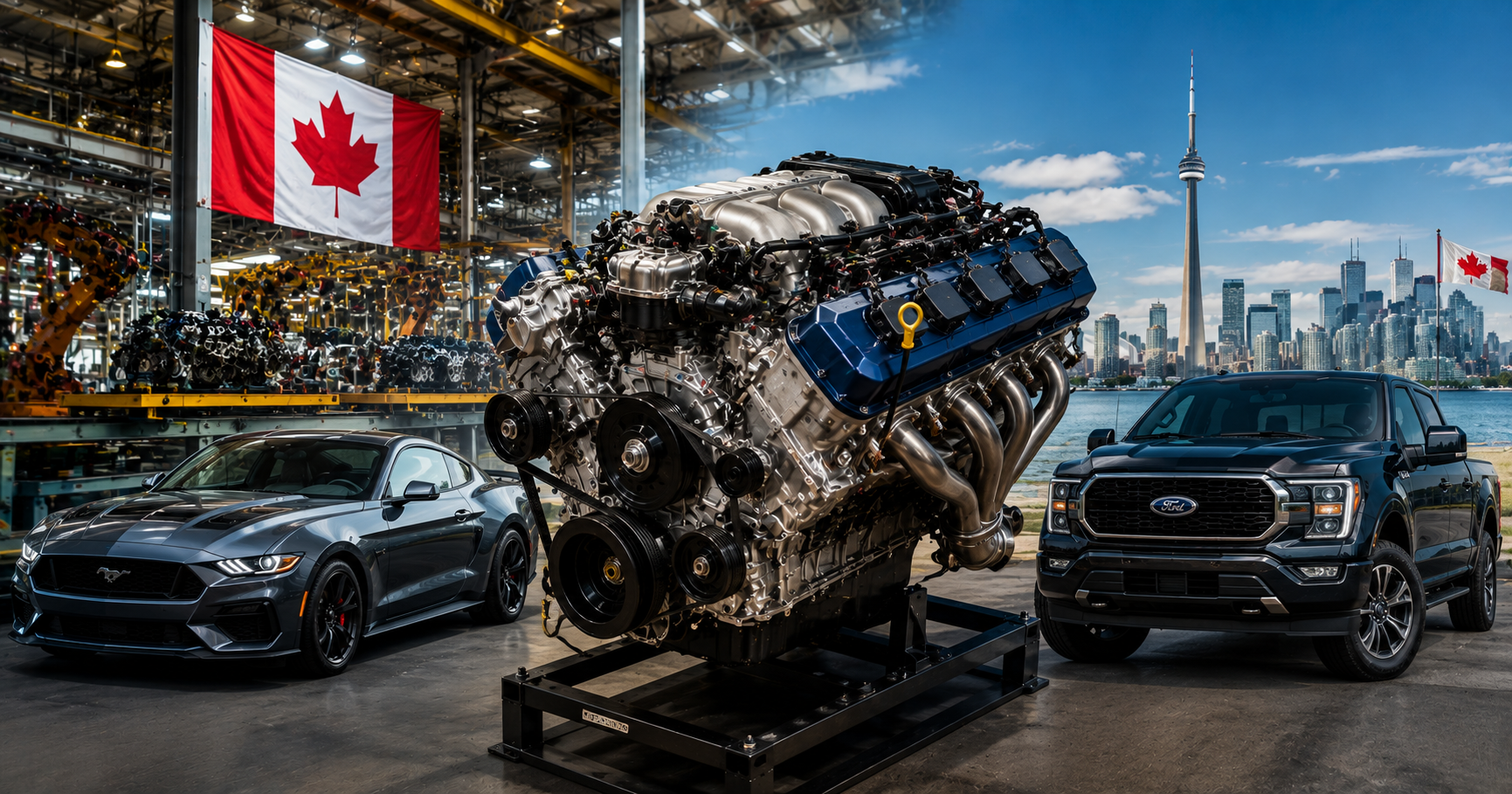
Ford is signaling continued demand for V8 engines by expanding production plans in Canada following a new three-year labor agreement with Unifor. The agreement includes higher wages, improved pension benefits, and provisions that point to increased V8 engine production at Ford’s Canadian facilities.
New Labor Agreement Covers 5,000 Canadian Workers
Ford and Unifor, the union representing approximately 5,000 Canadian auto workers, have reached a three-year labor agreement.
The contract provides a 9% wage increase, enhanced pension benefits, and ratification bonuses of $7,090 for full-time employees and $1,419 for temporary workers. The agreement also keeps the Canadian facilities operating over the next three years.
Ford Plans to Increase V8 Engine Production
According to a report by CarBuzz, Ford’s negotiations indicate continued demand for V8 engines, with future production expected to be supported by its Canadian manufacturing operations.
The agreement projects the addition of a third shift at the Essex Engine Plant beginning in 2029, reflecting Ford’s plans to expand V8 production capacity.
The Essex Engine Plant builds the 5.0-liter Coyote V8, while the Windsor Engine Plant produces the 6.8-liter V10 and 7.3-liter V8 engines.
Ford continues to manufacture V8 engines in the United States, including the supercharged 5.2-liter V8 used in the Mustang GTD and the F-150 Raptor R at its Dearborn, Michigan, facility.
Romeo Engine Plant Expected to Remain Closed
According to CarBuzz, industry analyst Sam Fiorani said Ford’s Romeo Engine Plant in Michigan, which ceased operations in 2022, is expected to remain closed.
Fiorani said the facility could reopen if tariffs or other trade conditions significantly changed the business case, although he described that scenario as unlikely.
As a result, the Essex Engine Plant is expected to handle demand for the 5.0-liter Coyote V8, which powers the Mustang, Mustang GT, Mustang Dark Horse, and certain Ford F-150 models.
V8 Engines Could Play a Role in Future Hybrids
Fiorani also said V8 engines could be paired with high-torque electric motors as an alternative to diesel powertrains.
“A plug-in hybrid Super Duty, for example, could pair a gasoline V8 with high-torque electric motors to deliver the towing capability customers expect while reducing emissions and avoiding the growing cost and complexity of modern diesel emissions systems,” Fiorani said.
The same concept could also be applied to the Ford F-150 using either a Canadian-built V8 or a V6 produced in Lima, Ohio, according to the article.
Potential Impact on Other Ford Facilities
The article notes that expanding V8 production in Canada could affect manufacturing at other Ford engine plants.
According to Fiorani, increased production in one area may result in reduced output elsewhere. The report states that Ford’s Chihuahua Engine Plant in Mexico, which builds diesel engines, could experience lower production volumes.
The new labor agreement and planned production changes indicate that Ford expects continued demand for V8 engines while maintaining its broader electrification efforts.