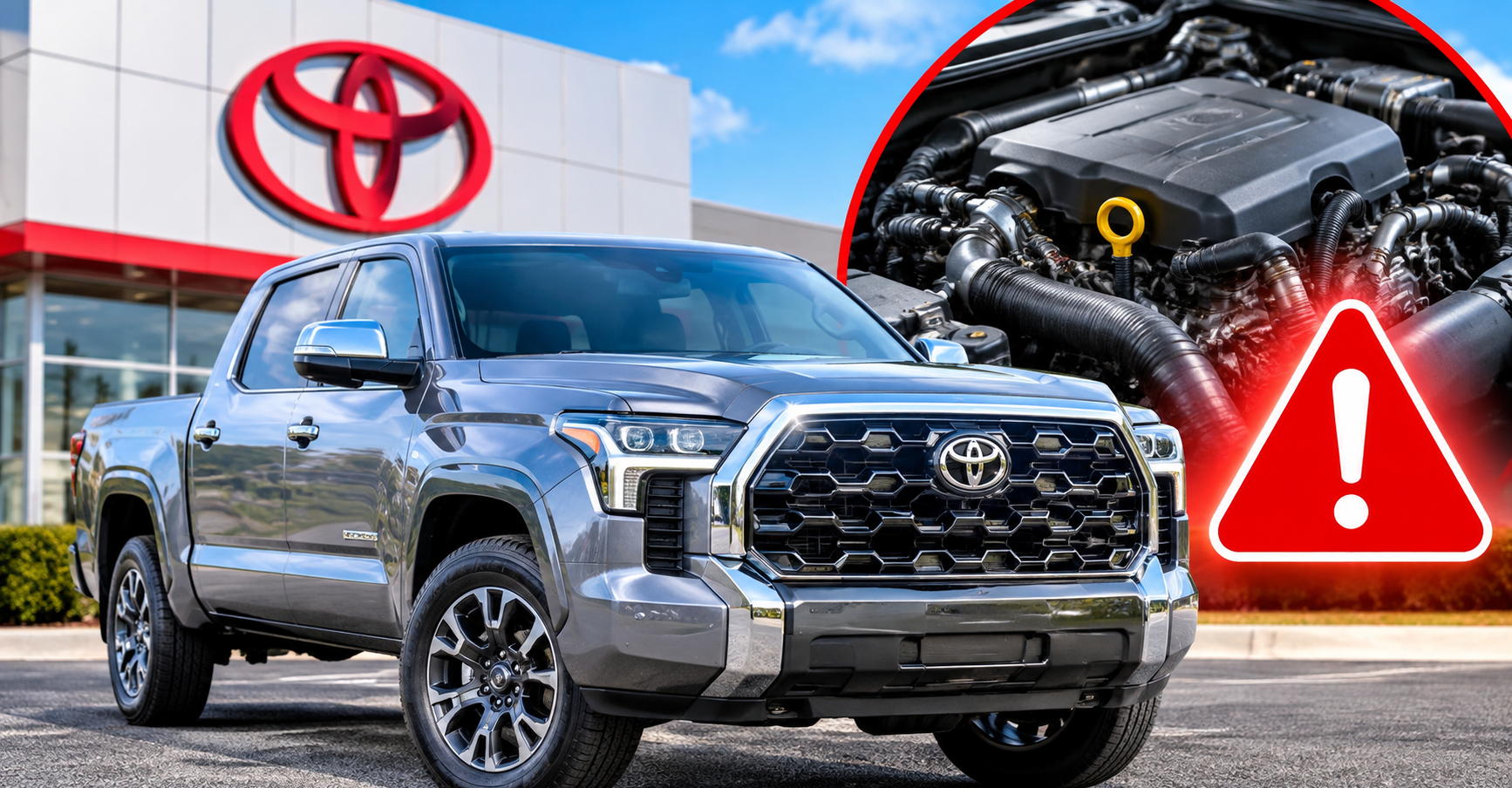
More than 62,000 Toyota Tundra pickup trucks in the United States are facing a potentially serious engine-related safety issue that could leave drivers without power while traveling on busy roads or highways. The problem involves a potentially defective engine camshaft that may crack and eventually break, raising concerns about unexpected engine stalling and the possibility of an accident.
The Toyota Vehicle Safety Recall NHTSA announcement covers approximately 62,490 trucks from the 2022, 2023, 2025, and 2026 model years. Although Toyota does not expect every recalled vehicle to contain the defective component, the potential consequences of an engine failure make the recall particularly important for owners.
Under recall campaign number 26V750, Toyota is asking owners of potentially affected vehicles to verify their vehicle identification numbers (VINs) and follow the manufacturer’s instructions for inspection. Authorized Toyota dealerships will examine the relevant engine components and replace an affected camshaft when necessary, without charging customers for the recall-related repair.
For Tundra owners, the most important question is whether their particular truck is included. Understanding the mechanical problem, recognizing possible warning signs, and knowing how to check recall eligibility can help drivers make informed decisions before an unexpected mechanical failure occurs.
What Is the Toyota Vehicle Safety Recall NHTSA Announcement About?
The latest Toyota Tundra recall addresses a manufacturing defect involving a specific production lot of engine camshafts. These components are essential to normal engine operation because they help control the opening and closing of the engine’s intake and exhaust valves.
According to the recall information provided to federal safety regulators, certain camshafts may not have been manufactured to the required specifications. The defect could cause cracks to develop during normal engine operation.
If a crack progresses, the camshaft could eventually break. Such a failure could interfere with the engine’s ability to operate properly and potentially cause it to stall while the vehicle is moving.
The possibility of sudden power loss is the primary safety concern. A pickup truck traveling at highway speeds may become difficult to control or maneuver safely if its engine unexpectedly stops producing power.
Key Details of the Toyota Tundra Recall
- Manufacturer:Toyota Motor Corporation.
- Affected vehicle: Selected Toyota Tundra pickup trucks.
- Model years: 2022, 2023, 2025, and 2026.
- Estimated vehicles involved: Approximately 62,490.
- Recall campaign number: 26V750.
- Defective component: Engine camshaft.
- Potential consequence: Engine failure, stalling, and sudden loss of power.
- Remedy: Inspection and replacement of an affected camshaft when necessary.
- Repair cost: Free for owners under the recall program.
- Owner notification: Expected by mid-January 2027.
One important distinction is that the recall population does not necessarily represent the number of trucks with defective camshafts. Toyota estimates that approximately 300 potentially affected camshafts may have been installed in the vehicles covered by the campaign.
This means the manufacturer must identify which vehicles actually contain components from the potentially defective production lot rather than assuming that every truck included in the recall population has the same mechanical problem.
Which Toyota Tundra Model Years Are Included in the Recall?
The recall covers selected gasoline-powered, non-hybrid Toyota Tundra trucks from four model years. However, owners should understand that the campaign does not automatically include every vehicle manufactured or sold during those years.
The affected model years are:
2022 Toyota Tundra
The 2022 Tundra is among the vehicles covered by the recall. As the first model year of the redesigned third-generation Tundra, it introduced a substantially updated platform and new powertrain configurations.
Owners of 2022 trucks should check their VINs rather than relying on the model year alone. The presence of a potentially affected camshaft depends on the specific manufacturing history of the vehicle.
2023 Toyota Tundra
Certain 2023 Tundra pickup trucks are also included in the safety campaign. Although these vehicles share much of their underlying engineering with the previous model year, the recall concerns a specific production lot of engine components.
Consequently, two trucks from the same model year may have different recall statuses. One could require an inspection while another may not be included.
2025 Toyota Tundra
Selected 2025 Tundra models are included in the campaign as well. The presence of a newer model year does not necessarily eliminate the possibility of a manufacturing-related component defect.
For owners of these pickups, checking the vehicle identification number is the most reliable way to determine whether the truck is subject to an open recall.
2026 Toyota Tundra
The 2026 Tundra is the newest model year identified in the recall information. Owners of potentially affected trucks should pay particular attention to manufacturer notifications and official recall updates.
As with the other model years, eligibility depends on the individual vehicle rather than simply the year displayed on its registration documents.
Why Is the Toyota Tundra Engine at Risk of Failure?
Understanding the mechanical problem helps explain why Toyota and federal safety regulators consider this issue important.
The affected component is the engine camshaft, a rotating mechanical part responsible for coordinating valve operation. Although it is not usually visible during routine vehicle inspections, it plays a critical role in keeping an internal combustion engine running correctly.
What Does an Engine Camshaft Do?
An internal combustion engine needs to bring air into its cylinders and release exhaust gases after combustion. This process depends on valves opening and closing at precisely controlled moments.
The camshaft contains specially shaped sections called lobes. As the camshaft rotates, these lobes interact with the engine’s valve-operating mechanism, helping determine when individual valves open and close.
The timing and movement of these components must remain coordinated with the engine’s other rotating parts. If the camshaft becomes damaged, the engine may no longer operate as designed.
In a modern pickup truck, this can affect engine performance, smooth operation, and the ability to maintain power under different driving conditions.
How Can a Cracked Camshaft Cause Engine Stalling?
The defect identified in the Toyota recall involves camshafts that may develop cracks because of a manufacturing issue.
A crack can gradually become more serious as the component experiences repeated mechanical stress during engine operation. If the damaged camshaft eventually breaks, it may prevent the engine’s valve system from operating correctly.
This can lead to several possible outcomes:
- Irregular engine operation caused by disrupted valve timing.
- Reduced engine performance and unexpected power loss.
- Abnormal mechanical noises or engine vibrations.
- Engine malfunction or misfiring.
- Potential engine stalling while driving.
The most significant concern is that a failure could happen while the vehicle is being driven rather than while it is parked.
For example, imagine a Tundra traveling along an interstate highway with traffic moving at normal highway speeds. If the engine suddenly stalls, the driver may have less ability to accelerate and maintain the truck’s previous performance.
Although the driver may still be able to steer and apply the brakes, losing engine power in moving traffic can create a hazardous situation, particularly when other vehicles are following closely.
Does the Recall Mean All 62,490 Toyota Tundra Trucks Have Defective Engines?
No. This is one of the most important details for owners to understand.
The estimated 62,490 vehicles represent the potential recall population, not the confirmed number of trucks containing defective camshafts.
Toyota’s information identifies a particular production lot of camshafts supplied by one manufacturer. Approximately 300 potentially affected components are estimated to have been installed in vehicles covered by the campaign.
As a result, the inspection process is designed to determine whether an individual truck actually contains a camshaft from the potentially defective production lot.
This distinction is important for several reasons.
- Recall population: The number of vehicles potentially involved in the safety campaign.
- Defective components: The smaller estimated number of camshafts that may have the manufacturing issue.
- Confirmed affected vehicles: Vehicles identified through the manufacturer’s inspection and identification process.
Owners should therefore avoid assuming that their truck is defective simply because it belongs to one of the listed model years.
At the same time, the relatively small estimated number of potentially defective components does not mean the recall can be ignored. Even a limited number of component failures can create a significant safety concern when the potential consequence is sudden engine failure on public roads.
What Are the Warning Signs of a Faulty Toyota Tundra Engine?
Not every vehicle involved in the recall will necessarily display symptoms before a component fails. Nevertheless, drivers should pay attention to unusual engine behavior and avoid dismissing warning signs as ordinary vehicle wear.
Potential symptoms of engine or camshaft-related problems may include the following:
1. Check Engine Warning Light
An illuminated check engine light can indicate that the vehicle’s engine management system has detected an abnormal operating condition.
The warning may be associated with various engine problems, including misfires or irregular engine performance. However, the light alone cannot confirm that the specific camshaft manufacturing defect identified in this recall is present.
A professional diagnostic inspection is necessary to determine the underlying cause.
2. Unusual Engine Knocking or Mechanical Noise
New or unusual mechanical sounds should never be ignored, particularly if they become more noticeable as engine speed increases.
Knocking, ticking, or other abnormal noises may indicate a mechanical problem. Although these sounds can have several causes, they deserve attention when they occur alongside other performance issues.
3. Rough Idling and Engine Vibrations
A properly functioning engine should generally operate smoothly under normal conditions.
If a Tundra begins vibrating excessively, running unevenly, or struggling to maintain a stable idle, the owner should arrange a professional inspection.
These symptoms can be associated with several different engine and ignition problems and should not automatically be attributed to the recall defect.
4. Engine Misfires
Engine misfires occur when combustion does not happen as expected in one or more cylinders.
Drivers may notice hesitation, reduced acceleration, uneven operation, or a noticeable loss of smoothness.
Because the camshaft helps coordinate valve operation, a serious camshaft-related problem could affect normal engine performance.
5. Sudden Loss of Engine Power
Unexpected power reduction is among the most concerning symptoms for any pickup truck driver.
A Tundra that suddenly struggles to accelerate or maintain normal engine operation should be treated as a potential safety concern.
Drivers experiencing a severe loss of power should prioritize getting to a safe location and arranging professional assistance rather than continuing to drive normally.
6. Unexpected Engine Stalling
An engine that shuts down unexpectedly while moving requires immediate attention.
Stalling can have multiple causes, but it is particularly important in the context of a recall involving a component that could potentially cause engine failure.
Owners should contact Toyota or an authorized dealership for guidance and avoid operating a vehicle that may be unsafe.
How Will Toyota Fix the Tundra Camshaft Problem?
Toyota’s recall remedy involves inspecting the relevant engine camshaft to determine whether it belongs to the potentially defective production lot.
The inspection will be performed by authorized Toyota dealership technicians. If the potentially affected component is identified, the dealership will replace it without charging the owner for the recall-related repair.
What Happens During the Dealership Inspection?
The process is intended to establish whether the vehicle contains the specific camshaft associated with the manufacturing issue.
Although the exact procedures may depend on the vehicle and Toyota’s technical instructions, the general process includes:
- Vehicle identification: The dealership verifies the truck’s VIN and recall eligibility.
- Technical inspection: Qualified technicians examine the relevant engine component using Toyota’s prescribed procedures.
- Component identification: The inspection determines whether the installed camshaft belongs to the potentially defective production lot.
- Replacement when necessary: An affected camshaft is replaced under the recall program.
- Completion documentation: The dealership records the completed recall service according to Toyota’s procedures.
Owners should contact their dealership before visiting to confirm the inspection arrangements and whether any additional instructions apply to their vehicle.
Will Toyota Charge Owners for the Repair?
No. Toyota’s announced recall remedy provides the required inspection and replacement of the affected camshaft at no cost to eligible vehicle owners.
This is an important distinction between a manufacturer safety recall and an ordinary repair appointment.
When a problem is covered by an official safety recall, the manufacturer is responsible for providing the specified remedy under the recall program’s terms.
Owners should ask the dealership to confirm that the work is being processed under recall campaign 26V750 rather than as a separately billed maintenance or repair service.
When Will Toyota Notify Affected Tundra Owners?
Toyota has indicated that notification letters for owners of potentially affected vehicles are expected by mid-January 2027.
These letters are intended to explain the nature of the defect, identify the recall campaign, and provide instructions for arranging the necessary inspection.
However, waiting for a physical notification letter is not the only way to find out whether a truck may be affected.
Vehicle owners can use the official National Highway Traffic Safety Administration recall database or Toyota’s recall lookup service to check their vehicles directly.
This is particularly useful for drivers who have moved recently, purchased a used Tundra, or may not receive manufacturer communications at their current address.
How to Check If Your Toyota Tundra Is Included in the NHTSA Recall
The most reliable way to determine whether an individual vehicle is subject to an open safety recall is to search using its vehicle identification number.
A VIN is a unique 17-character identifier assigned to a vehicle. Unlike the model year or vehicle trim, it allows recall databases to identify a specific truck.
Step-by-Step VIN Recall Check
- Find your VIN: Locate the 17-character vehicle identification number. It is commonly displayed on the driver’s side dashboard near the windshield and on the driver’s door-jamb label. It may also appear on registration and insurance documents.
- Open the official NHTSA website: Visit NHTSA.gov/recalls.
- Enter your VIN: Type the complete 17-character identification number into the recall search field.
- Review the results: Check whether the database identifies an outstanding safety recall associated with your truck.
- Contact Toyota: If the vehicle is affected, contact an authorized dealership to arrange the required inspection and repair.
Owners can also use Toyota’s official manufacturer recall lookup service:
For additional assistance, Toyota owners in the United States can contact the Toyota Brand Engagement Center at 1-800-331-4331.
Why Is a VIN Check More Important Than Checking the Model Year?
It may seem logical to assume that every 2022 or 2023 Toyota Tundra is affected because those model years appear in the recall announcement.
However, automotive safety recalls frequently involve specific manufacturing periods, production batches, component suppliers, or vehicle configurations.
Two trucks that look almost identical and were manufactured in the same year may have different recall statuses.
For example, one 2025 Tundra could contain a camshaft from the potentially defective production lot, while another vehicle from the same year could have a component produced outside that lot.
A VIN-based lookup is therefore more useful than relying on a general model-year list.
Does the Toyota Tundra Recall Affect Hybrid Models?
The recall information identifies the affected population as certain non-hybrid Toyota Tundra vehicles.
This distinction matters because the Tundra lineup includes different powertrain configurations. The conventional gasoline-powered models and hybrid versions do not necessarily share identical component arrangements or recall eligibility.
Owners should not assume that their vehicle is automatically included or excluded based solely on the powertrain badge.
Instead, they should use the VIN lookup services provided by Toyota and NHTSA to establish the vehicle’s actual recall status.
It is also important to remember that a recall affecting a particular engine component does not automatically mean every vehicle equipped with a similar engine has the same manufacturing defect.
What Should Toyota Tundra Owners Do Before Their Recall Appointment?
Once an owner discovers that a vehicle may be affected, the next step is to contact an authorized Toyota dealership and follow the manufacturer’s instructions.
There are several practical steps that can make the process easier and help owners avoid unnecessary delays.
Confirm the Recall Status
Start by checking the VIN through the NHTSA or Toyota recall website. Keep a record of the recall information displayed for the vehicle.
If the online result is unclear, contact Toyota directly and ask the dealership to verify eligibility using its manufacturer systems.
Schedule an Inspection
Contact an authorized Toyota dealership to arrange an appointment.
When speaking with the service department, mention recall campaign 26V750 and ask whether the required inspection can be performed at the scheduled visit.
It is also reasonable to ask how long the inspection may take and whether the dealership expects to have the necessary replacement components available if the camshaft is identified as affected.
Describe Any Unusual Engine Symptoms
If the truck has experienced unusual noises, warning lights, rough operation, misfires, or unexpected power loss, explain those symptoms to the service advisor.
Providing details about when the symptoms occur can help technicians understand the issue and determine whether additional diagnostic work is necessary.
Keep Recall Service Records
After the inspection or repair, keep the dealership documentation with the vehicle’s maintenance records.
These documents can be useful when selling the truck, discussing future service requirements, or demonstrating that the recall work has been completed.
Is It Safe to Continue Driving a Toyota Tundra Under This Recall?
This is a reasonable question for owners who rely on their trucks for commuting, work, towing, and long-distance travel.
The recall information identifies a potential risk of camshaft failure and sudden engine power loss. However, it does not establish that every truck included in the recall population is defective or that every vehicle will experience a failure.
Owners should therefore avoid making assumptions about the safety of their individual vehicle.
The most appropriate course of action is to check the VIN, contact Toyota, and follow any driving instructions provided by the manufacturer or an authorized dealership.
If the vehicle is experiencing serious engine symptoms, particularly stalling or a sudden loss of power, drivers should not continue operating it as though nothing is wrong.
Instead, they should move to a safe location when possible and seek professional assistance.
When a mechanical issue has the potential to affect vehicle operation at highway speeds, taking a cautious approach is more important than avoiding a dealership visit or delaying an inspection.
Why This Toyota Recall Matters to Pickup Truck Owners
The Toyota Tundra is an important model in the full-size pickup segment, competing with established trucks from manufacturers such as Ford, Chevrolet, GMC, and Ram.
Many owners choose the Tundra because they expect a combination of durability, towing capability, everyday usability, and long-term dependability.
For buyers and existing owners, an engine-related safety recall naturally raises questions about reliability and maintenance costs.
However, it is important to distinguish between a specific manufacturing defect and a conclusion about the reliability of an entire vehicle lineup.
A recall identifies a safety issue that requires a manufacturer’s attention. It does not automatically establish that every vehicle of the same model has a widespread mechanical problem.
How a Manufacturing Defect Differs From Normal Engine Wear
Engine components experience mechanical stress during normal operation. Over time, ordinary wear can affect moving parts, especially in vehicles subjected to heavy use, high temperatures, or demanding driving conditions.
A manufacturing defect is different. It involves a problem associated with how a component was produced or supplied, potentially causing it to fail earlier than expected.
In this case, the recall concerns camshafts from a specific supplier production lot that may develop cracks and eventually break.
That is why replacing an affected component through an official recall program is important. Routine oil changes and normal maintenance cannot necessarily correct an underlying manufacturing defect.
Why Recall Awareness Matters When Buying a Used Tundra
The announcement is also relevant to people considering purchasing a used 2022, 2023, 2025, or 2026 Toyota Tundra.
A used vehicle may have changed owners several times, and a prospective buyer may not know whether the previous owner received every manufacturer notification.
Before completing a purchase, buyers should:
- Check the vehicle’s VIN through the official NHTSA recall database.
- Ask the seller whether any open recalls remain outstanding.
- Request documentation for previously completed recall repairs.
- Confirm the recall status directly with a Toyota dealership.
- Arrange a professional pre-purchase inspection when appropriate.
An outstanding safety recall does not automatically mean a vehicle should never be purchased. However, buyers should understand the required remedy and confirm how the issue will be addressed before making a final decision.
What Is the Difference Between an NHTSA Recall and a Toyota Service Bulletin?
Vehicle owners sometimes encounter different types of manufacturer notices and may not understand how they differ.
An official safety recall is intended to address a safety-related defect or noncompliance with applicable federal motor vehicle safety standards.
The National Highway Traffic Safety Administration oversees vehicle safety recalls in the United States and maintains a public database where consumers can search for recall information.
A technical service bulletin, by comparison, generally provides dealership technicians with information about a particular vehicle condition, diagnostic procedure, or repair recommendation.
A service bulletin does not automatically mean that a vehicle is subject to a safety recall, and the existence of a technical bulletin does not necessarily provide the same free-repair coverage as an official recall.
For owners affected by the Toyota Tundra campaign, the important reference is the official recall information associated with campaign number 26V750.
Frequently Asked Questions About the Toyota Vehicle Safety Recall NHTSA
1. How many Toyota Tundra trucks are included in the latest recall?
Approximately 62,490 Toyota Tundra pickup trucks in the United States are potentially involved in the recall. However, this does not mean all 62,490 vehicles contain defective camshafts.
2. Which Toyota Tundra model years are affected?
The recall covers selected non-hybrid Toyota Tundra vehicles from the 2022, 2023, 2025, and 2026 model years. Individual eligibility depends on the vehicle’s VIN and manufacturing history.
3. What is the NHTSA recall number for the Toyota Tundra engine problem?
The recall campaign number identified in the supplied recall information is 26V750. Owners should use the official NHTSA database to verify the current recall details for their vehicles.
4. What is wrong with the Toyota Tundra engine?
The problem involves an engine camshaft that may have been improperly manufactured. The component could develop cracks and eventually break, potentially disrupting engine operation and causing the vehicle to stall.
5. Can the Toyota Tundra engine suddenly lose power because of this defect?
Yes. A broken camshaft could interfere with normal engine operation and potentially cause a sudden loss of power or engine stalling while driving. This is the primary safety concern behind the recall.
6. Does the recall affect every 2022 Toyota Tundra?
No. Only selected vehicles are potentially involved. Owners should enter their 17-character VIN into the official NHTSA recall lookup or Toyota’s recall website to determine whether their specific truck is affected.
7. Are Toyota Tundra hybrid models included?
The recall information identifies the affected population as certain non-hybrid Tundra vehicles. Owners of hybrid models should still verify their individual VINs rather than making assumptions about recall eligibility.
8. Will Toyota replace the defective camshaft for free?
Yes. Toyota’s announced recall remedy includes inspection and replacement of the affected camshaft when necessary at no cost to the owner under the recall program.
9. When will Toyota send recall notification letters?
Toyota has indicated that notification letters are expected to be mailed to potentially affected owners by mid-January 2027. Owners can check their VINs before receiving a letter.
10. How can I check whether my Toyota Tundra has an open safety recall?
Visit the official NHTSA recall website and enter your vehicle’s 17-character VIN. You can also use Toyota’s official recall lookup service.
11. What should I do if my Toyota Tundra has engine problems?
If your truck experiences unusual mechanical noises, rough operation, warning lights, misfires, or sudden power loss, contact an authorized Toyota dealership. If the vehicle stalls or develops serious symptoms, move to a safe location when possible and arrange professional assistance rather than continuing to drive it normally.
12. Does an open recall affect the resale value of a Toyota Tundra?
An open safety recall can be a consideration for prospective buyers, but it does not automatically determine a vehicle’s market value. Buyers should verify the recall status, review repair documentation, and confirm whether the manufacturer has completed the required remedy.
13. Can I have the recall repaired at an independent repair shop?
The announced remedy is intended to be performed through authorized Toyota dealerships. Owners should contact Toyota for the official inspection and replacement procedure and to ensure the work is properly recorded as a completed recall repair.
Final Thoughts: Toyota Tundra Owners Should Check Their VINs
The latest Toyota Vehicle Safety Recall NHTSA announcement is an important safety development for owners of selected Tundra pickup trucks in the United States.
Although the estimated recall population reaches approximately 62,490 vehicles, Toyota’s information indicates that the number of potentially affected camshafts is significantly smaller. Nevertheless, the possibility of a cracked or broken engine camshaft creates a serious concern because it could lead to unexpected engine failure and loss of power while driving.
Owners of 2022, 2023, 2025, and 2026 Toyota Tundra trucks should not rely exclusively on their vehicle’s model year to determine whether action is necessary. Checking the VIN through NHTSA or Toyota is the most practical way to establish recall eligibility.
If a truck is included, owners should follow Toyota’s instructions and arrange the recommended dealership inspection. The manufacturer has announced that the inspection and replacement of an affected camshaft will be provided without charge under the recall program.
Ultimately, the most important step is straightforward: verify your vehicle’s recall status, pay attention to unusual engine behavior, and address any confirmed safety issue promptly. A few minutes spent checking a VIN could help prevent a potentially dangerous situation on the road.