
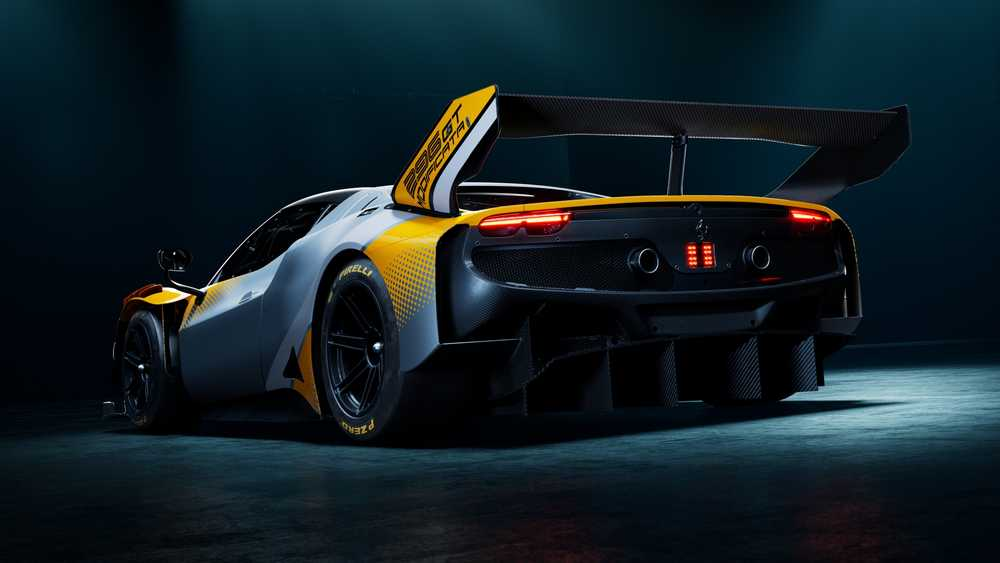
Ferrari has patented an unconventional aerodynamic device: an adjustable rear wing that extends while the car is moving without requiring electric motors or actuators. The design aims to deliver greater downforce while allowing the wing to return to a position that meets crash safety requirements.
Why Ferrari Wants a Different Rear Wing Design
Ferrari’s patent explains how rear wings work alongside underbody diffusers. The two components are most effective when they have minimal vertical and horizontal separation, with the wing extending over and behind the diffuser without anything positioned between them.
Achieving that arrangement can require the wing to extend considerably beyond the rear of the car. However, that positioning creates challenges for crash safety regulations.
Ferrari explains that the wing must be mounted over the trunk lid because of a crash test involving a pendulum striking the rear bumper. If the pendulum or its arm contacts the wing first, the wing must function as part of the vehicle’s crash structure.
As a result, conventional wings are positioned several inches farther forward than aerodynamic designers would prefer.
How Ferrari’s Self-Adjusting Wing Works
Ferrari’s solution gives the wing two positions. In the first, it sits forward over the rear of the car, where it complies with safety requirements. In the second, it extends farther beyond the rear, placing it in the airflow for greater aerodynamic effectiveness.
The mechanism does not require motors or actuators. When the car is stationary, the wing remains fully retracted. It is mounted loosely in slots, allowing airflow to push it backward as the vehicle accelerates.
Once the wing reaches the end of its travel, it sits farther out in clear air, where it can generate maximum aerodynamic effect.
A Spring Mechanism Returns the Wing After an Impact
The design also allows the wing to respond to a rear-end collision. An impact pushes it forward into its retracted, safety-compliant position.
Ferrari says even a person bumping into the wing can make it snap forward. A string and coil spring pull the component back into place, using a mechanism similar to the spring found on a screen door.
The wing consists of three sections: one inner segment and two outer segments. Each section moves along its own track, meaning an impact to just one part can push that section forward without requiring the other two to move.
Ferrari’s Design Avoids Motors and Actuators
By relying on sliding tracks, a string and a coil spring, Ferrari’s proposed design avoids the need for powered adjustment systems. The company says the mechanism would be easy to manufacture and relatively economical.
The patented concept combines an extended aerodynamic position for driving with a retractable design that moves forward when struck, offering a mechanical approach to adjustable downforce and crash safety.