
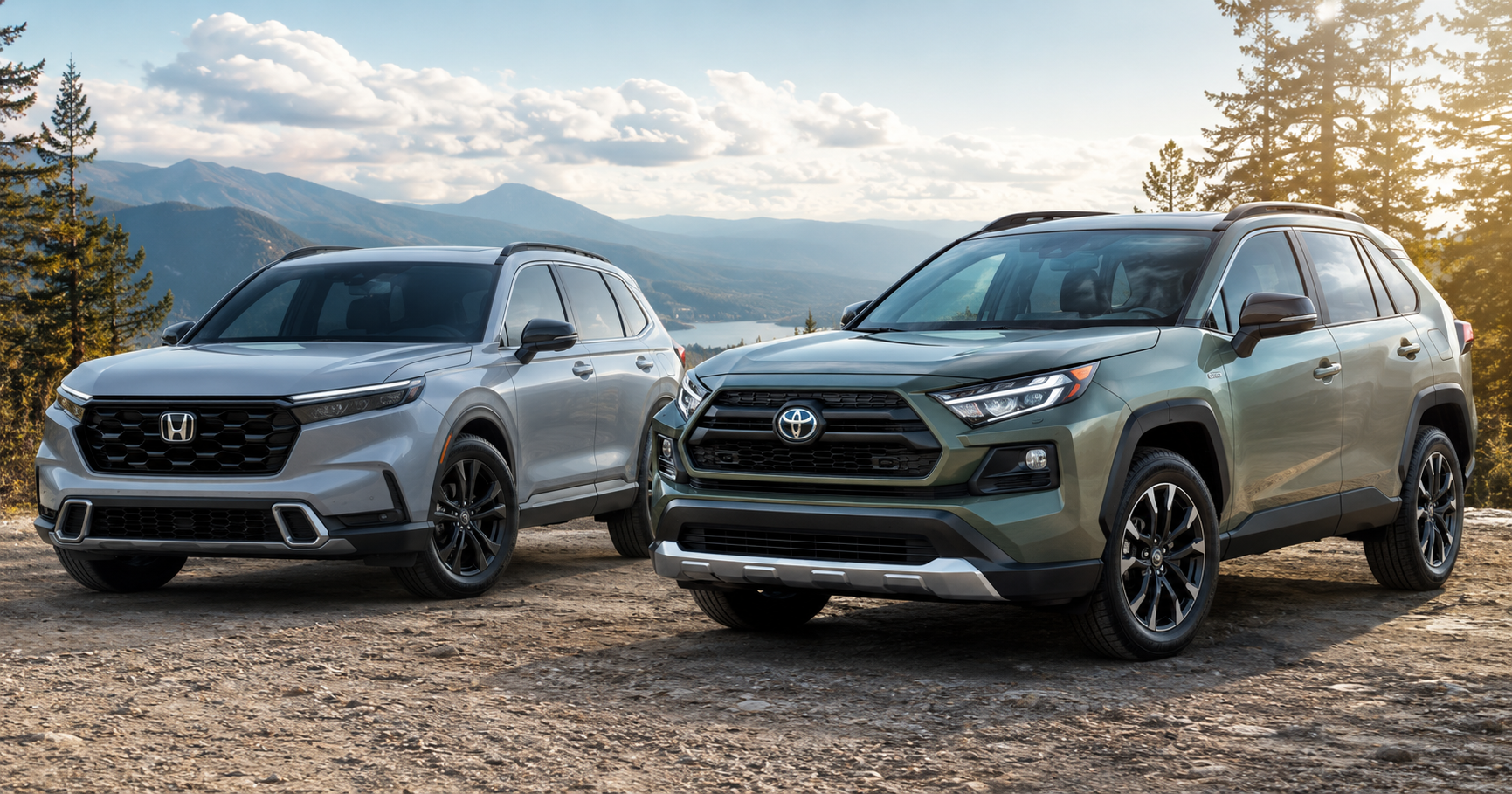
The battle between the Honda CR-V and Toyota RAV4 has become one of the most important matchups in the American SUV market. These two compact SUVs consistently rank among the best-selling non-pickup vehicles in the United States, and for good reason. Both offer strong reliability, impressive fuel economy, practical interiors, and advanced safety technology.
But when it comes to the real-world decision of honda crv vs toyota rav4, the differences matter more than ever in 2026. Toyota has fully electrified the new RAV4 lineup with hybrid and plug-in hybrid options only, while Honda continues offering both gas and hybrid CR-V models for buyers who want more flexibility.
For families, commuters, and long-distance drivers alike, choosing between these SUVs comes down to priorities: comfort or efficiency, space or power, simplicity or advanced electrification.
2026 Honda CR-V vs Toyota RAV4 Overview
The 2026 CR-V and RAV4 approach the compact SUV formula differently. Honda focuses heavily on ride comfort, cabin refinement, and interior practicality. Toyota emphasizes hybrid efficiency, stronger performance, and rugged styling.
| Category | 2026 Honda CR-V | 2026 Toyota RAV4 |
|---|---|---|
| Starting Price | Approx. $32,370 | Approx. $33,350 |
| Base Engine | 1.5L Turbo I4 | 2.5L Hybrid |
| Hybrid Power | 204 hp | 226–236 hp |
| PHEV Option | No | Yes |
| Max Cargo Space | 76.5 cu-ft | 70.4 cu-ft |
| Fuel Economy | 40–43 MPG Hybrid | 47–48 MPG Hybrid |
| Passenger Volume | Up to 106 cu-ft | 98.9 cu-ft |
Performance and Driving Experience
Honda CR-V: Smooth and Comfortable
The 2026 Honda CR-V continues Honda’s tradition of building SUVs that feel refined and easy to live with every day. The suspension tuning favors comfort over sportiness, making the CR-V one of the quietest and smoothest compact SUVs on the road.
Drivers who spend hours commuting or taking family road trips will likely appreciate the CR-V’s relaxed personality. The steering feels predictable, visibility is excellent, and the cabin insulation reduces highway noise noticeably better than many competitors.
The available hybrid system produces 204 horsepower, which is enough for confident daily driving, though it does not feel especially fast.
Toyota RAV4: More Power and Efficiency
Toyota takes a different approach with the 2026 RAV4. Since every RAV4 is now electrified, buyers automatically get the benefits of hybrid torque and better fuel economy.
The standard hybrid produces between 226 and 236 horsepower depending on drivetrain configuration, while the plug-in hybrid variant delivers up to 320 horsepower. That makes the RAV4 significantly quicker than the CR-V.
Drivers looking for stronger acceleration, towing confidence, or better fuel savings may find the RAV4 more appealing.
Interior Comfort and Technology
CR-V Prioritizes Cabin Space
Inside, the CR-V feels open and practical. Honda designed the SUV with family usability in mind, and it shows in the second-row legroom and cargo layout.
- More rear-seat space
- Larger cargo area
- Comfort-focused seating
- Quiet highway ride
- Excellent outward visibility
The dashboard layout is simple and intuitive, though the standard 9-inch touchscreen is smaller than what Toyota offers.
RAV4 Adds Larger Screens and Rugged Styling
Toyota upgraded the 2026 RAV4 interior with larger infotainment displays, including a 12.9-inch touchscreen on higher trims. The cabin design feels more rugged and modern, especially in Woodland and GR Sport trims.
However, some trims still use harder plastics compared to the more upscale feel of the CR-V.
Which is bigger Toyota RAV4 or Honda CR-V?
The Honda CR-V is clearly the larger SUV overall. It is several inches longer than the RAV4 and offers more passenger volume and cargo capacity.
That extra room becomes noticeable for families with child seats, taller passengers, or frequent road trips. The CR-V also provides more maximum cargo space with the rear seats folded.
For shoppers prioritizing practicality, the CR-V holds a meaningful advantage.
Honda CR-V vs Toyota RAV4 Maintenance Cost
Both SUVs have relatively low ownership costs compared to most compact crossovers, but the Toyota RAV4 tends to be slightly cheaper to maintain over five years.
Estimated five-year maintenance costs:
The difference is modest, but Toyota’s extensive hybrid experience and long battery warranty improve long-term ownership confidence.
Honda CR-V vs Toyota RAV4 Price
The 2026 Honda CR-V starts slightly lower than the Toyota RAV4. Entry-level CR-V models begin around $32,370, while the RAV4 starts closer to $33,350.
However, pricing becomes more competitive in hybrid AWD trims. Fully loaded versions of either SUV can exceed $45,000 depending on equipment and drivetrain choices.
Value depends largely on what buyers prioritize. The CR-V delivers more interior room for the money, while the RAV4 includes standard hybrid technology.
Honda CR-V vs Toyota RAV4 Which Is More Reliable?
Reliability remains a major reason why these SUVs dominate the market.
The Toyota RAV4 generally earns a slight edge thanks to Toyota’s long history with hybrid systems and strong resale values. The company’s hybrid battery coverage also improves consumer confidence.
That said, the Honda CR-V also scores extremely well in reliability studies and owner satisfaction surveys. Honda’s hybrid system has improved substantially over recent generations.
In practical terms, both SUVs are considered among the safest long-term bets in the compact SUV segment.
Fuel Economy Comparison
Fuel economy is one of the biggest reasons buyers consider the RAV4.
The 2026 Toyota RAV4 Hybrid achieves roughly 47–48 MPG combined, making it one of the most efficient SUVs in its class.
The CR-V Hybrid remains competitive at approximately 40–43 MPG combined, but Toyota’s fully electrified strategy gives it the advantage here.
For high-mileage drivers, that difference can translate into meaningful fuel savings over time.
Which SUV Is Better for Families?
Families shopping for a compact SUV often care more about daily comfort than outright performance.
In that area, the CR-V excels.
Its larger rear seat, smoother ride, and bigger cargo area make it especially practical for:
- Parents with young children
- Long-distance commuters
- Frequent travelers
- Drivers who prioritize comfort
The RAV4, meanwhile, appeals more to buyers who want:
- Better fuel economy
- Stronger acceleration
- Hybrid-only efficiency
- More rugged styling
- Off-road-oriented trims
Off-Road and Winter Driving
Both SUVs offer all-wheel drive and perform well in snow, but Toyota gives adventure-focused buyers more variety.
The RAV4 Woodland and GR Sport trims feature more rugged tires, suspension adjustments, and off-road-inspired styling. Drivers in colder climates or rural areas may appreciate those upgrades.
Honda counters with the new TrailSport-inspired CR-V Hybrid trim, though it remains more comfort-oriented overall.
Who Should Buy the 2026 Honda CR-V?
The CR-V is the better choice for buyers who prioritize:
- Interior space
- Ride comfort
- Quiet cabins
- Family practicality
- Traditional gas-engine availability
It feels more refined in everyday driving situations and offers one of the best cabin layouts in the compact SUV segment.
Who Should Buy the 2026 Toyota RAV4?
The RAV4 makes more sense for buyers who want:
- Best-in-class fuel economy
- More horsepower
- Hybrid or plug-in hybrid performance
- Higher resale value perception
- Outdoor-oriented trims
Toyota’s move to a fully electrified lineup positions the RAV4 as one of the most future-focused compact SUVs available in 2026.
Final Verdict: Honda CR-V vs Toyota RAV4
The honda crv vs toyota rav4 debate ultimately comes down to lifestyle priorities.
The Honda CR-V is arguably the better all-around family SUV thanks to its spacious cabin, smoother ride, and comfort-focused personality. It feels polished, practical, and easy to live with every day.
The Toyota RAV4, however, wins for buyers prioritizing efficiency, hybrid performance, and rugged versatility. Its stronger powertrains and excellent fuel economy make it especially attractive for long-distance drivers and eco-conscious shoppers.
Neither choice is wrong. Both SUVs remain among the smartest compact SUV purchases in America for 2026.
FAQ: Honda CR-V vs Toyota RAV4
Which is bigger, Toyota RAV4 or Honda CR-V?
The Honda CR-V is larger overall, offering more passenger room and greater cargo capacity than the Toyota RAV4.
Which is more fuel-efficient, the 2026 CR-V or RAV4?
The Toyota RAV4 Hybrid delivers better fuel economy, averaging around 47–48 MPG combined compared to roughly 40–43 MPG for the CR-V Hybrid.
Which is cheaper to maintain?
The Toyota RAV4 is slightly cheaper to maintain over five years, though both SUVs remain affordable compared to most competitors.
Which SUV is more reliable?
Both are highly reliable, but the Toyota RAV4 holds a slight edge due to Toyota’s hybrid expertise and strong warranty reputation.
Is the Honda CR-V better for families?
Yes. The CR-V generally offers more comfort, rear-seat space, and cargo practicality for family-focused buyers.
Does the 2026 Toyota RAV4 still offer gas-only models?
No. The 2026 Toyota RAV4 lineup is fully electrified, offering hybrid and plug-in hybrid powertrains only.