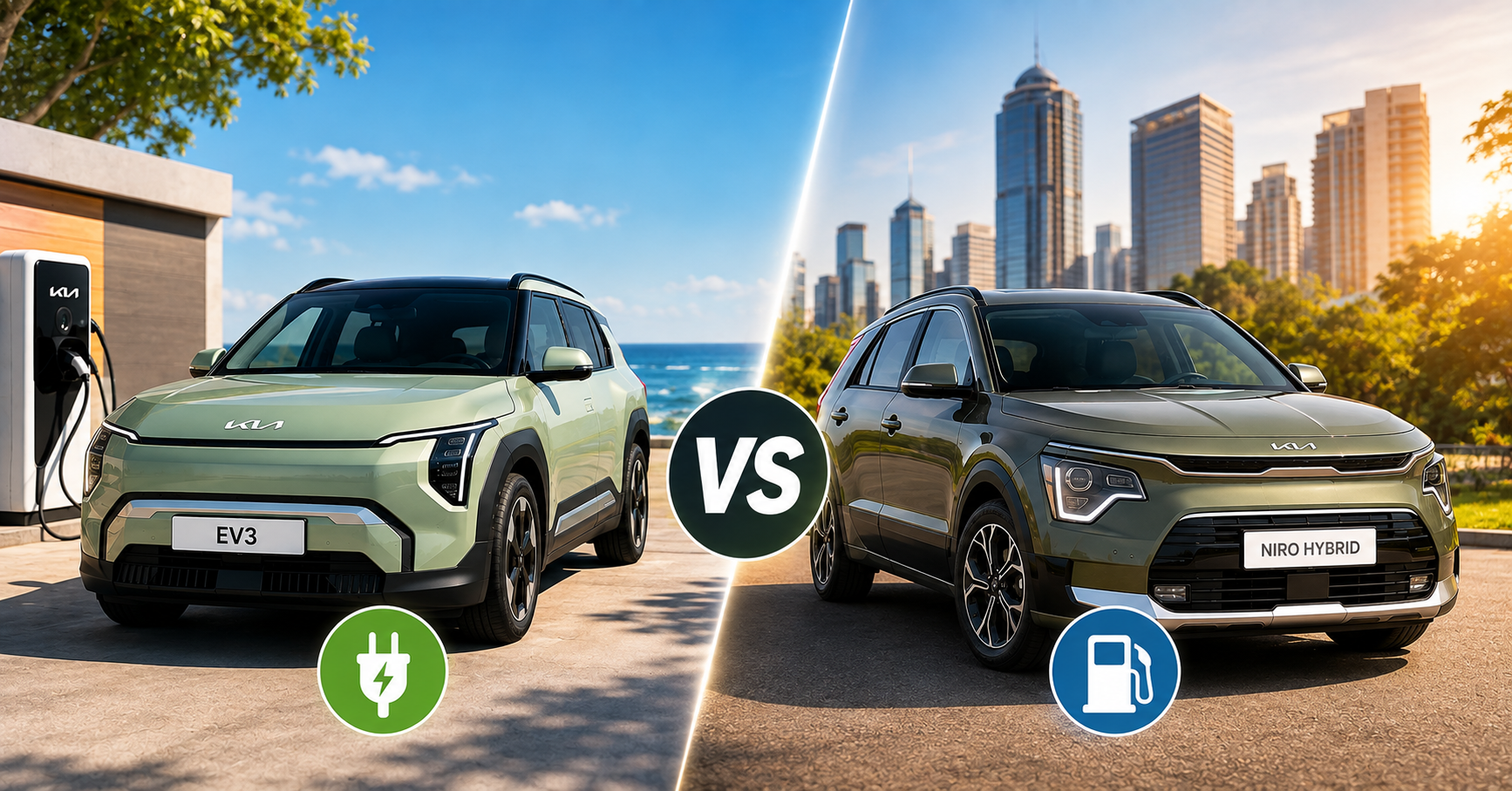
The Kia EV3 versus Niro Hybrid cost comparison is no longer a simple choice between an expensive EV and an affordable hybrid. Kia has created an unusually close price matchup: the new 2027 Kia EV3 enters the U.S. market at $29,890 before destination, while the 2026 Kia Niro Hybrid starts at $27,390. Once destination charges are included, the gap narrows further, putting two very different powertrains within striking distance of each other.
That makes the decision more complicated than simply asking which vehicle has the lower sticker price. The Niro Hybrid uses gasoline but delivers excellent fuel economy and a long driving range. The EV3 requires charging infrastructure but can deliver substantially lower energy costs per mile and eliminates tailpipe emissions.
The research behind this comparison was prepared by the Newest Cars editorial team, with pricing, efficiency, range and ownership considerations gathered from automotive sources including Kia, Car and Driver, MotorTrend, Edmunds, KBB, Cars.com, Carscoops and Electrek. The goal is not simply to identify the cheaper vehicle, but to explain where each one can save money—and where it can cost more.
Kia EV3 Versus Niro Hybrid Cost at a Glance
Before getting into ownership costs, it helps to understand what buyers are actually comparing. The 2026 Niro Hybrid is a conventional hybrid crossover, while the EV3 is a dedicated electric vehicle arriving as a 2027 model-year vehicle in the United States.
| Category | 2026 Kia Niro Hybrid | 2027 Kia EV3 Light |
|---|---|---|
| Starting MSRP | $27,390 | $29,890 |
| Approx. price with destination | $28,535 | $31,385 |
| Powertrain | 1.6-liter hybrid | Electric, 58.3-kWh battery |
| EPA range | 544–588 miles of gas range | 221 miles (Light) / 321 miles (Wind) |
| EPA efficiency | 49–53 mpg combined | About 3.5 miles/kWh estimated |
| Top reported trim price | Up to $37,285 | Up to $45,890 before destination for GT |
The basic numbers show why the Kia EV3 versus Niro Hybrid cost debate is interesting. The Niro is less expensive at the entry point, but the EV3 is close enough in price to make operating expenses a major part of the buying decision.
Kia has also discontinued the all-electric Niro in the U.S. market, effectively positioning the EV3 as its replacement in the brand’s affordable EV lineup. The EV3 also undercuts the retired Niro EV’s previous starting price by roughly $10,000.
The Biggest Difference: Purchase Price
If your priority is spending as little as possible on day one, the Niro Hybrid has the advantage.
The 2026 Niro Hybrid starts at $27,390. With an estimated destination charge included, the figure rises to roughly $28,535. The 2027 EV3 Light starts at $29,890, or about $31,385 including destination.
That puts approximately $2,850 between the two vehicles when comparing the reported destination-inclusive figures.
For a buyer financing a vehicle, that difference can matter. A lower purchase price means a smaller amount financed, potentially reducing monthly payments and the total interest paid over the life of the loan.
But there is a catch: the cheapest EV3 is not necessarily the EV3 that makes the most sense for every buyer.
The EV3 Light Has the Lowest Price, But Also the Shortest Range
The entry-level EV3 Light has a reported EPA range of 221 miles. Buyers who want the EV3’s more compelling 321-mile range need to move up to the Wind trim, which starts at $34,990 before destination.
That changes the financial equation considerably.
Someone comparing a base Niro Hybrid with a base EV3 is looking at a relatively small upfront difference. Someone comparing a Niro Hybrid with a 321-mile EV3 is looking at a much larger purchase-price gap.
This is one of the most important points in the Kia EV3 versus Niro Hybrid cost comparison:
trim selection can matter almost as much as powertrain choice.
Why the Niro Hybrid Can Still Be the Cheaper Choice
The Niro Hybrid’s biggest financial advantage is simplicity. You buy it, fill it with gasoline and drive. There is no need to install a home charger, learn public charging networks or plan longer trips around charging stops.
Its 1.6-liter hybrid powertrain is also designed around efficiency rather than outright performance. Depending on configuration, the Niro is rated at roughly 49 to 53 mpg combined, with the most efficient FE configuration achieving even higher economy figures in certain driving conditions.
Annual gasoline spending is estimated at around $1,250. Other estimates put the Niro’s driving expense at approximately $131 per month.
That is a relatively modest fuel bill for a vehicle that can potentially travel more than 500 miles between fill-ups.
Long Range Changes the Ownership Equation
The Niro Hybrid’s reported 544–588-mile gas range is one of its strongest practical advantages.
Even the 321-mile EV3 Wind does not match that distance on a single charge. The difference becomes particularly important for drivers who regularly travel long distances, live in areas where public charging is limited or do not have convenient access to overnight charging at home.
In those situations, the Niro can save more than money. It can save time.
A five-minute fuel stop is fundamentally different from planning a charging session, even though modern EV charging has become considerably faster. For some drivers, that convenience is worth more than the EV’s potential energy savings.
Where the Kia EV3 Can Save More Money
The EV3 reverses the financial argument once operating costs enter the picture.
An electric motor is substantially more efficient at converting stored energy into motion than a gasoline engine. Electricity prices can also produce a lower cost per mile than gasoline when an EV is charged at home, although the exact savings depend on local electricity rates and driving habits.
That distinction is critical. There is no single universal answer to the question, “How much cheaper is an EV3 to operate?”
A driver who charges at home during relatively inexpensive electricity periods could see attractive savings. Someone who relies heavily on public DC fast charging may experience much smaller savings because public charging can be significantly more expensive than home charging.
Home Charging Is the Key to EV3 Savings
For the EV3 to maximize its financial advantage, home charging is generally the most favorable setup.
Instead of repeatedly purchasing gasoline, the owner can replenish the battery at home. The exact cost depends on the local electricity rate, charging losses and how many miles the driver travels.
This means the EV3’s energy economics are highly personal.
- Low electricity rates: EV3 operating costs can become particularly attractive.
- High annual mileage: Energy savings can accumulate more quickly.
- Mostly home charging: Usually the strongest setup for maximizing EV savings.
- Frequent DC fast charging: Can reduce the financial advantage.
- Short daily commutes: Make overnight charging particularly convenient.
So, when analyzing Kia EV3 versus Niro Hybrid cost, buyers should look beyond the vehicle’s MSRP and calculate their own annual miles and local energy prices.
EV3 Charging Speed and Convenience
Charging is often presented as the biggest disadvantage of an electric vehicle, but the EV3 has several features designed to reduce that inconvenience.
The EV3 can charge from 10% to 80% in approximately 29 to 31 minutes when connected to a suitable 350-kW DC fast charger. It also comes with a native NACS port, allowing compatibility with Tesla Supercharger infrastructure without relying on an adapter.
That does not make the EV3 identical to a gasoline-powered Niro in terms of refueling time, but it does make long-distance EV ownership easier than it was for many earlier electric vehicles.
For daily driving, however, the more relevant question is not how quickly the EV3 can fast-charge. It is whether the owner can conveniently charge overnight.
If the answer is yes, the EV3 can effectively start each morning with a full or nearly full battery without making a trip to a gas station.
What About the Federal EV Tax Credit?
This is one area where buyers should be careful.
The research reports that the EV3 arrives without qualifying for the federal EV tax credit, while the Niro Hybrid generally does not qualify for federal EV credits because it is not a plug-in vehicle. Buyers should verify current IRS eligibility rules before including any federal incentive in their purchase calculations.
That means buyers should not automatically subtract $7,500 from the EV3’s price when calculating Kia EV3 versus Niro Hybrid cost.
State, local or utility incentives may also vary by location and eligibility. Those programs can change the equation, but they should be checked individually rather than assumed.
For a buyer who receives a meaningful local EV incentive, the EV3’s higher purchase price could become easier to justify. For someone receiving no incentives, the Niro retains its upfront-cost advantage.
Maintenance Costs: Another Advantage for the EV3
Purchase price and energy expenses are only two pieces of ownership cost.
Electric vehicles generally require less routine mechanical maintenance because they do not use engine oil and have fewer conventional powertrain components that require servicing. The EV3 therefore has the potential to reduce routine maintenance expenses over time.
The Niro Hybrid, however, benefits from a mature hybrid architecture and does not require the owner to manage charging equipment or battery charging schedules.
EV ownership can also come with higher insurance costs and potentially higher tire wear.
Consequently, it would be misleading to claim that the EV3 automatically has a lower total cost of ownership in every situation. Maintenance is only one component of the broader ownership equation.
Insurance Could Narrow the EV3’s Savings
Insurance is an often-overlooked component of Kia EV3 versus Niro Hybrid cost.
The research notes that EVs can have higher upfront insurance premiums. Insurance rates vary considerably according to driver profile, location, coverage level, vehicle configuration and insurer, so there is no universal EV3-versus-Niro insurance figure that can be applied to every buyer.
This is why shoppers should request insurance quotes for both vehicles before making a purchase decision.
A few hundred dollars of additional annual insurance expense can meaningfully reduce the EV3’s energy savings, particularly for drivers who do not travel many miles each year.
2026 Niro Hybrid vs. 2027 EV3: Don’t Mix the Model Years
There is an important model-year detail that can easily create confusion in online comparisons.
The EV3 is being sold in the United States as a 2027 model-year vehicle, despite launching during August 2026. The Niro figures used for the main comparison are for the 2026 Niro Hybrid.
That distinction should remain clear throughout any pricing article.
There is also a newly revealed 2027 Niro Hybrid with a reported starting price of $31,385 including destination. It is described as a hybrid-only model with updated styling, a quieter cabin and approximately 50 mpg combined.
That creates an especially interesting pricing collision: the reported destination-inclusive starting price of the 2027 Niro Hybrid is essentially the same as the 2027 EV3 Light’s reported destination-inclusive price.
In other words, the newest Niro and the newest EV3 can sit at nearly identical entry prices while offering radically different ownership experiences.
Which One Has the Better Range?
If range means the maximum distance you can cover without refueling or recharging, the Niro Hybrid wins easily.
The Niro is reported at approximately 544–588 miles of gasoline range, depending on configuration. The EV3 Light is rated at 221 miles, while the Wind and higher trims can reach up to 321 miles.
But range should be interpreted differently for an EV.
Many EV owners do not routinely drive the full battery range between charging sessions. A driver traveling 40 or 50 miles per day may have no practical need for a 500-mile gasoline range if the vehicle can recharge overnight.
That makes the better range choice dependent on usage.
Choose the Niro If You Frequently Take Long Trips
The Niro is the safer financial and logistical choice for buyers who regularly make long highway trips and do not want to plan around charging.
Choose the EV3 If Most Driving Is Local
The EV3 becomes more compelling when most driving consists of commuting, school runs, errands and predictable daily travel that can be handled through home charging.
Three Real-World Buyer Scenarios
Scenario 1: The High-Mileage Commuter
Imagine a driver who covers a large number of miles every year and has reliable home charging. This buyer is positioned to benefit most from the EV3’s lower energy cost per mile.
Because the driver travels frequently, even a modest difference in energy cost per mile can accumulate over thousands of miles.
In this scenario, the higher initial EV3 price could potentially be offset by operating savings over time, particularly if the buyer keeps the vehicle for several years.
Scenario 2: The Apartment-Dwelling Driver
Now consider someone without convenient access to home charging.
If that owner must depend primarily on public charging, the EV3’s energy-cost advantage may be smaller. Charging becomes a logistical consideration as well as a financial one.
The Niro Hybrid could be the more practical choice because it delivers strong fuel economy without requiring any charging infrastructure.
Scenario 3: The Long-Distance Traveler
A buyer who routinely drives several hundred miles on weekends may prefer the Niro even if the EV3 could deliver lower energy costs.
The Niro’s long gasoline range and quick refueling can make long-distance travel more straightforward.
This is an important reminder that the cheapest vehicle on paper is not always the vehicle that costs the least in real life. Convenience has economic value too.
Is the More Expensive EV3 Actually the Better Value?
Potentially—but only under the right circumstances.
The EV3 offers several advantages beyond energy costs. It is built on a dedicated EV platform, offers modern technology, provides available all-wheel drive, features a large approximately 30-inch-class ccNC infotainment setup and offers up to 321 miles of reported EPA range in higher-range configurations.
The EV3 also offers a spacious interior, with approximately 99.7 cubic feet of interior volume.
That gives the EV3 a strong value proposition for shoppers who want an affordable modern EV rather than simply the lowest-cost crossover.
However, moving into the better-equipped, longer-range EV3 trims also makes the vehicle significantly more expensive than a base Niro Hybrid.
Kia EV3 Versus Niro Hybrid Cost: Five-Year Thinking
A five-year ownership comparison is more useful than comparing MSRPs alone, but the available research does not provide enough standardized data to calculate a definitive five-year total cost of ownership for every driver.
Instead, buyers should think about the five major categories that determine long-term cost:
- Purchase price: The Niro starts lower, while the EV3 carries a higher initial MSRP.
- Energy: The EV3 can have lower per-mile energy costs, especially with home charging.
- Maintenance: The EV3 may require less routine powertrain maintenance.
- Insurance: EV insurance can be higher depending on the driver and location.
- Usage: Annual mileage and charging access can dramatically change the result.
The simplest way to think about it is this:
the Niro minimizes financial risk at purchase, while the EV3 offers more opportunity to reduce operating costs.
That distinction explains why there is no single winner for every buyer.
Pros and Cons of the Niro Hybrid
Pros
- Lower starting price than the EV3.
- Excellent fuel economy of roughly 49–53 mpg combined depending on configuration.
- Very long driving range between fuel stops.
- No home charging equipment required.
- Proven hybrid powertrain.
- Potentially lower insurance costs than an EV, depending on the driver.
Cons
- Continues to rely on gasoline.
- Higher ongoing energy expense than a highly efficient home-charged EV can achieve.
- Older vehicle architecture compared with the dedicated EV3 platform.
- Less of the latest EV-focused technology.
Pros and Cons of the Kia EV3
Pros
- Competitive starting price for a dedicated electric SUV.
- Lower potential energy cost per mile.
- Up to 321 miles of reported EPA range in Wind and Land configurations.
- Fast DC charging capability.
- Native NACS charging connection.
- Modern infotainment and technology.
- Dedicated EV platform.
- Available all-wheel drive.
- No tailpipe emissions.
Cons
- Higher entry price than the 2026 Niro Hybrid.
- The base Light trim’s 221-mile range is significantly below the Niro’s gasoline range.
- The 321-mile version costs substantially more.
- Home or public charging is required.
- Reportedly does not qualify for the federal EV tax credit, subject to current eligibility rules.
- Insurance may be more expensive.
Which Kia Saves More Money in 2026?
For buyers focused strictly on upfront cost, the 2026 Niro Hybrid is the clear winner. Its $27,390 starting MSRP is below the EV3’s $29,890 entry price.
For buyers focused on energy costs, the EV3 can be the more economical choice, particularly when it is charged primarily at home and driven frequently.
For buyers focused on long-distance convenience, the Niro’s exceptionally long gasoline range gives it a major practical advantage.
For buyers focused on modern EV technology and zero tailpipe emissions, the EV3 is the more compelling product.
And for buyers considering the latest 2027 Niro Hybrid, the decision becomes even more interesting because its reported destination-inclusive starting price is approximately the same as the EV3 Light.
Ultimately, the winner in the Kia EV3 versus Niro Hybrid cost comparison depends on what “saving money” means to you.
If saving means spending the least today, buy the Niro.
If saving means minimizing energy costs over years of high-mileage driving and you can charge at home, the EV3 deserves serious consideration.
For many shoppers, that is the real takeaway. Kia has not created two versions of the same vehicle. It has created two fundamentally different approaches to affordable crossover ownership—and brought their prices unusually close together.
What Buyers Should Calculate Before Purchasing
Before choosing between the two, run these numbers using your own circumstances:
- How many miles do you drive annually?
- What is the gasoline price where you live?
- What is your residential electricity rate?
- Can you charge at home?
- How often do you take trips longer than 200–300 miles?
- What will insurance cost for each vehicle?
- Are there state, local or utility EV incentives available?
- Which EV3 trim would you actually buy?
- How long do you plan to keep the vehicle?
The answers can completely change the result. Someone driving 8,000 miles annually without home charging has a very different cost profile from someone driving 20,000 miles annually with inexpensive overnight charging.
Frequently Asked Questions
Is the Kia EV3 cheaper than the Niro Hybrid?
No, not at the starting MSRP. The 2027 Kia EV3 starts at $29,890, while the 2026 Niro Hybrid starts at $27,390. Including the reported destination charges, the approximate figures are $31,385 for the EV3 and $28,535 for the Niro.
Does the Kia EV3 cost less to drive than the Niro Hybrid?
It can. Electricity generally costs less per mile than gasoline when an EV is efficiently charged at home, but actual savings depend on electricity rates, gasoline prices, annual mileage and charging habits.
How much range does the Kia EV3 have?
The entry-level EV3 Light has a reported 221-mile EPA range. The Wind and higher-range configurations can reach up to 321 miles according to the research.
How far can the Niro Hybrid travel on a full tank?
The research reports an estimated gasoline range of approximately 544–588 miles, depending on configuration.
Is the Kia EV3 eligible for the $7,500 federal EV tax credit?
The supplied research reports that the EV3 arrives without qualifying for the federal EV tax credit. Buyers should verify current IRS eligibility requirements before including any federal incentive in their calculations.
Which is better for long road trips, the EV3 or Niro Hybrid?
The Niro Hybrid has the advantage in maximum range and refueling convenience. The EV3 can also handle road trips, but charging requires more planning than gasoline refueling.
Is the Niro Hybrid being discontinued?
No. The all-electric Niro EV was discontinued and effectively replaced by the EV3. The Niro Hybrid continues, including a refreshed 2027 model.
Which has lower maintenance costs, the EV3 or Niro Hybrid?
The EV3 has the potential for lower routine maintenance because it has no engine oil changes and fewer conventional powertrain components. However, insurance, tires and other ownership costs can affect the overall result.
Is the Kia EV3 worth paying more for?
It can be, particularly for drivers with home charging who drive enough miles to benefit from lower energy costs and who value modern EV technology. Buyers focused on low upfront cost and easy long-distance travel may prefer the Niro Hybrid.
Which Kia should I buy in 2026?
Choose the Niro Hybrid if your priority is low initial cost, long range and no dependence on charging. Choose the EV3 if your priority is electric driving, potentially lower energy costs, modern technology and zero tailpipe emissions.
Final Verdict
The Kia EV3 versus Niro Hybrid cost battle is unusually close because Kia has placed a new dedicated electric crossover directly alongside one of its most efficient hybrids.
The Niro Hybrid remains the safer low-cost choice: it costs less to purchase, delivers excellent fuel economy and offers an enormous driving range without charging. For buyers who want predictable ownership with minimal infrastructure changes, it is difficult to overlook.
The EV3, meanwhile, makes the stronger case for drivers who can take advantage of home charging. Its higher purchase price can potentially be offset over time by lower energy costs, reduced routine powertrain maintenance and the broader advantages of electric driving.
The most important lesson is not that one vehicle universally beats the other. It is that
the cheapest vehicle to buy is not necessarily the cheapest vehicle to own.
Before signing a purchase agreement, compare your annual mileage, local gasoline and electricity prices, insurance quotes, charging access and the exact EV3 trim you want. Those factors will tell you far more about your personal Kia EV3 versus Niro Hybrid cost than the sticker price alone.