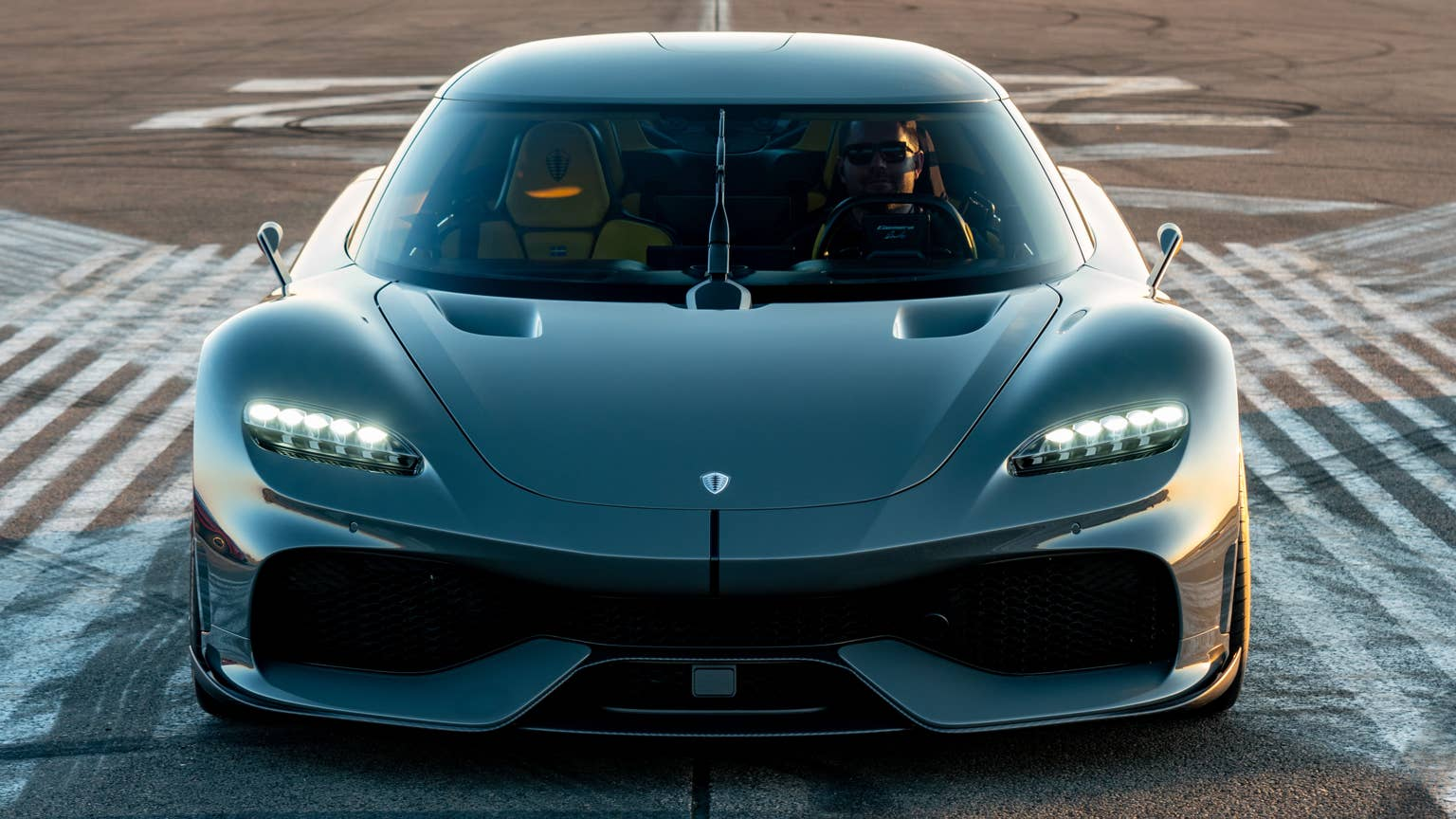
The first customer-bound Koenigsegg Gemera was severely vandalized in Copenhagen, Denmark, just days after being delivered. Parked outside the Hotel d’Angleterre, the multi-million-dollar four-seat hypercar suffered a shattered driver-side windshield and damaged side mirror in what appeared to be a targeted attack.
Koenigsegg Gemera Faces Extensive Damage
Photographs shared online show extensive cracking across the Gemera’s windshield. The damage will require specialized factory repairs because Koenigsegg builds its vehicles to bespoke specifications, making custom body panels and curved glass unsuitable for replacement by local repair shops.
The vehicle will likely need to be transported to Ängelholm, Sweden, where factory technicians can carry out the restoration. The incident comes just days after delivery and marks a troubled start for the long-awaited four-seat hypercar, which spent six years in development before customer shipments began.
Vandalism Sparks Debate Over Registration
Online speculation about the motive for the vandalism focused on the Gemera’s registration status. Comments on Reddit noted that the Swedish-registered vehicle had reportedly been driven extensively throughout Denmark on temporary dealer plates for more than a month.
Denmark imposes a 150% registration tax on new vehicles in addition to standard value-added taxes. Some commentators consequently accused the owner of using foreign dealer plates to bypass local tax obligations.
Reactions on the r/koenigsegg subreddit ranged from dark humor to frustration over local tax laws. Some users joked about cyclists fleeing the scene or police drawing chalk outlines around the vehicle before tow trucks arrived.
Many Danish commenters, however, emphasized that tax avoidance generates strong public hostility in Scandinavia, where high automotive taxes directly fund public infrastructure and healthcare.
The Gemera’s Complex Powertrain
The controversy surrounding the vandalized Koenigsegg Gemera comes as the vehicle itself represents a significant mechanical evolution for the Swedish brand.
Koenigsegg originally planned to offer a three-cylinder hybrid powertrain alongside its flagship engine. The company later shifted production to a V8 engine configuration following overwhelming customer demand.
That engineering complexity makes replacing individual components exceptionally costly for both insurance providers and owners.
Koenigsegg’s Production Plans Continue
Despite the setback in Copenhagen, Koenigsegg’s production pipeline remains focused on high-performance developments. The manufacturer continues work on upcoming projects, including a recently teased track hypercar designed for extreme circuit performance.
As chassis number one undergoes repairs, the company will look to streamline international deliveries while navigating complex regional registration rules.