
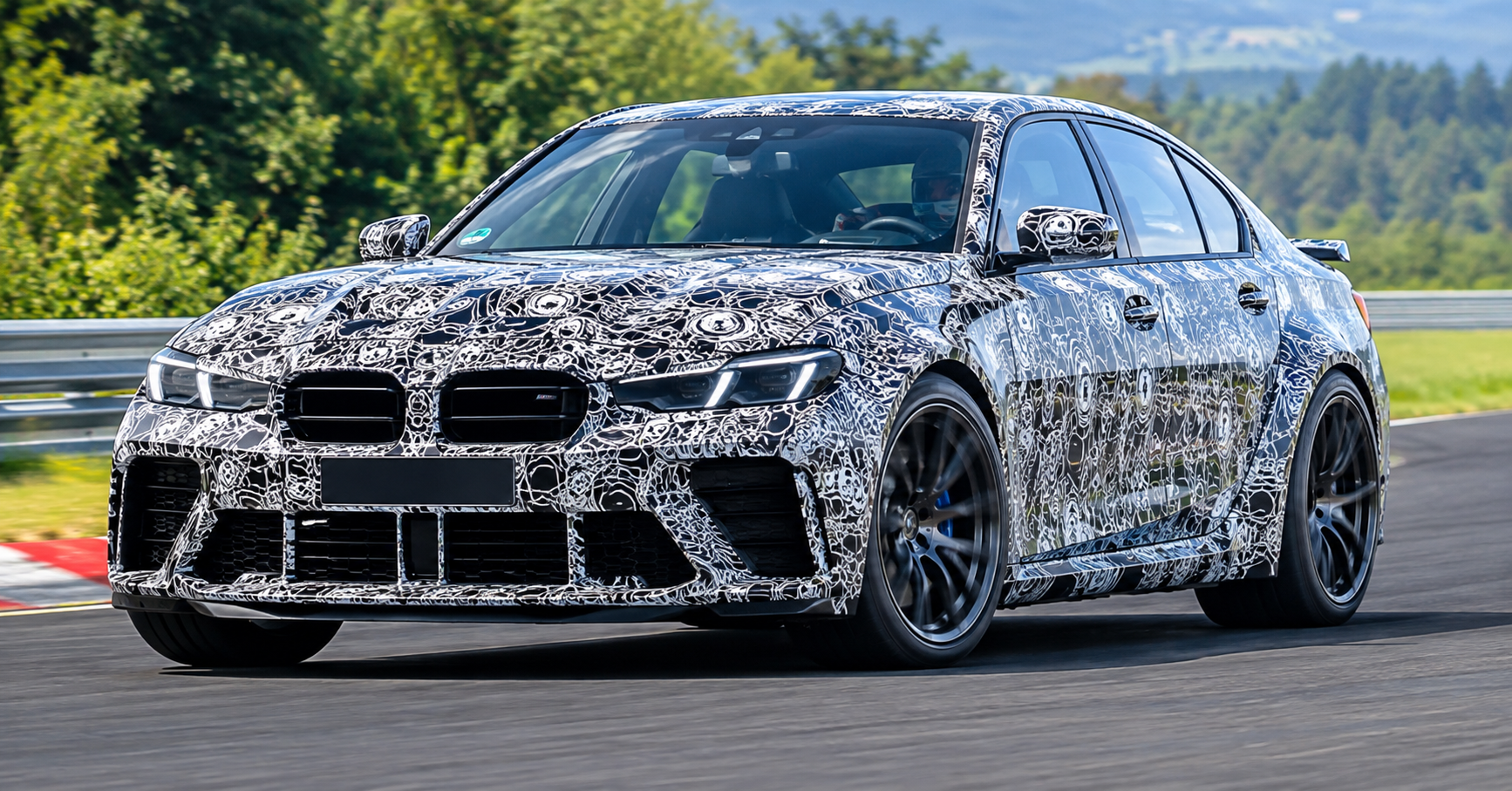
The next BMW M3 powered by an internal-combustion engine has been spotted testing at the Nürburgring with less camouflage than before, offering a clearer look at the upcoming gas-powered sports sedan and its distinctive four-tailpipe exhaust.
New BMW M3 Reveals Neue Klasse Design
BMW’s upcoming combustion-powered M3 adopts design elements from the automaker’s Neue Klasse language, which has already appeared on the iX3 and i3 EVs.
The front end features wide, short kidney grilles that replace the current M3’s larger “beaver teeth” design. At the rear, the car gets hockey stick-like taillights.
Despite the smaller kidney grilles, the M3 still needs substantial airflow for cooling. Huge lower-bumper openings provide additional air, with four separate openings directing airflow to the radiator, other fluid coolers and the brakes for heavy track use.
BMW M3 Prototype Shows Wide Stance
Wide front and rear fenders conceal large tires mounted on wheels that are not as large as might be expected.
The prototype photographed at the Nürburgring uses 275/35 R19 tires at the front and 285/30 R20 tires at the rear, matching the current M3 Competition’s setup.
The tires are Michelin Pilot Sport 5 models, although that specification could change many times before the production car arrives.
At the rear, the new M3 maintains a relatively restrained appearance. A small lip spoiler sits on the trunklid, while the most obvious performance detail is the four exhaust tips protruding from the bumper.
Gas M3 Faces Nearly 1,000-HP Electric Model
The new M3 appears substantially larger overall. Its size could even make it look like a new M5, while buyers seeking a more visually imposing design may find the M4 more distinctive, particularly with brighter paint options.
The combustion-powered M3 will also face a powerful electric counterpart. According to BMW, the first electric M3 will produce nearly 1,000 horsepower while carrying a window sticker nearly the same as the gas-powered M3.
That price parity with a four-motor electric model puts significant emphasis on what the combustion-powered M3 will deliver.
BMW’s 3.0-Liter Inline-Six Continues
BMW’s 3.0-liter inline-six remains at the center of the gas-powered M3. The German automaker has recently added new M Ignite technology designed to reduce fuel consumption and emissions even at high power levels.
The S58 inline-six has been in use for some time, with output gradually increasing from 473 horsepower to 552 horsepower.
The remaining question is how much more BMW M can extract from the twin-turbo engine and whether it is approaching its limit. The next M3 is expected to provide the answer, although a major power increase is not expected this time.