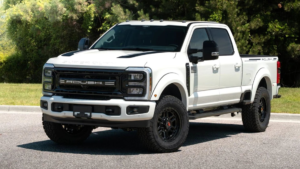

Toyota is moving ahead with a hydrogen-powered HiLux pickup, confirming plans to begin building a fuel-cell version of the truck for 2028. The hydrogen HiLux will use a fuel cell rather than a hydrogen combustion engine and is set to launch in Europe alongside battery-electric and combustion-powered versions.
Toyota Confirms Fuel-Cell HiLux Production
The announcement follows years of development and testing. When Toyota introduced the latest version of the HiLux late last year, the company said the pickup was designed to support both battery-electric and fuel-cell powertrains, but it had not confirmed whether a fuel-cell version would enter production or when it might arrive.
Toyota has now confirmed the plan. The company showed a teaser of the hydrogen-powered truck at the IAA Transportation Hannover work truck show alongside its full range of light commercial vehicles.
The new HiLux FCEV is expected to travel about 250 miles on a tank of hydrogen. Toyota is also targeting a towing capacity of up to 5,500 pounds.
Hydrogen HiLux Will Join Toyota’s European Lineup
Toyota plans to launch the hydrogen HiLux in Europe for 2028, where it will be sold alongside the battery-electric HiLux and combustion-powered models.
The company said it is seeing significant success in Europe’s light commercial market, where electric vehicles now account for 22% of Toyota Professional sales. That figure is double the market average.
Toyota began developing the HiLux FCEV prototype in 2023. The project received funding from the UK government to install a Mirai fuel cell into the pickup and test whether the concept could eventually be produced.
How Toyota Tested the HiLux FCEV
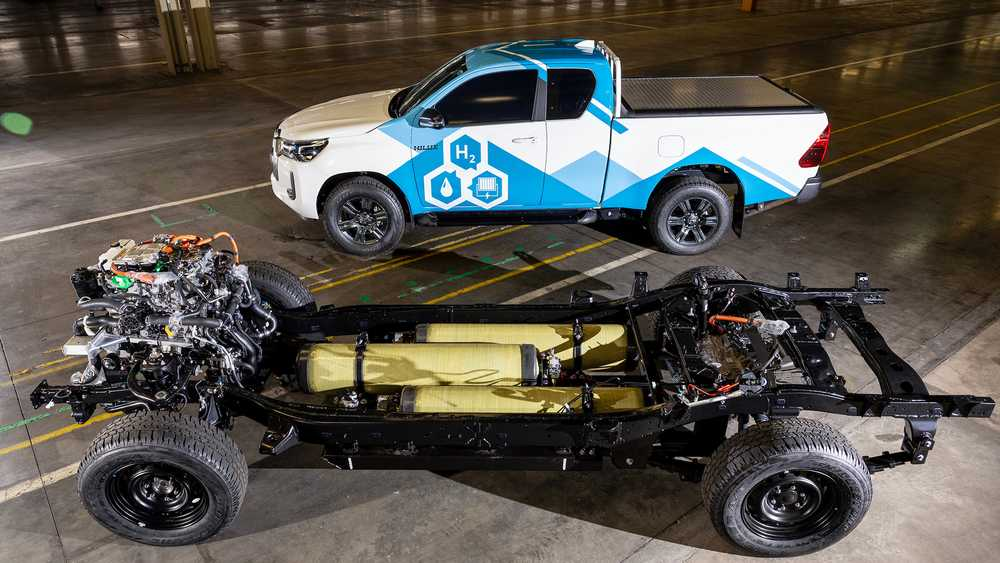
The prototypes were equipped with three H2 tanks inside the HiLux’s ladder frame, along with the Mirai fuel cell. A lithium-ion battery positioned under the bed stored power for the electric motor.
Toyota built 10 prototypes in the UK for testing, and the testing has evidently gone well enough for the company to move toward production.
Other Automakers Are Developing Fuel-Cell Vehicles
Hydrogen remains difficult to find for vehicles in the U.S., while it is somewhat more available in other parts of the world. There appear to be just 179 hydrogen stations spread across the continent, with Germany, France and the Netherlands having the highest density of stations.
Toyota is a leader in fuel-cell vehicle development, but it is not alone in pursuing the technology. The Hyundai Nexo and Honda CR-V e:FCEV are both available in the U.S., alongside Toyota’s Mirai.
BMW is also working to promote the alternative fuel and has developed several vehicles, including a version of its X5 SUV. Multiple commercial truck and bus options using fuel cells are also in production.
Toyota’s confirmation of the 2028 hydrogen HiLux adds a fuel-cell version to the pickup’s planned European lineup, following the company’s prototype testing and development work that began in 2023.