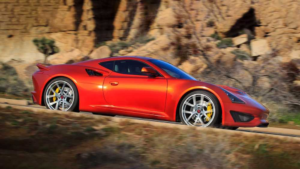

Ferrari appears to be exploring a radical new way to extract more performance from internal combustion engines without relying on additional electrification of the powertrain. A new patent from the automaker describes a triple-charged setup combining one mechanical turbocharger with two electrically driven compressors.
Ferrari’s Triple-Charged Engine Design
Turbocharging typically involves a compromise between power and throttle response. Large turbochargers can move substantial amounts of air but may hurt throttle response, while smaller turbos can respond more quickly but cannot move as much air.
Automakers commonly address that trade-off by adding more turbochargers, such as parallel units or separate turbos for different cylinder banks. Another approach is turbo compounding, also known as sequential turbocharging, in which a smaller turbo handles low engine speeds while a larger unit takes over at higher revs.
Ferrari’s patent combines both approaches in a setup unlike the configurations described in the source.
One Large Turbocharger Handles High-RPM Airflow
The patent describes a large, high-volume and high-pressure turbocharger positioned directly after the exhaust ports. Its job is to supply the engine with the airflow required to produce high power.
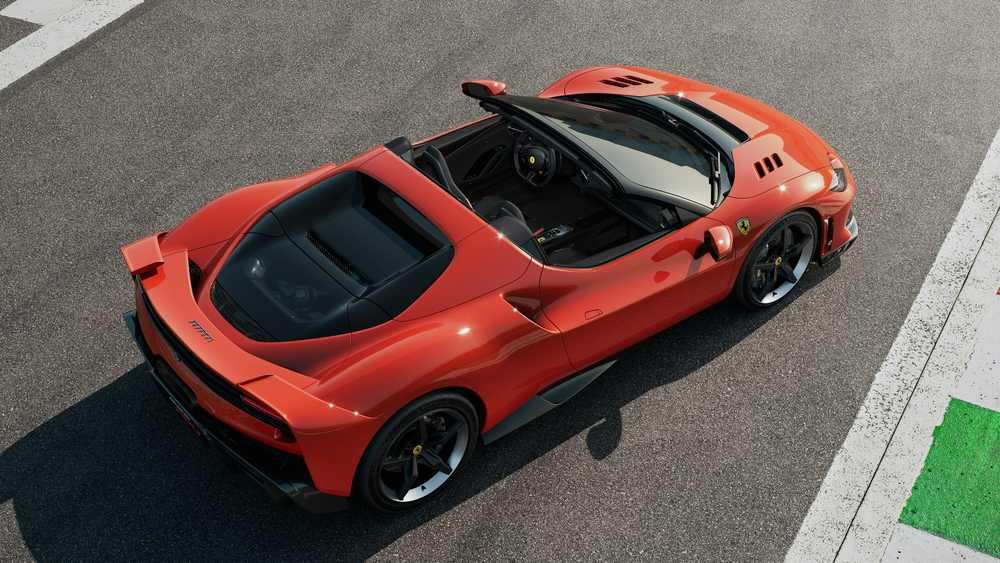
The 849 Testarossa’s two turbochargers produce 820 horsepower from 4.0 liters, while the patented engine would use just one turbocharger.
At low engine speeds, the large turbocharger would spend much of its time in the exhaust stream with its bypass open. It would remain ready to take over as exhaust flow increases.
Electric Compressors Provide Instant Low-RPM Boost
At low RPM, two additional compressors would provide most of the engine’s forced induction. Unlike the large turbocharger, these units would not be driven by exhaust gases.
Instead, electric motors would power them, making them superchargers in the strictest sense. Because an electric motor produces maximum torque at zero RPM, the compressors would not need exhaust flow to begin operating.
As soon as the throttle is applied, the electric compressors could begin compressing air and feeding it into the engine.
Mechanical Turbo Takes Over as RPM Rises
As engine speed increases and exhaust flow builds, the mechanical turbocharger would have enough energy to begin operating. It would then take over the airflow duties while the system bypasses the electric compressors.
The engine computer could continue spinning the electric compressors even after the mechanical turbo takes over. That would keep them ready to provide immediate boost if engine speed falls or operating conditions require it.
Electric Turbocharging Is Not New
Ferrari’s proposed design would not be the first system to use an electrically driven compressor. Volvo introduced twin-charged engines with an electric supercharger more than a decade ago.
Porsche’s latest 911 T-Hybrid system also adds an electric motor to its exhaust-driven turbochargers to help them spool more quickly.
Ferrari’s patent instead combines two electrically driven compressors with a large mechanical turbocharger, creating a triple-charged configuration designed to address both low-RPM response and high-RPM airflow.