

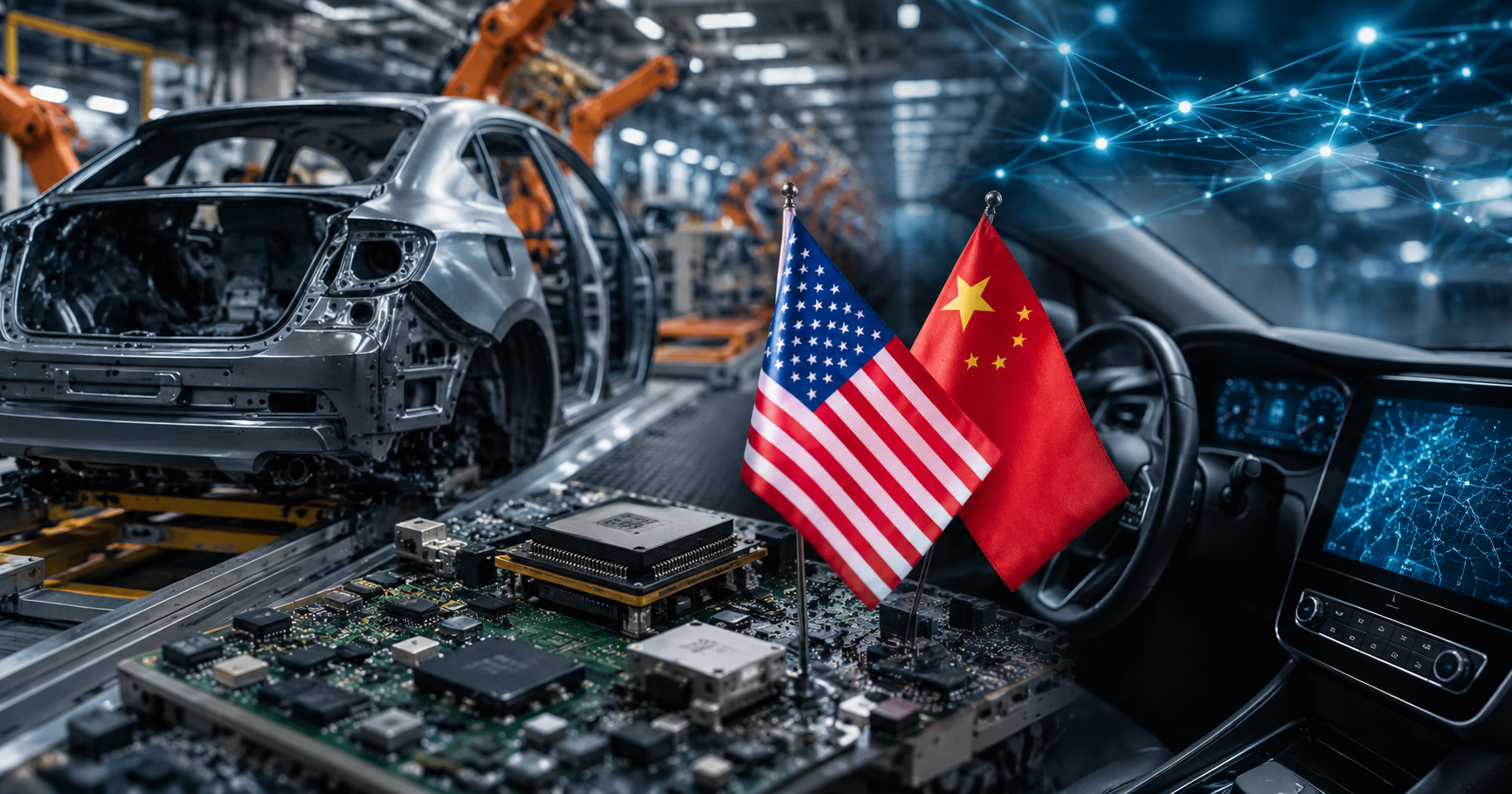
The Chinese tech ban affecting connected vehicles is forcing automakers to remove Chinese software and hardware from vehicles sold in the United States under a strict federal timeline. As manufacturers redesign vehicle systems and replace key components, the industry is facing higher costs, supply chain challenges, and growing pressure to meet regulatory deadlines.
Federal Rule Requires Removal of Chinese Connected-Car Technology
Federal regulators have ordered automakers to eliminate Chinese connected-car technology from vehicles sold in the U.S. A federal rule prohibits Chinese connectivity software beginning with the 2027 model year, while physical hardware will be barred by 2030.
The directive, driven by national security and data privacy concerns, applies to technologies including satellite communications, external antennas, and microcontrollers that manage external vehicle data.
Because automotive product development depends on suppliers being selected years before production begins, manufacturers have little flexibility to delay compliance. Companies are now redesigning electronic architectures while searching for replacement suppliers, even as domestic alternatives remain limited and more expensive.
Automakers Face Higher Costs and Supply Chain Challenges
According to Reuters, supplier Eagle Wireless, based in Solon, Ohio, is expanding production to replace Chinese-made components. The company expects its annual revenue to double to $100 million this year as it manufactures cellular connectivity modules.
Replacing Chinese suppliers, however, comes at a higher price. Basic connectivity modules carry a cost premium of between 5% and 15%, while more advanced autonomous driving components face even larger pricing differences.
As automakers replace Chinese software and hardware modules, supply chain disruptions are affecting the broader industry.
Market Access Already Affected by the New Rules
The regulations are already reshaping the U.S. automotive market. Chinese-owned Polestar has been barred from selling new vehicles in the United States under the new requirements.
At the same time, established automakers are seeking exemptions that would allow them to continue importing certain vehicles. Parts suppliers are also being required to provide complete supply chain transparency to verify that no Chinese components remain in their products.
Suppliers Race to Develop New Technology
Even manufacturers producing components domestically are facing significant hurdles. Eagle Wireless currently licenses its core module designs from China-based Quectel Wireless Solutions and must replace those licensed designs with its own proprietary technology before the 2030 deadline.
Industry analysts have also raised concerns about Volkswagen’s operations and the possibility of U.S. market restrictions involving Mercedes-Benz because of corporate ties.
Consumers Could Feel the Impact
The federal effort to eliminate Chinese vehicle hardware is expected to increase costs throughout the industry. With basic cellular modules becoming up to 15% more expensive, higher vehicle prices are expected to follow.
Domestic suppliers also lack the immediate manufacturing capacity to meet rapidly increasing demand, creating the potential for both higher prices and production delays.
The article states that while protectionist policies may provide temporary relief, they do not address broader manufacturing efficiency and technology development challenges. It also notes that industry leaders such as Ford have acknowledged that trade barriers cannot isolate the market indefinitely, making a broader manufacturing overhaul unavoidable.