
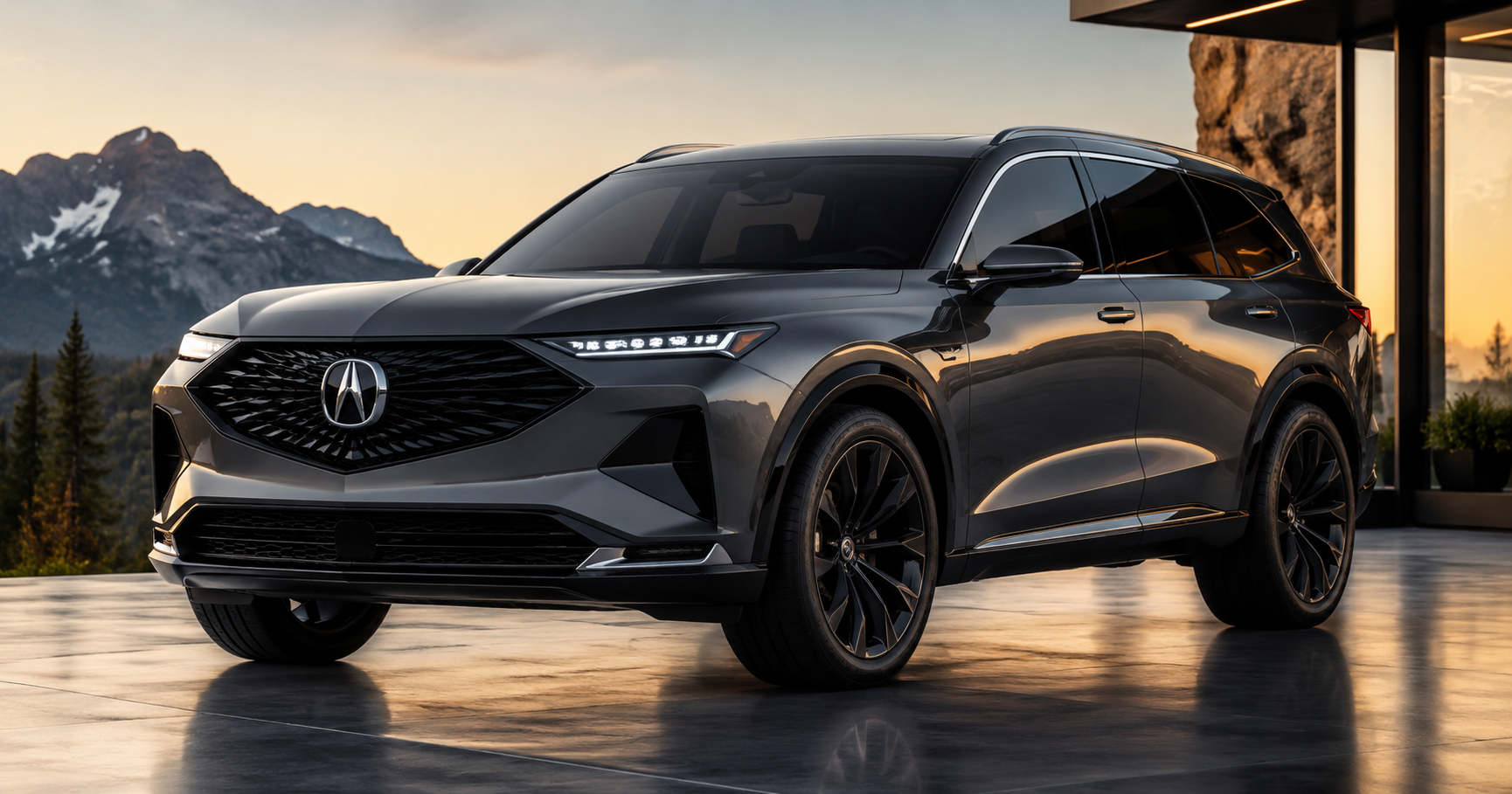
Acura is reportedly preparing a new three-row hybrid SUV aimed at narrowing its sales gap with Lexus by competing directly with the Lexus TX. According to Automotive News, the upcoming model is expected to sit above the Acura MDX and become the brand’s largest utility vehicle when it enters production later this decade.
Acura Targets the Lexus TX Segment
Toyota’s Lexus outsold Acura by nearly 3-to-1 in 2025, and Acura is reportedly responding by developing a larger premium SUV designed to compete in the growing three-row crossover segment.
The Lexus TX is based on the unibody Toyota Grand Highlander but distinguishes itself with unique styling, upgraded interior materials, improved sound insulation, and exclusive premium powertrains.
According to Automotive News, Acura appears to be pursuing a similar strategy with a new three-row hybrid SUV positioned above the midsize MDX. Internal company documents currently refer to the vehicle as the “XL,” although it remains unclear whether that name is temporary or will become the production model’s official designation.
Production Timeline and Hybrid Powertrain
Automotive News, citing people familiar with Honda’s production plans, reported that the Acura XL is expected to begin production in September 2029 at Honda’s manufacturing facility in Lincoln, Alabama.
The report said annual production could reach approximately 40,000 units. The SUV is also projected to receive a new hybrid powertrain.
Platform Questions Remain Unanswered
Honda currently does not sell a full-size crossover SUV in the United States, with the midsize Pilot serving as its largest utility vehicle.
The report does not indicate whether Honda will introduce a full-size model sharing its underpinnings with the Acura XL. As a result, that possibility remains speculative.
The platform choice for Acura’s future flagship SUV also remains uncertain. According to Automotive News, one U.S. dealer said the brand needs a “full-fledged large SUV that gives us the ability to compete against Tahoe, Expedition, Escalade.”
Body-on-Frame or Unibody?
Competing directly with vehicles such as the Chevrolet Tahoe, Ford Expedition, and Cadillac Escalade would require a body-on-frame platform. However, neither Acura nor parent company Honda currently produces vehicles on that architecture, as all of the automaker’s cars, SUVs, and pickups use unibody platforms.
The report added that Honda is reportedly evaluating Nissan’s truck platforms, including those intended for the upcoming revived Xterra and next-generation Pathfinder, as potential foundations for future pickups and SUVs.
If Honda and Nissan reach an agreement, the first Honda body-on-frame models would likely be built by Nissan at its own factories. Because the Acura XL is expected to be assembled at Honda’s Alabama plant, which also produces the Pilot and Passport midsize SUVs, the report said the new model will probably use a unibody design.
A stretched version of Honda’s PF7 unibody platform, which underpins the company’s midsize models, appears to be the most logical choice based on the report.
A Key Addition to Acura’s Future Lineup
According to the report, Acura’s product lineup is expected to shrink to three nameplates—the Integra, ADX, and MDX—following the cancellation of several planned electric vehicles as part of the brand’s strategic shift toward hybrids.
The Acura XL is expected to help the brand compete more directly with the Lexus TX while also offering a more affordable alternative to European flagship SUVs, including the upcoming Audi Q9, BMW X7, and Mercedes-Benz GLS.
While several aspects of the project remain unconfirmed, the reported hybrid SUV would represent a significant expansion of Acura’s lineup and its push into the large premium three-row SUV segment.