
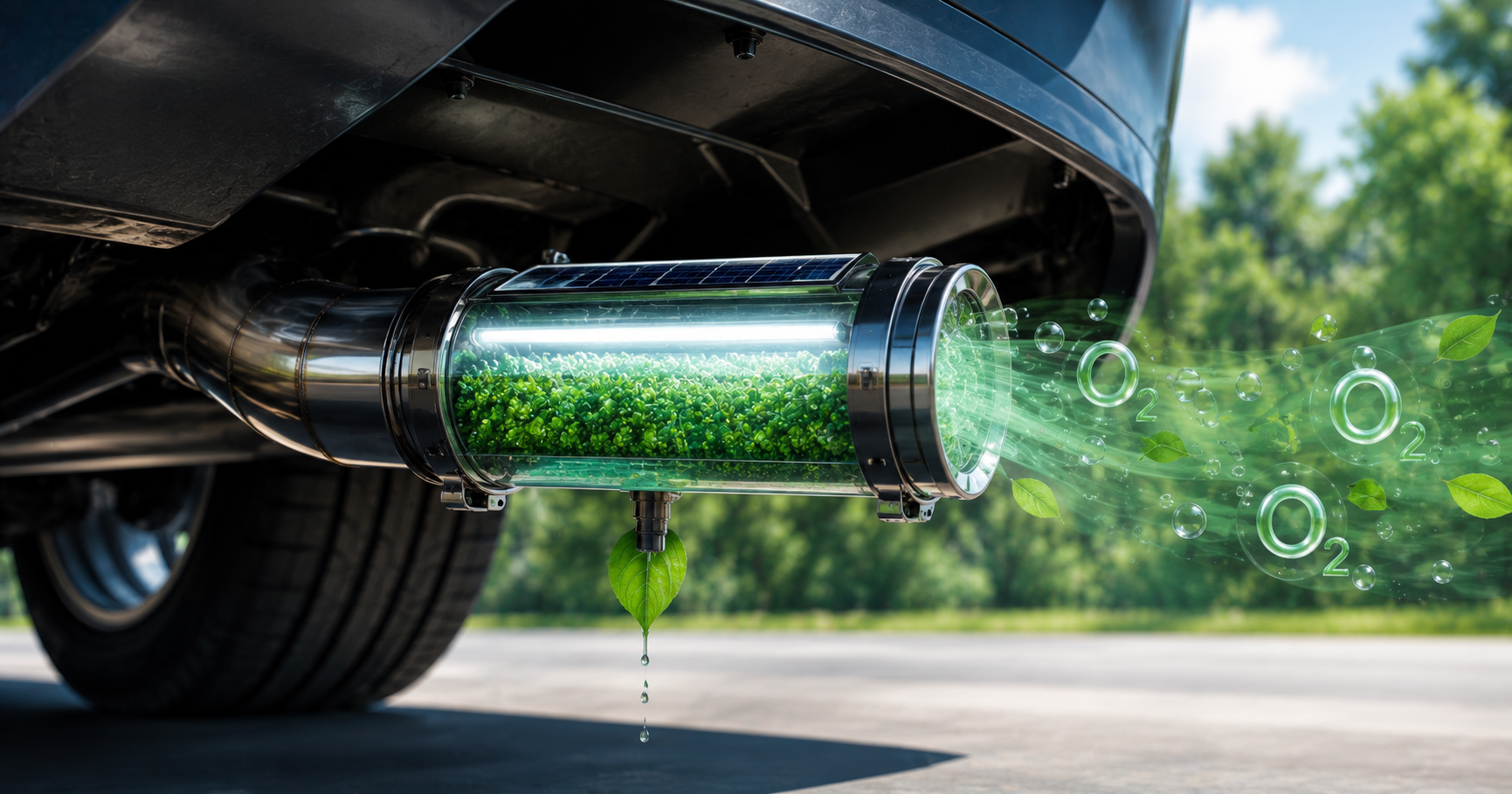
The Go Green Filter, a prototype created by two 18-year-old students from Pennsylvania, aims to reduce vehicle emissions by using living microalgae, water, and light to convert harmful exhaust gases into oxygen. The developers say the device achieved a 74% reduction in vehicle emissions during testing while costing about $50 to manufacture.
Two Pennsylvania Teenagers Develop Go Green Filter
Rohan Kapoor and Jack Reichert, both 18, created the Go Green Filter after drawing inspiration from research by an MIT professor. The pair spent nearly a year refining the concept before producing a working prototype.
The tailpipe-mounted device uses living microalgae, water, and light to transform harmful exhaust gases into oxygen. According to the developers, manufacturing the filter costs approximately $50.
The students also estimate that installing the device on every vehicle worldwide could reduce global carbon emissions by more than 16%. The report notes that this figure is theoretical but highlights the potential impact of a low-cost solution if it reaches large-scale production.
Automakers Continue Pursuing Cleaner Combustion Technologies
The Go Green Filter joins a growing number of technologies designed to reduce the environmental impact of internal combustion engines while extending their viability.
Mazda has developed its Mobile Carbon Capture system, which is intended to remove carbon dioxide directly from a vehicle’s exhaust while driving. BMW, Toyota, and Lamborghini are also exploring renewable gasoline as another approach to lowering emissions while continuing to use combustion engines.
Industry Shifts Toward Smaller and Electrified Powertrains
As emissions regulations become more stringent, naturally aspirated and large-displacement engines are gradually being replaced by smaller turbocharged engines, hybrids, plug-in hybrids, and electric vehicles.
Mercedes-Benz replaced the C 63’s twin-turbocharged V8 with a turbocharged four-cylinder hybrid, although the report states that the V8 will return in the near future. Lamborghini also replaced the naturally aspirated V10-powered Huracán with the twin-turbocharged V8-powered Temerario.
Ferrari continues to offer a naturally aspirated 6.5-liter V12 in the 12Cilindri, but the company has also introduced its first electric vehicle, the Luce.
Cleaner Engines Remain a Focus
The report states that electric vehicle adoption has progressed more slowly than many expected, but automakers continue investing in cleaner combustion engines that consume less fuel and produce fewer emissions.
It also notes that moving away from electrification entirely would be difficult to justify, citing estimates that electric vehicles could prevent more than 100,000 deaths linked to vehicle pollution by 2050.
Meanwhile, the Environmental Protection Agency has proposed delaying Tier 4 vehicle emissions standards until the 2029 model year, giving manufacturers additional time to develop future technologies.
Whether the future of transportation is driven by electric vehicles, renewable fuels, advanced carbon capture, or a combination of these technologies remains uncertain. For now, concepts such as the Go Green Filter represent another effort to reduce emissions while supporting the future of combustion-powered vehicles.