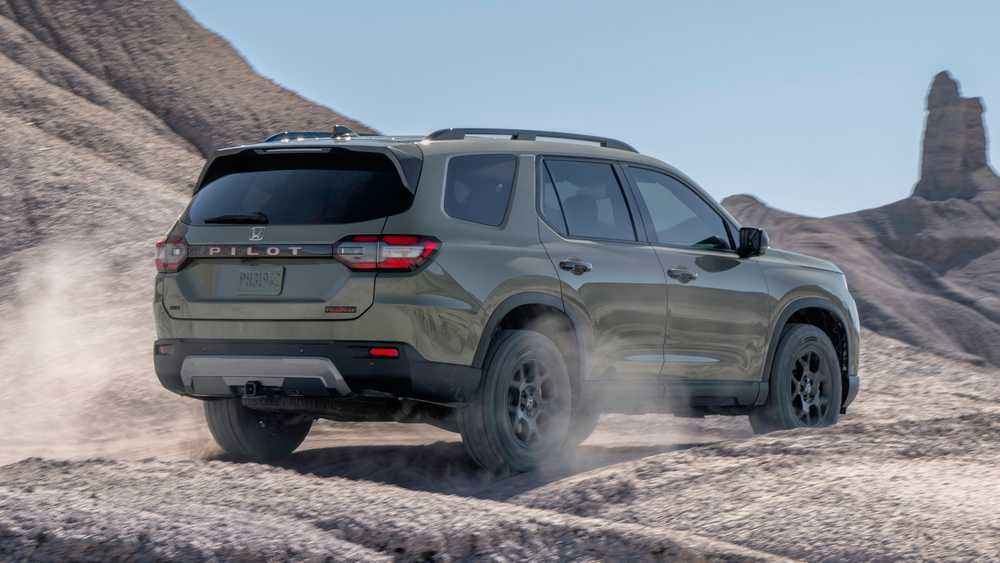
The Honda Pilot has been the largest vehicle in Honda’s lineup since its debut in 2002, but that could change with a new, much larger SUV reportedly planned to sit above it. According to a recent Automotive News report, the upcoming Honda could be around 8 inches longer than the current Pilot and closely related to a reported three-row Acura flagship SUV.
Honda’s New SUV Could Be Around 8 Inches Longer
Automotive News cited an anonymous source in reporting on the potential new Honda. The SUV would sit above the current Pilot in the lineup and could measure roughly 8 inches longer.
The larger Honda would reportedly share a close relationship with the three-row Acura flagship SUV. Building a vehicle for both brands could increase volume across Honda and Acura, with the Honda version reportedly targeting about 40,000 units per year.
That volume would represent a slow-selling model for Honda, performing worse than the Ridgeline, while the same numbers would make the vehicle a bestseller for Acura. The Honda Prologue sold about 40,000 units last year, and that did not save it. However, a very large SUV would almost certainly have much better margins than a small to midsize mainstream EV.
New Honda V6 Hybrid Powertrain Expected
The new SUV is expected to use Honda’s V6 hybrid powertrain developed for large vehicles such as the Pilot and Odyssey. The system uses the same basic powertrain setup as Honda’s current four-cylinder hybrids, but combines it with a V6 and much larger electric motors.
The powertrain would also use a separate rear motor to drive the rear wheels. It is expected to debut in the next-generation Acura RDX by the end of the decade.
The flagship Acura SUV related to the larger Honda is also rumored to arrive around the end of the decade. The Honda version, however, is not expected until 2032.
How the Larger Honda Would Compare With Rivals
The current Honda Pilot is already one of the larger three-row SUVs in its class. At 200.1 inches long, it is longer than the Ford Explorer, Toyota Highlander, Mazda CX-90 and Nissan Pathfinder.
The Pilot is also just 1.3 inches longer than Toyota’s largest unibody SUV, the Grand Highlander, while remaining 4.4 inches shorter than the Chevrolet Traverse.
An additional 8 inches would make the new Honda longer than the entire three-row unibody SUV segment and put it within reach of body-on-frame SUVs. At that size, it would match the Toyota Sequoia, measure 1.5 inches shorter than the Nissan Armada, 1.8 inches shorter than the Ford Expedition and 3.2 inches shorter than the Chevrolet Tahoe.
Its hybrid powertrain could provide substantially better fuel economy than those competitors, while its unibody, car-like chassis could offer more civilized driving dynamics. However, other specifications, including towing capacity and off-road capability, could be more difficult to match.
Honda’s Hybrid Strategy Could Extend Beyond the Pilot
Honda currently faces a challenge against Toyota as some of its models offer robust gas-only engines while competing Toyota models provide both gas and hybrid options.
Those Honda vehicles include the Pilot, the Ridgeline unibody pickup truck and the Odyssey minivan. The upcoming larger Pilot will most likely benefit from Honda’s new hybrid engine, although the future of hybrid options for the other models remains to be seen.
The Ridgeline is set to go on break for a year, raising the possibility of its return with a hybrid option to rival the Tacoma’s iForceMax hybrid powertrain. Matching the most powerful Tacoma hybrid’s 326 horsepower and 465 lb-ft of torque, however, might be difficult.
What a Larger Pilot Could Mean for the Odyssey
The Odyssey faces another potential challenge if Honda adds a larger Pilot. Buyers could have to choose between the larger SUV, with better styling, and the Odyssey, which offers even more interior space.
The Toyota Sienna currently makes a compelling case for families seeking a softer ride than the Sequoia’s body-on-frame construction provides. Because the Pilot will remain a unibody SUV, it could draw buyers away from the Odyssey, even if both vehicles eventually receive Honda’s new hybrid system.