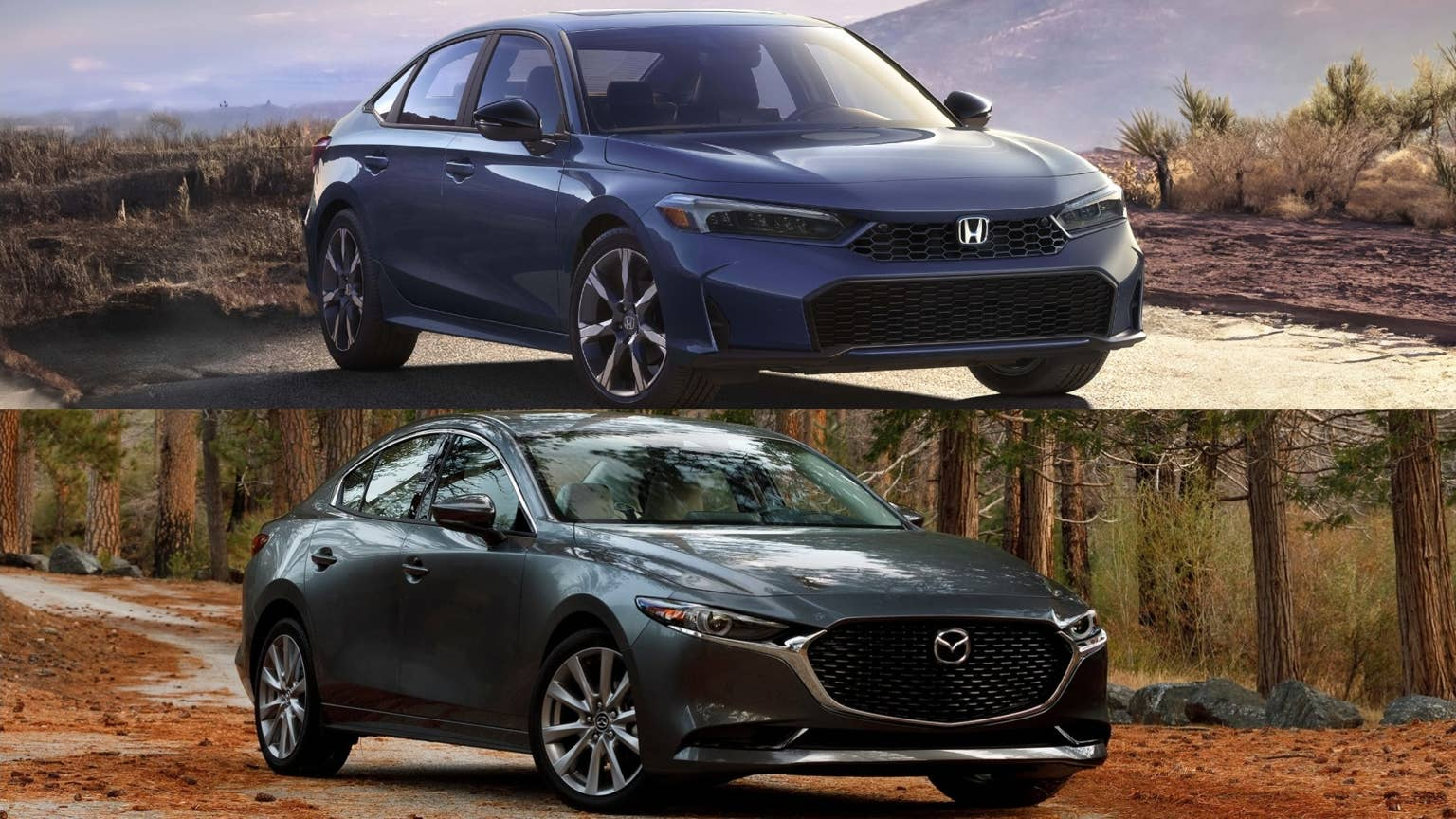
Honda and Mazda are seeing an unexpected shift in their 2026 U.S. sales, with passenger cars gaining ground while SUVs and light trucks struggle to keep pace. Through September, Honda car sales climbed 16.5%, while Mazda’s increased 33%, even as Mazda’s overall sales declined and Honda continued to grow.
Honda and Mazda Sales Show a Shift Toward Cars
Sales figures for January through September reveal a clear difference between the two automakers. Honda’s passenger-car gains have helped lift its overall sales, while Mazda’s faster growth in percentage terms has not been enough to offset declining SUV sales.
| Vehicle category | Honda | Mazda |
|---|---|---|
| Cars | 343,555 (+16.5%) | 40,084 (+33.0%) |
| SUVs and trucks | 702,038 (-0.3%) | 270,184 (-6.7%) |
| Total sales | 1,045,593 (+4.7%) | 310,268 (-2.9%) |
Note: Honda figures cover the Honda brand only and exclude Acura.
Honda sells more than eight times as many cars as Mazda, meaning its 16.5% increase translates into a much larger number of additional vehicles. Cars account for about one in eight Mazda vehicles sold this year, making the brand’s overall decline more difficult to overcome.
Mazda reported its best-ever September, with 34,519 vehicles sold, but its year-to-date total remains below last year’s level. Honda, meanwhile, increased overall sales by 4.7% and surpassed 1 million sales in September, a month earlier than it did last year.
Mazda3 Sales Close the Gap With the CX-30
The Mazda3 is making substantial gains against Mazda’s CX-30 crossover. Through September 2025, the CX-30 had outsold the Mazda3 by more than 24,000 vehicles. This year, the difference has narrowed to about 1,900.
| Model | Jan.-Sept. 2025 | Jan.-Sept. 2026 | Change |
|---|---|---|---|
| Mazda3 Sedan | 16,158 | 21,135 | +30.8% |
| Mazda3 Hatchback | 6,679 | 11,351 | +70.0% |
| Mazda3 Total | 22,837 | 32,486 | +42.3% |
| CX-30 | 47,147 | 34,386 | -27.1% |
The Mazda3 hatchback recorded the strongest increase, with sales rising 70% to 11,351 units. Sedan sales climbed 30.8% to 21,135, leaving the sedan selling nearly twice as many units as the hatchback.
Combined Mazda3 sales reached 32,486 through September, up 42.3% from 22,837 during the same period last year. Over the same period, CX-30 sales fell 27.1% to 34,386.
Most of Mazda’s other crossovers have also recorded declines this year, with the CX-50 standing out as the main exception. Mazda’s sales report does not explain the shift toward passenger cars or the drop in CX-30 sales.
Honda Car Sales Reach Their Best Third Quarter Since 2020
Honda’s passenger-car performance strengthened during the third quarter, when sales rose 20.9%. It was the brand’s best third quarter for passenger cars since 2020.
The Accord has been a major contributor to the increase, with sales up 32.7% this year. Hybrid models accounted for 44% of Accord sales during the third quarter.
Honda’s SUV business has remained relatively stable. The CR-V recorded a third-quarter sales record of 110,730 vehicles, which Honda said it achieved with about 17 days of supply.
Although Honda’s light-truck sales were down 0.3% through September, they increased 4.3% in the third quarter, showing stronger recent performance than the year-to-date figure suggests.
Lance Woelfer, vice president of auto sales at American Honda, attributed the company’s results to “a winning formula focused on affordability, record sales of hybrid models and a commitment to offer our customers a balanced lineup of passenger cars and light trucks.”
Why Honda’s Gains Outpace Mazda’s Overall Results
Honda’s passenger-car growth has been large enough to support overall brand growth while SUV and light-truck sales remain broadly stable. Mazda’s cars are growing faster in percentage terms, adding roughly 10,000 sales, but losses of roughly 19,000 SUV sales have outweighed the gains from the Mazda3 and MX-5.
Neither automaker’s report fully explains what is driving the shift. Beyond Woelfer’s comments about Honda’s strategy, the company did not provide a detailed breakdown of the factors behind its passenger-car gains. Pricing, incentives and inventory could also play a role, although the reports do not establish their impact.
What the Sales Shift Means for Car Shoppers
For buyers comparing compact cars and crossovers, the starting prices listed for Mazda and Honda models show a cost advantage for the passenger cars before considering other differences between the vehicles.
Mazda3 vs. Mazda CX-30
The 2026 Mazda3 sedan starts at $24,650, while the hatchback starts at $25,650. The Mazda CX-30 starts at $26,375.
Destination charges are $1,315 for the Mazda3 and $1,595 for the CX-30. Including those charges, the Mazda3 sedan costs $2,005 less than the CX-30, while the hatchback costs $1,005 less.
Honda Civic vs. Honda HR-V
The 2027 Honda Civic sedan starts at $24,995, compared with $26,600 for the 2027 Honda HR-V. Destination charges are $1,295 for the Civic and $1,550 for the HR-V.
After adding destination charges, the Civic is $1,860 cheaper than the HR-V based on the listed starting prices.
Vehicle Availability
Honda reports 16 to 17 days of supply for key models, a level that may limit the selection available at some dealerships. Mazda’s report does not provide a comparable inventory figure.
Through September 2026, Honda’s passenger-car gains have contributed to broader sales growth, while Mazda’s expanding Mazda3 sales have not yet offset the decline across its SUV lineup. The figures show two automakers experiencing a similar shift toward cars, but with different effects on their overall results.