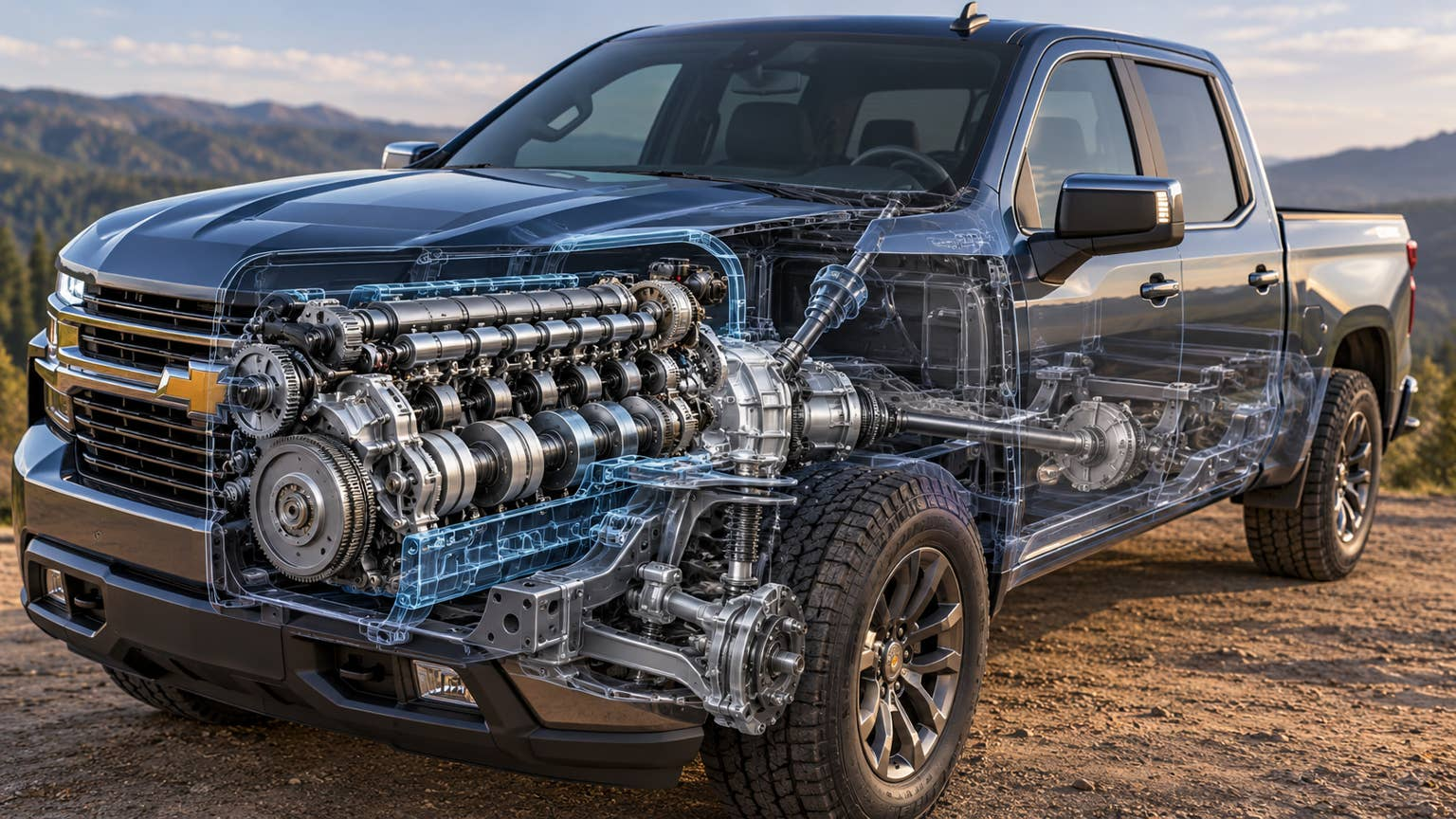
General Motors is exploring another way to improve internal-combustion engine efficiency through a newly published patent describing a design that can vary compression ratios and extend the expansion of combustion gases. The concept could offer a new approach to improving engine performance and fuel economy, although GM has not announced plans to put the technology into production.
The patent follows the automaker’s introduction of several new engines for upcoming trucks, including a new V8 and a large diesel engine for heavy-duty models. The proposed design indicates that GM is continuing to investigate additional ways to refine traditional engine technology.
How GM’s Variable Compression Engine Design Works
Titled “Extended Expansion Engine With Variable Compression Ratio for Longitudinal Mounting Applications,” the patent was filed last year and published last week. It describes a mechanical system intended to alter piston movement and adjust an engine’s compression ratio.
In a conventional internal-combustion engine, pistons travel up and down inside cylinders, while connecting rods transfer that movement to the crankshaft. GM’s proposed design, depicted in patent sketches as an inline-six engine, introduces a more elaborate arrangement of gears, links and control components to change how these parts move in relation to one another.
This mechanism could allow the engine to vary how much the air-fuel mixture is compressed before ignition. Compression ratio plays an important role in engine efficiency and power, as well as its ability to handle heavy loads.
Extended Expansion Could Improve Engine Efficiency
The patent also describes an extended-expansion approach intended to extract additional work from combustion gases. After combustion pushes a piston downward, the hot gases retain energy that could be used to continue driving the piston before the gases exit through the exhaust system.
Allowing the gases to expand further could help the engine extract more useful energy from each combustion cycle. In theory, that additional work could improve fuel economy under suitable operating conditions.
However, the proposed mechanism also introduces additional moving parts, potentially increasing mechanical complexity, manufacturing costs and friction. GM would need to demonstrate that the efficiency gains justify those trade-offs.
Could GM Use the Technology in Future Trucks and SUVs?
The patent specifically addresses longitudinal engine mounting, a configuration commonly used in rear-wheel-drive vehicles and many trucks and SUVs. That makes the concept relevant to some of GM’s existing vehicle architectures, although the automaker has not identified a specific vehicle intended to use the technology.
If developed further, the design could provide another way to improve gasoline-engine efficiency without switching to a different fuel source. However, GM has not disclosed production plans, performance figures or fuel-economy estimates for the proposed engine arrangement.
GM’s Engine Patent Does Not Guarantee Production
The newly published patent outlines a potential approach to improving internal-combustion engines, but it does not confirm that GM will bring the technology to market. The automaker has not announced a production application or provided details about when the design might be developed further.
For now, the variable compression and extended-expansion system remains a patented concept. Whether it eventually appears in a production vehicle will depend on further development and whether its potential benefits justify the added mechanical complexity.