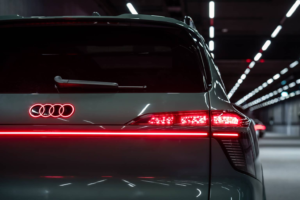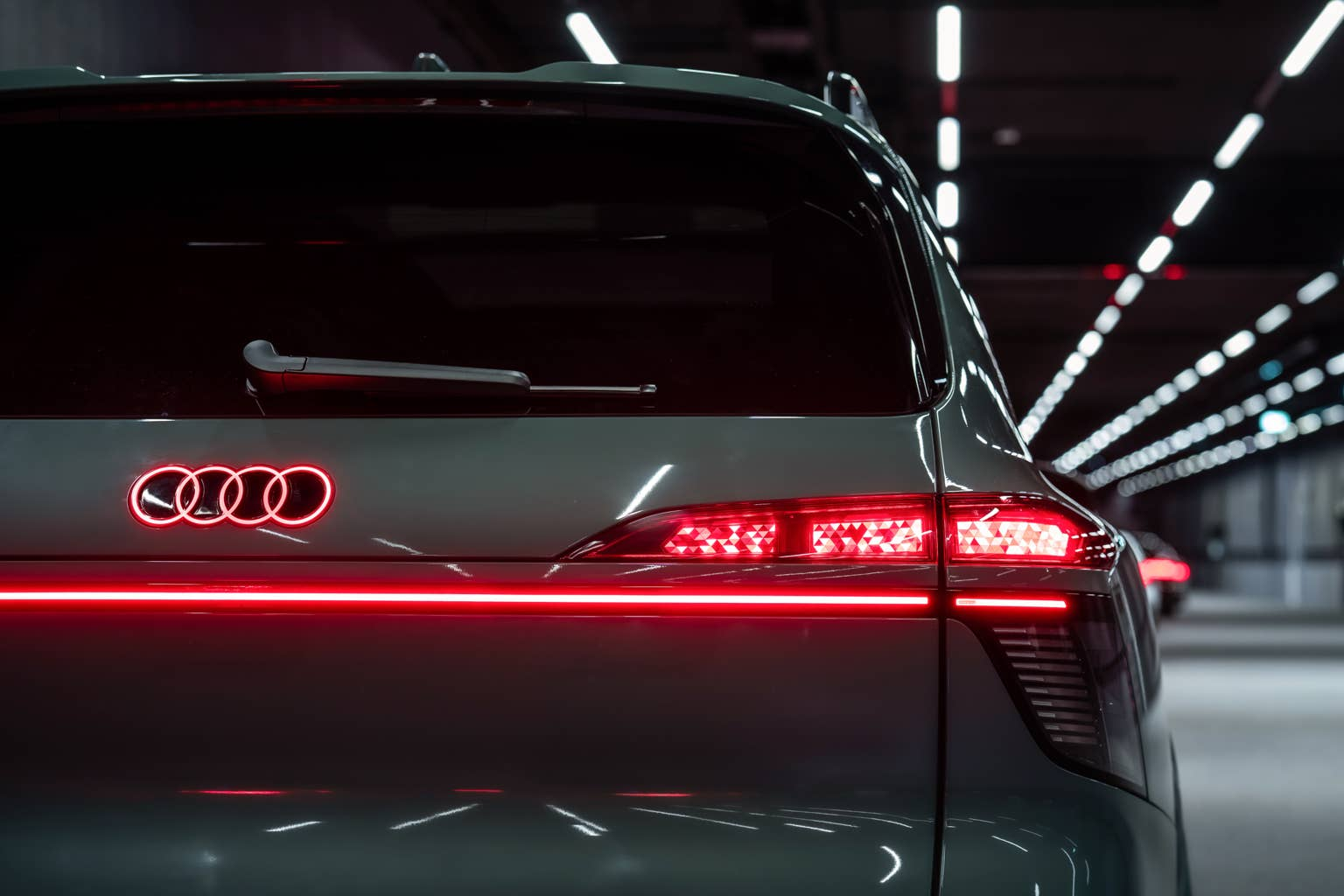
Audi is introducing curved OLED exterior lighting on the Q9, marking a world-first for the technology. The system allows rear lighting panels to follow the vehicle’s contours while giving designers more flexibility and helping brake lights and turn signals remain visible from the vehicle’s corners.
Audi Continues Its Lighting Innovation
Audi has introduced several lighting milestones over the years. The second-generation D3 A8 was the first car to feature LED daytime running lights, while the first-generation R8 became the first to use full LED illumination at both the front and rear.
The third-generation A8 introduced matrix LED lighting in a production car, while the TT RS was among the first vehicles to feature OLED tail lights. Many of these technologies have since become commonplace in the automotive industry.
How Curved OLED Lighting Works
The Q9’s curved OLED panels allow brake lights and turn signals to remain more visible from the vehicle’s corners. The technology also provides uniform illumination across the lighting surface without relying on point bulbs or reflectors.
The OLED carrier glass measures just 0.1 millimeters thick, or 1/256th of an inch. Its thin construction allows the panel to bend and follow the vehicle’s shape, giving designers more freedom to develop distinctive exterior lighting designs.
Q9 Features Audi’s Largest OLED Panel
The Q9 features the third iteration of Audi’s OLED technology and the largest OLED panel the automaker has built to date. Its rear lighting system contains 512 individually controllable segments distributed across six digital OLED panels.
The segments support multiple static, active and semi-active digital light signatures. They can also display warning symbols.
Curved OLED Lights Limited to Select Models
The curved OLED lighting is not available across every Q9 trim. It is offered only on the Prestige model and is not available on the base Premium or mid-level Premium Plus variants.
The lights are included as standard equipment on the SQ9.