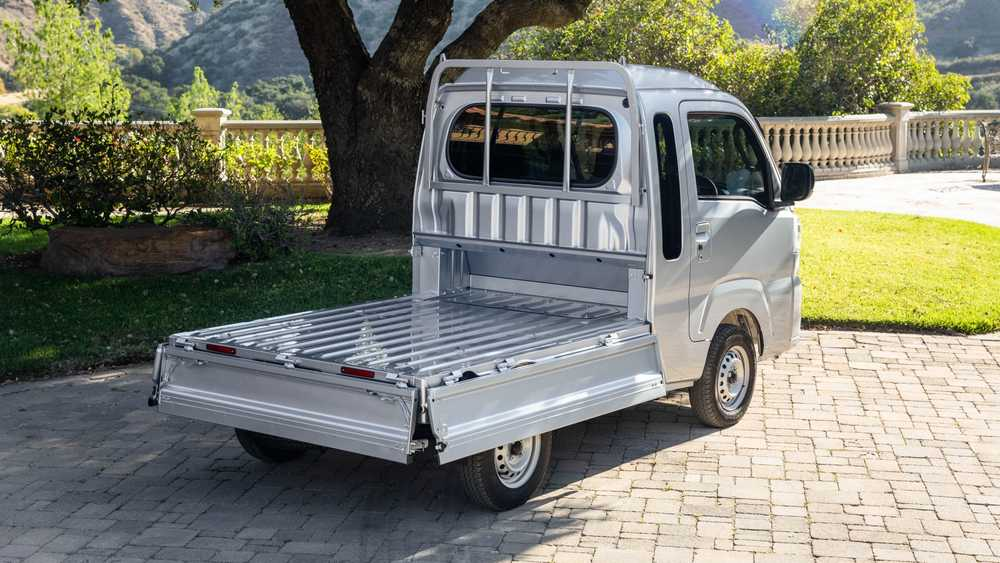
The Toyota Kei-01 could cost nearly three times as much in the United States as the small truck it is based on in Japan. While the vehicle starts at roughly $7,500 in its home market, comments from a Toyota executive suggest an American price of around $22,000, raising questions about how competitive the tiny pickup will be.
Toyota has not officially announced pricing for the Kei-01. However, the company has indicated that the truck will cost no more than $30,000, while a price of $22,000 has been described as reasonable.
Toyota Kei-01 Could Cost $22,000 in America
The Kei-01 could appeal to American buyers who want a smaller truck than a Ford Maverick or a full-size pickup. The average transaction price for a new full-size truck is currently $67,000, while a new Ford Maverick can be purchased for around $30,000.
Until now, buyers looking for an even smaller vehicle have had limited choices. Options have included importing a 25-year-old truck from Asia that can be driven on highways or purchasing utility terrain vehicles (UTVs), many of which are not designed or legally permitted for public-road use.
Toyota plans to assemble the Kei-01 in the United States using a kit built overseas. That approach would allow the automaker to avoid the 25% Chicken Tax applied to imported pickups.
Don Federico, Toyota’s chief engineer for Special Mobility Operations, said the truck would not cost more than $30,000. He also suggested that a price of $22,000 would be reasonable.
Why the Japanese Toyota Kei Truck Costs Just $7,500
The Kei-01 is based on the Toyota Pixis sold in Japan, a rebadged version of the Daihatsu Hijet pickup popular across Asia.
In Japan, the truck starts at 1,303,500 yen, including the country’s 10% sales tax. Removing the tax and converting the remaining amount into U.S. currency puts the price at approximately $7,500.
That creates a significant gap between the Japanese starting price and the $22,000 figure discussed for the American market, even with Toyota planning to assemble the vehicles in Indiana rather than Nakatsu.
Toyota has not announced an estimated retail price for the Kei-01, despite the executive’s comments about a possible $22,000 price.
How the Toyota Kei-01 Compares With Other Small Utility Vehicles
A price around $22,000 may seem high for such a small truck, but other utility-focused vehicles provide some perspective. The Mahindra Roxor, for example, is a low-speed vehicle similar in some respects to the Kei-01 and has a starting MSRP of just over $30,000.
The Roxor can carry 1,500 pounds in its bed and tow 3,500 pounds, compared with a 600-pound figure cited for the Toyota. The Roxor’s price is also relatively close to that of a new Jeep Wrangler, which starts at $36,000.
Buyers prioritizing speed over limited public-road access also have options such as the Can-Am Defender, which starts at $12,999. It offers a 1,000-pound payload, although its towing capacity has not been specified.
The Polaris Ranger starts at $9,999, with the ability to carry 500 pounds and tow 1,500 pounds.
Could the Kei-01 Compete With Side-by-Side Vehicles?
There is an important difference between the Toyota and those two side-by-side vehicles. The Can-Am Defender and Polaris Ranger do not come with features such as heating, air conditioning or doors. Buyers can add those features, but doing so increases their prices to levels comparable to the Kei-01.
That could make Toyota’s small truck more appealing to buyers who want some of the convenience of a traditional vehicle alongside the size and utility of a side-by-side.
However, the Kei-01 would have significant operating restrictions. It can only be driven on roads with speed limits of 35 mph or less, and its maximum speed is limited to 25 mph even on private property.
The expected $22,000 price also puts the Toyota in the same range as the recently revealed REO pickup truck, which is likewise expected to cost $22,000.
Although Toyota has yet to announce official pricing, the figures discussed so far suggest that the Kei-01 will be considerably more expensive in the United States than its Japanese counterpart. Its final value proposition will depend on how buyers weigh its price, equipment and road-use limitations.