
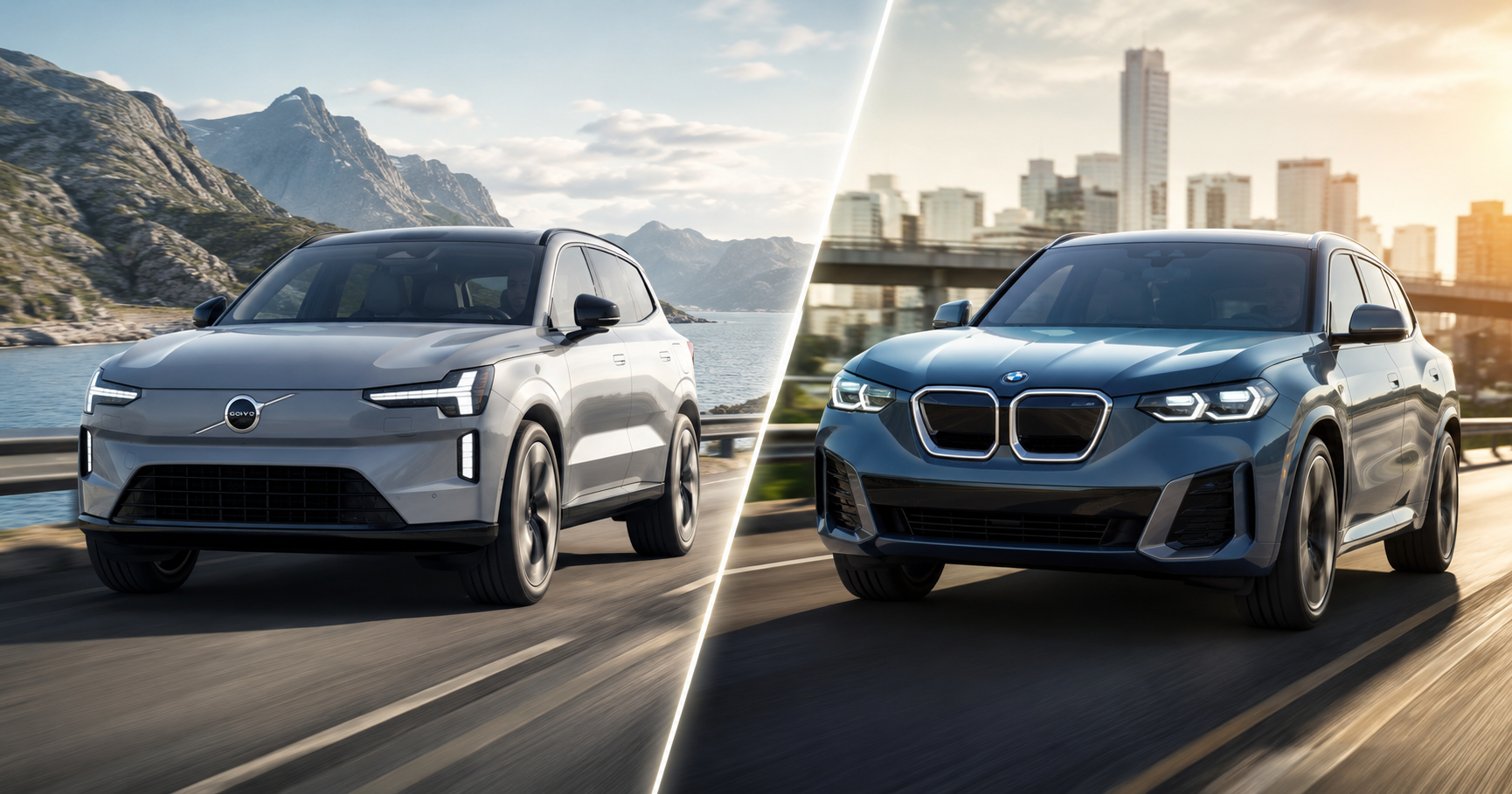
The Volvo EX60 vs BMW iX3 range comparison has quickly become one of the most important conversations among electric SUV shoppers in America. Driving range remains one of the biggest deciding factors when purchasing an EV, especially in the premium midsize SUV segment where buyers expect long-distance capability without sacrificing comfort, technology, or performance.
Volvo recently received official EPA certification for its all-new 2027 EX60, delivering a better result than originally expected. Meanwhile, BMW enters the competition with an impressive EPA-certified range for the new iX3, establishing itself as one of the longest-range premium electric SUVs on the market.
While both vehicles represent the next generation of luxury EVs, their range figures tell two very different stories. The numbers alone suggest BMW has a sizable advantage—but range is only one part of the ownership experience.
In this detailed comparison, we’ll examine official EPA ratings, battery efficiency, charging performance, wheel-size differences, technology, and what these numbers actually mean for everyday American drivers.
Official EPA Ratings: The Numbers That Matter
The U.S. Environmental Protection Agency (EPA) provides standardized range estimates that allow consumers to compare electric vehicles under consistent testing procedures.
The latest ratings show Volvo outperforming its own expectations while BMW continues to lead the segment in outright driving distance.
2027 Volvo EX60 P10 AWD
- EPA Range: 330 miles
- 20-inch wheels: 330 miles
- 21-inch wheels: 330 miles
- 22-inch wheels: 312 miles
When Volvo first introduced the EX60, the company estimated a maximum launch range of 322 miles. The finalized EPA certification increased that figure by eight miles, representing roughly a 2.5% improvement.
Although the increase may appear modest, exceeding a manufacturer’s preliminary estimate is always welcome because official EPA numbers generally influence consumer confidence far more than internal projections.
2027 BMW iX3 50 xDrive
- Maximum EPA Range: 434 miles
- Other wheel configurations: 383–399 miles
BMW’s strongest configuration surpasses the Volvo EX60 by an impressive margin.
Even the least efficient iX3 configuration remains comfortably above 380 miles, putting it well ahead of Volvo’s current launch model.
Volvo EX60 vs BMW iX3 Range: Side-by-Side Comparison
| Specification | 2027 Volvo EX60 P10 AWD | 2027 BMW iX3 50 xDrive |
|---|---|---|
| Maximum EPA Range | 330 miles | 434 miles |
| Lowest EPA Range | 312 miles | 383 miles |
| Range Difference | – | +104 miles |
| Platform | SPA3 | Neue Klasse |
| Electrical Architecture | 800V | 800V |
| NACS Port | Yes | Not specified |
Why Wheel Size Makes Such a Big Difference
Many buyers overlook wheel size when shopping for an electric SUV.
However, larger wheels almost always reduce driving range because they typically increase:
- Tire width
- Vehicle weight
- Rolling resistance
- Aerodynamic drag
Volvo’s EPA ratings clearly demonstrate this relationship.
- 20-inch wheels: 330 miles
- 21-inch wheels: 330 miles
- 22-inch wheels: 312 miles
That represents an 18-mile reduction simply from selecting the larger wheel package.
BMW experiences a similar effect, although even its lower-rated configurations remain significantly ahead of Volvo’s launch model.
Understanding the 104-Mile Difference
At first glance, a 104-mile advantage sounds enormous.
For many buyers, it certainly is.
Consider several common driving scenarios.
Weekend Road Trip
A driver traveling roughly 400 miles in a single day may need:
Daily Commuting
For commuters covering 40 miles per day:
- Volvo EX60 can theoretically drive about eight days before charging.
- BMW iX3 can approach eleven days.
Most owners will charge at home before reaching those limits, but additional range provides greater flexibility.
Charging Technology Levels the Playing Field
Driving range tells only half the story.
Charging speed is becoming equally important.
The Volvo EX60 introduces several major technological improvements.
800-Volt Architecture
The EX60 uses Volvo’s new SPA3 platform with an 800-volt electrical system.
This enables faster charging than previous Volvo EVs while improving efficiency during high-power charging sessions.
165 Miles in Just 10 Minutes
According to Volvo, compatible DC fast chargers can restore up to 165 miles of range in approximately ten minutes.
This significantly reduces charging time during long-distance travel.
Native NACS Charging Port
Perhaps even more important for U.S. buyers is Volvo’s adoption of the North American Charging Standard (NACS).
The EX60 becomes Volvo’s first American-market vehicle equipped with a built-in Tesla-compatible charging connector.
Owners gain direct access to Tesla’s extensive Supercharger network without carrying an adapter.
Real-World Range Is Never Exactly the EPA Number
EPA ratings provide valuable benchmarks, but actual driving range depends on many variables.
Among the biggest influences are:
- Outside temperature
- Highway speeds
- Passenger load
- Cargo weight
- Wind conditions
- Terrain
- Climate control usage
- Driving style
Drivers traveling at 75 mph during winter will almost certainly experience lower efficiency than the official EPA estimates.
Likewise, city driving often exceeds published ratings thanks to regenerative braking.
How Volvo Improved Beyond Its Original Estimate
Volvo initially projected 322 miles for the launch version.
The finalized EPA certification reached 330 miles.
Although Volvo has not publicly explained the increase, manufacturers commonly refine software calibration, battery management systems, regenerative braking strategies, and drivetrain optimization before final certification.
An eight-mile increase may not sound dramatic, but every additional mile improves buyer confidence and strengthens competitive positioning.
The EX60 Is Volvo’s Longest-Range EV Yet
The new certification also marks an important milestone for Volvo.
The EX60 officially becomes the company’s longest-range electric vehicle available in the United States.
That achievement reflects substantial progress over Volvo’s previous EV lineup.
The new SPA3 platform appears designed not only for longer range but also for future software upgrades and additional battery options.
A 400-Mile Volvo Is Still Coming
The current EPA-certified numbers only apply to the launch-model EX60 P10 AWD.
Volvo has already previewed another version.
EX60 P12 AWD
- Claimed Range: 400 miles
- EPA Rating: Pending
If official EPA certification comes close to Volvo’s claim, the future P12 would dramatically narrow the gap with BMW.
Until those figures become official, however, comparisons should rely only on certified EPA data.
Who Should Buy the Volvo EX60?
The EX60 may not deliver the longest driving range in the segment, but it offers several compelling advantages.
- Modern Scandinavian luxury
- Excellent safety reputation
- Native Tesla Supercharger compatibility
- Fast 800V charging
- Competitive 330-mile EPA range
- Advanced software architecture
For buyers whose daily driving rarely exceeds 250 miles, the Volvo’s certified range will easily meet normal transportation needs.
Who Should Buy the BMW iX3?
BMW’s strongest selling point is straightforward.
It simply goes farther.
Drivers who frequently travel long interstate distances or want to minimize charging stops will appreciate the extra capacity.
The substantial EPA advantage also provides additional flexibility during cold weather, towing, or sustained highway driving where efficiency naturally decreases.
Which EV Offers Better Long-Distance Confidence?
Long-distance travel depends on more than battery size.
Drivers also need:
- Reliable charging infrastructure
- Fast charging speeds
- Accurate navigation
- Battery thermal management
- Efficient route planning
Volvo’s integrated NACS connector reduces charging anxiety by providing seamless access to one of North America’s largest fast-charging networks.
BMW’s greater range, meanwhile, means fewer charging sessions overall.
For many buyers, choosing between the two comes down to whether they value maximum distance or maximum charging convenience.
Final Verdict: Volvo EX60 vs BMW iX3 Range
From a purely numerical standpoint, the BMW iX3 clearly wins the range battle.
Its EPA-certified maximum of 434 miles exceeds the Volvo EX60 P10 AWD by 104 miles, giving BMW one of the strongest figures currently available in the premium electric SUV market.
However, numbers never tell the complete story.
The Volvo EX60 introduces a modern 800-volt platform, rapid charging capability, built-in Tesla Supercharger compatibility, and an EPA-certified 330-mile range that comfortably satisfies the needs of most American drivers.
Volvo’s future 400-mile EX60 P12 could significantly reshape this comparison once official EPA certification becomes available.
Until then, buyers seeking the longest driving range will likely favor BMW, while those prioritizing charging convenience, Scandinavian design, and next-generation EV technology may find the Volvo EX60 to be the more balanced choice.
Frequently Asked Questions
What is the EPA range of the 2027 Volvo EX60?
The 2027 Volvo EX60 P10 AWD is officially EPA-rated at up to 330 miles with 20-inch or 21-inch wheels.
How far can the BMW iX3 travel on a full charge?
The 2027 BMW iX3 50 xDrive is EPA-rated for up to 434 miles in its most efficient configuration.
Why does wheel size affect EV range?
Larger wheels typically increase rolling resistance, aerodynamic drag, and vehicle weight, reducing efficiency and total driving range.
Does the Volvo EX60 use Tesla Superchargers?
Yes. The EX60 is the first Volvo sold in the United States with a built-in NACS charging port, allowing direct access to Tesla Superchargers without an adapter.
Will Volvo release a longer-range EX60?
Yes. Volvo has previewed the EX60 P12 AWD with a claimed 400-mile driving range, although official EPA certification has not yet been announced.