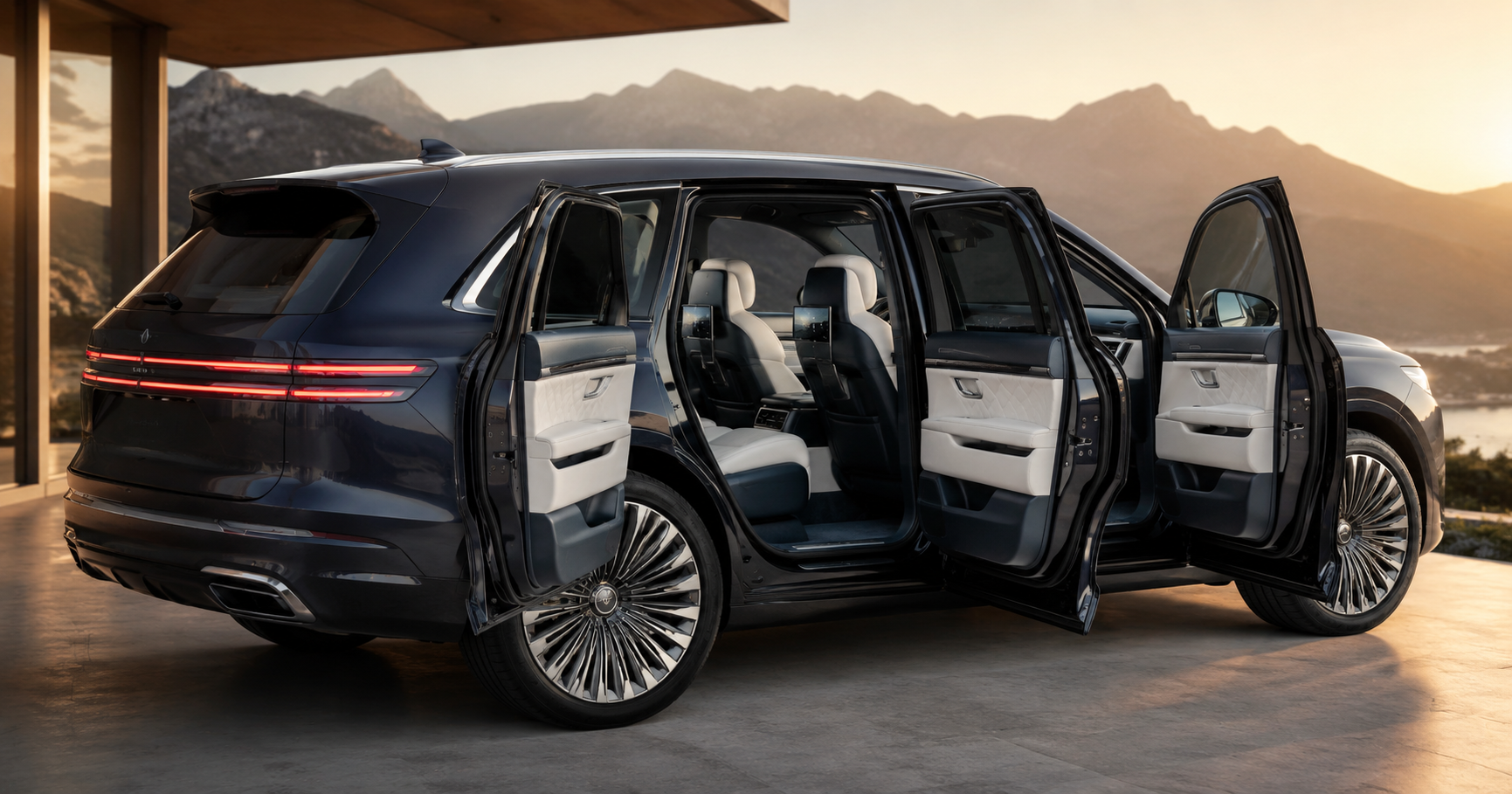
The 2028 Genesis GV90 Neolun takes a rare approach to rear-hinged coach doors, combining a pillarless opening with structural reinforcements designed to preserve safety and rigidity. Genesis says the solution relies on structural enhancements, heavy-duty hinges and a design that effectively moves the B-pillar structure into the doors themselves.
Why Coach Doors Are So Difficult to Engineer
Rear-swinging coach doors, sometimes called suicide doors, have become increasingly uncommon on modern automobiles. They are regularly seen on Rolls-Royce models, but the design presents engineering challenges because the doors can be difficult to seal against weather and may create functional compromises related to safety.
Rolls-Royce uses a physical B-pillar running from the roof to the floor, which improves rigidity and safety but can restrict ingress and egress. Other automakers, including Honda with the 2003-2011 Element and Mazda with the 2003-2012 RX-8, used B-pillar-less coach doors, but those openings were shortened to improve crash safety and could only be opened after the front doors were opened.
Genesis faced a different challenge with the GV90 Neolun: creating a fully functional pillarless opening without sacrificing structural integrity or safety.
How Genesis Engineered the Neolun Arch Doors
Genesis calls the system the “Neolun Arch Doors,” and the design almost did not make it into the vehicle. Luc Donkerwolke, Genesis’ president and chief creative officer, said obtaining approval for the concept from the Hyundai Motor Group president at the time was extremely difficult.
The Genesis design team was told it would receive approval only if it could make the coach-door version of the GV90 as safe as, or safer than, the conventional swing-door version. Donckerwolke described the challenge as daunting and credited a talented team of designers who would not take no for an answer.
GV90 Neolun Safety and Structural Reinforcement
To preserve the vehicle’s structural stability while maintaining the pillarless opening, Genesis effectively moved the B-pillar structure from the body into the doors.
The GV90 Neolun doors use dual-steel beams rated for 1.8 gigapascals, or GPa, of tensile strength. Most automotive steel is rated at less than 1.0 GPa. The beams run vertically along the inside edges of the doors before extending horizontally along their bottoms to the points where the doors meet the A and C pillars.
Heavy-duty stoppers mounted in the roof and the vehicle’s door sill also help secure the doors to the body.
Genesis further strengthened the GV90’s base body structure with what it calls a “hidden roll cage.” The system uses 1.5 GPa steel tubes running through the SUV’s roofline, along with high-strength steel through the rockers and around the wheel arches.
Additional reinforcement includes horizontal members across the floor, structural foam throughout the vehicle and high-pressure die-cast aluminum around the rear door hinges.
For occupant protection, Genesis moved the seatbelts from the B-pillar, where they are located on swing-door GV90s, to the front seats. The vehicle also uses multistage airbags, including what Genesis says is the world’s first roof airbag.
How the GV90 Neolun’s Dual-Motion Hinges Work
The rear doors weigh 155 pounds each, creating another engineering challenge: allowing them to open smoothly and independently.
Genesis developed a “dual-motion hinge” to address the issue. Mounted inside the cast aluminum panel, the system uses a high-strength cast-iron “center block” housed in aluminum.
When the electric doors are activated through a button on the door, the second-row infotainment system or the driver’s seat, each door initially extends outward like a minivan door. It then swings open smoothly to about 80 degrees.
The hinge slides along two rails containing more than 500 ball bearings, functioning somewhat like a forklift arm turned sideways. Genesis says the rails vary in thickness according to the door’s load-bearing path, helping reduce weight while supporting smooth operation and long-term reliability.
Sensors and Weather Sealing
The doors also use ultrasonic sensors to help prevent collisions during automatic opening and closing. The sensors can detect objects in the door’s path and stop its movement, while sensors on the inside can identify when a person’s body or limbs could obstruct the door.
Three layers of weather stripping are used to seal the cabin against dust, weather and noise.
Independent testing by the National Highway Traffic Safety Administration and Insurance Institute for Highway Safety will ultimately be needed to verify Genesis’ safety claims. The GV90 Neolun nevertheless represents an attempt to combine a functionally pillarless opening with independently operated coach doors and extensive structural reinforcement.