
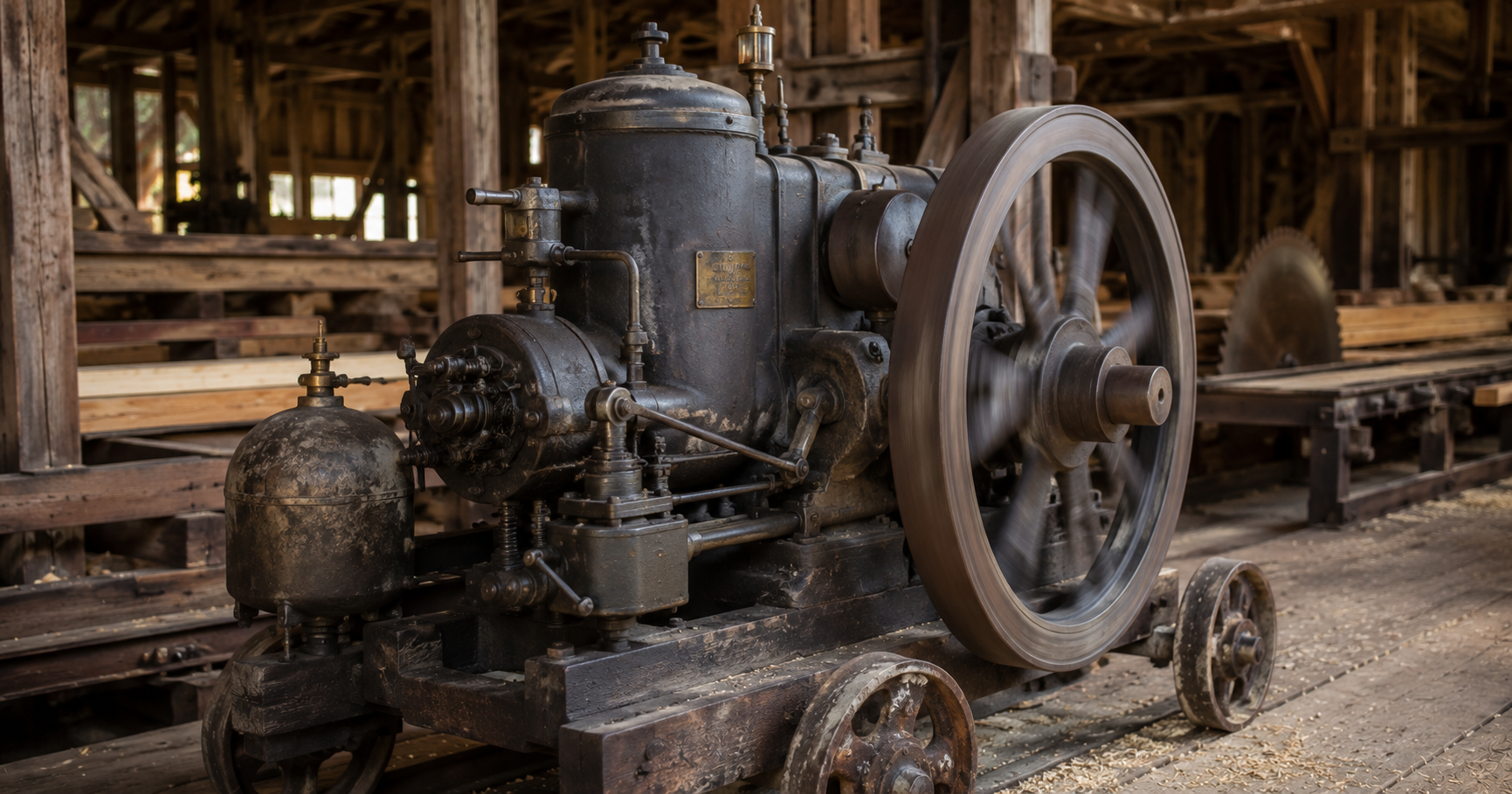
A rare 1915 International Harvester hit-and-miss engine that spent seven decades powering a Pennsylvania planing mill has resurfaced in remarkably original condition. Believed to be one of only three surviving examples, the 25-horsepower engine offers a rare look at an early stage in the evolution of internal-combustion technology.
A Rare Survivor From 1915
According to a recent video published on the YouTube channel Antique Tractor Life, the engine is one of just three examples thought to remain today.
The 25-horsepower, single-cylinder engine was built by International Harvester in 1915. It operated inside a planing mill for approximately 70 years before being sold at auction in the 1990s, retaining much of its original condition.
How a Hit-and-Miss Engine Works
The engine is known as a “hit-and-miss” design because it fires only when operating at a specific speed. When that speed is reached, the engine ignites during a “hit.” At other times, it cycles without ignition, creating a “miss.”
Engine speed is controlled by the opening and closing of the exhaust valve, which is connected to a rocker arm similar to those found in more conventional engine designs. A governor keeps the exhaust valve open to regulate speed, while the intake valve operates solely through the suction created inside the combustion chamber. If the exhaust valve remains open, the intake valve does not open.
The engine produces 25 horsepower from 1,100 cubic inches, or approximately 18 liters, of displacement.
International Harvester’s Early Engine Production
According to the video, International Harvester manufactured hit-and-miss engines in Milwaukee between 1904 and 1917.
The company initially produced gasoline-powered 6-, 8-, and 15-horsepower models before expanding the lineup. The 25-horsepower version entered production in 1910.
In 1913, International Harvester also introduced kerosene-powered variants as rising demand from the growing automobile industry increased gasoline prices.
The engines were offered in horse-portable and wagon-portable configurations for farm use, while stationary versions provided mechanical power before widespread access to electrical service. Although this particular engine spent most of its working life as a stationary power source, it was originally built on a wheeled chassis.
From the Scrap Yard to Decades of Service
By the 1930s, hit-and-miss engines had largely become obsolete as newer technologies replaced them.
This engine had already been destined for the scrap yard before receiving a second life in 1935. Following a fire caused by the steam engine that had previously powered a Pennsylvania mill, the discarded International Harvester engine was purchased because affordability was a priority during the Great Depression.
The decision proved successful, and the engine continued powering the mill until it was sold at auction in 1997.
Preserved by Years of Work
After its auction sale, only limited mechanical work was required to restore the engine to operating condition.
According to the video, decades of accumulated oil and sawdust from its working life helped preserve the engine, leaving one of the few known surviving 1915 International Harvester hit-and-miss engines in remarkably original condition.