
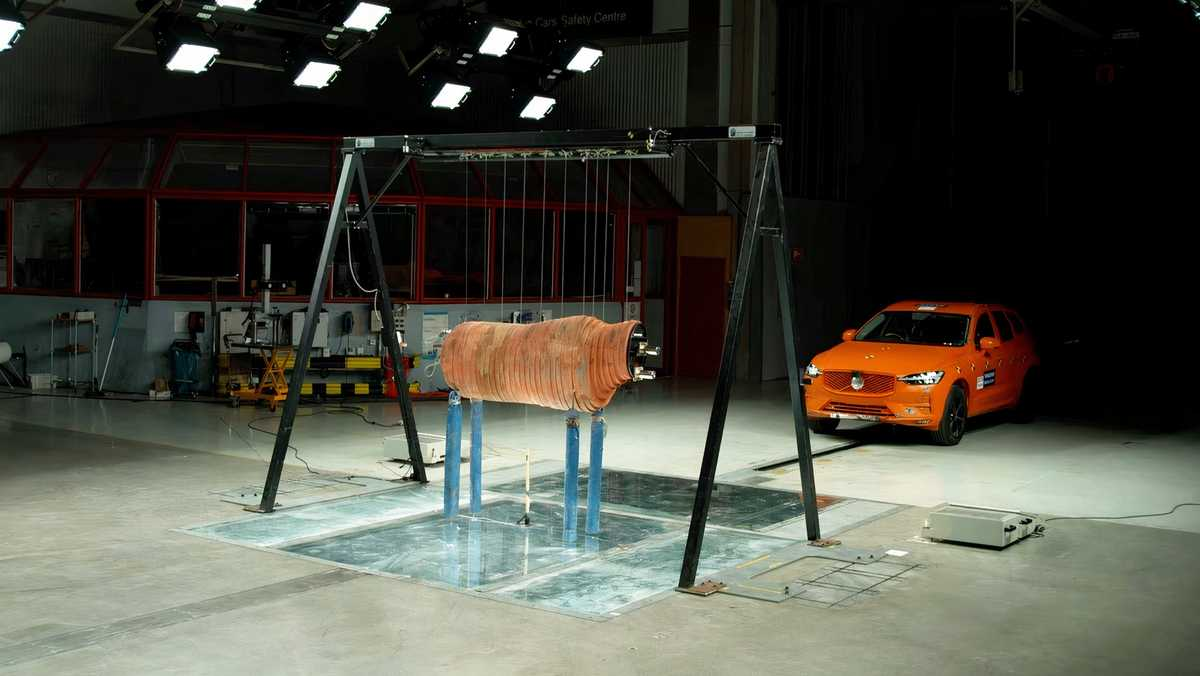
Volvo continues to use a specialized moose crash test dummy to study what happens when vehicles cannot avoid large animals, building on a safety practice that began in Sweden in the 1970s.
How the Moose Test Began
In the 1970s, moose posed enough of a problem for drivers in Sweden that a test was developed to examine how vehicles handle sudden, massive obstacles. The test is now standardized and performed at 45 mph on a dry road surface, using cones to force a vehicle into the oncoming lane before returning it to its original lane.
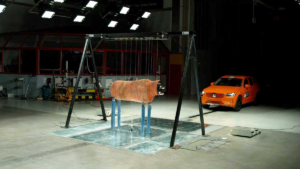
That procedure became known as the “moose test.” To better understand what happens when a vehicle fails to avoid the obstacle, the Swedish National Road and Transport Research Institute developed a moose crash test dummy.
Given Volvo’s legacy of vehicle safety, the company owns one of the specialized dummies and continues to use it.
Volvo Simulates Realistic Moose Collisions
During a recent visit with Volvo, Thomas Broberg, Senior Technical Advisor at the Volvo Cars Safety Center, discussed the company’s safety standards and its approach to animal collisions.
Broberg said Volvo’s safety standard goes beyond what any automaker is required to comply with and includes collisions with animals as a real-world concern.
“It started during the ’80s, I think with Nils Bohlin and the team at that time. Because they’re usually on rural roads, these animals move at dusk and dawn,” Broberg explained. “They are, by nature, camouflaged, so difficult to see. And it’s usually high speed then as well. All the mass of the animals can be anything from 300 kilos to 800 kilos.”
That range is roughly equivalent to 660 pounds to 1,760 pounds. The official crash test moose weighs 793 pounds.
There are likely only two such crash test moose because human crash test dummies are already incredibly expensive to develop and build, making a giant moose even more costly. Saab also previously focused specifically on moose, but the automaker is now defunct, meaning this could be the only one left.
Does Moose Testing Apply to Other Animals?
The same safety principles can apply to other large animals. Broberg said camels are one of the bigger traffic safety concerns in Saudi Arabia.
The legs of a large animal, whether it is a moose, elk, cow, deer or another animal that can unexpectedly cross a road, generally do not cause the main danger to the vehicle. Instead, the animal’s body can travel over the hood and strike the windshield.
That is why Volvo concentrates on areas including the header and A-pillars in an effort to prevent the crash from affecting passengers.
Animal Detection and Connected Safety
Ideally, modern vehicles would detect animals before impact and respond accordingly. However, Broberg explained that low-light conditions and the animals’ natural camouflage can make detection difficult.
The technology is improving, and Volvo is also discussing connected safety. The idea is that if a vehicle detects an animal at the side of the road, that information could be sent to the cloud and then shared with other drivers traveling on the same road.
Kangaroo Crashes Present a Different Challenge
Australia sees about 20,000 collisions with kangaroos each year, and crash test dummy kangaroos also exist.
The challenge is that most accidents involving kangaroos occur because drivers make avoidance maneuvers, bringing the issue back to the principle behind the moose test. Fortunately for drivers, though not for kangaroos, the collisions are mostly dangerous to the animals.