
Mazda’s rotary engine could return as a true source of propulsion, with the automaker considering hybrid technology as a potential way to overcome the emissions challenges that have long complicated the Wankel engine.
Mazda’s Last Rotary-Powered Car
For more than a decade, the Mazda RX-8 has been the company’s last rotary-powered sports car. But it was not Mazda’s final vehicle to use a Wankel engine.
That distinction belongs to the MX-30 R-EV, which is still being made in (presumably) limited numbers today. However, its rotary engine serves as a range extender rather than directly powering the vehicle.
Mazda has continued to express interest in bringing rotary propulsion back. While the MX-30 R-EV could be viewed as a test run, the company has confirmed that its next application will use the rotary engine to actually move the car rather than simply operate as a generator.
Mazda Wants Drivers to Experience the Rotary
Speaking to Car Magazine, Moritz Oswald, project manager for product planning and co-creation at Mazda Motor Europe, said Mazda intends to bring rotary power back.
Oswald explained that the appeal of the rotary comes from the driving sensations it provides, including its revving, sound and vibration. “The reason why people love the rotary is because of the revving, because of the sound, because of the vibration. So, I think if we want to bring that to an audience, the easiest way is if you could let the customer experience how that engine revs.”
For some Mazda enthusiasts, repeated promises of a rotary comeback may have become frustrating. The current automotive climate also presents significant emissions challenges for the engine, although Mazda could still find a way to make it work.
Hybrid Technology Could Help Mazda’s Rotary Return
Oswald suggested that hybrid technology could provide one possible solution to the emissions hurdle. It remains unclear whether Mazda would use a regular hybrid system or a plug-in hybrid setup.
“In theory, there’s a lot of opportunities. If you have a battery and you can control that, the car will always turn on in EV mode, and then the rotary heightens up [later]. So, there’s a lot of potential ways there.”
Mazda has also recently filed a patent for a clever exhaust gas regulator designed to help curb emissions, addressing a long-time weakness of the rotary engine.
A hybrid rotary setup would require Mazda to engineer a specialized battery management system capable of maintaining enough charge for the vehicle to operate in EV mode before the rotary engine starts. One potential compromise could involve a shorter electric-mode range, allowing the engine to operate more frequently to maintain the battery’s charge.
Which Mazda Could Get Rotary Power?
Oswald’s comments about the distinctive sensations of driving a rotary-powered vehicle point toward a sports car as one possible application. Which sports car could receive the engine remains unknown.
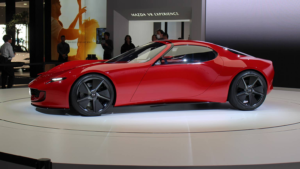
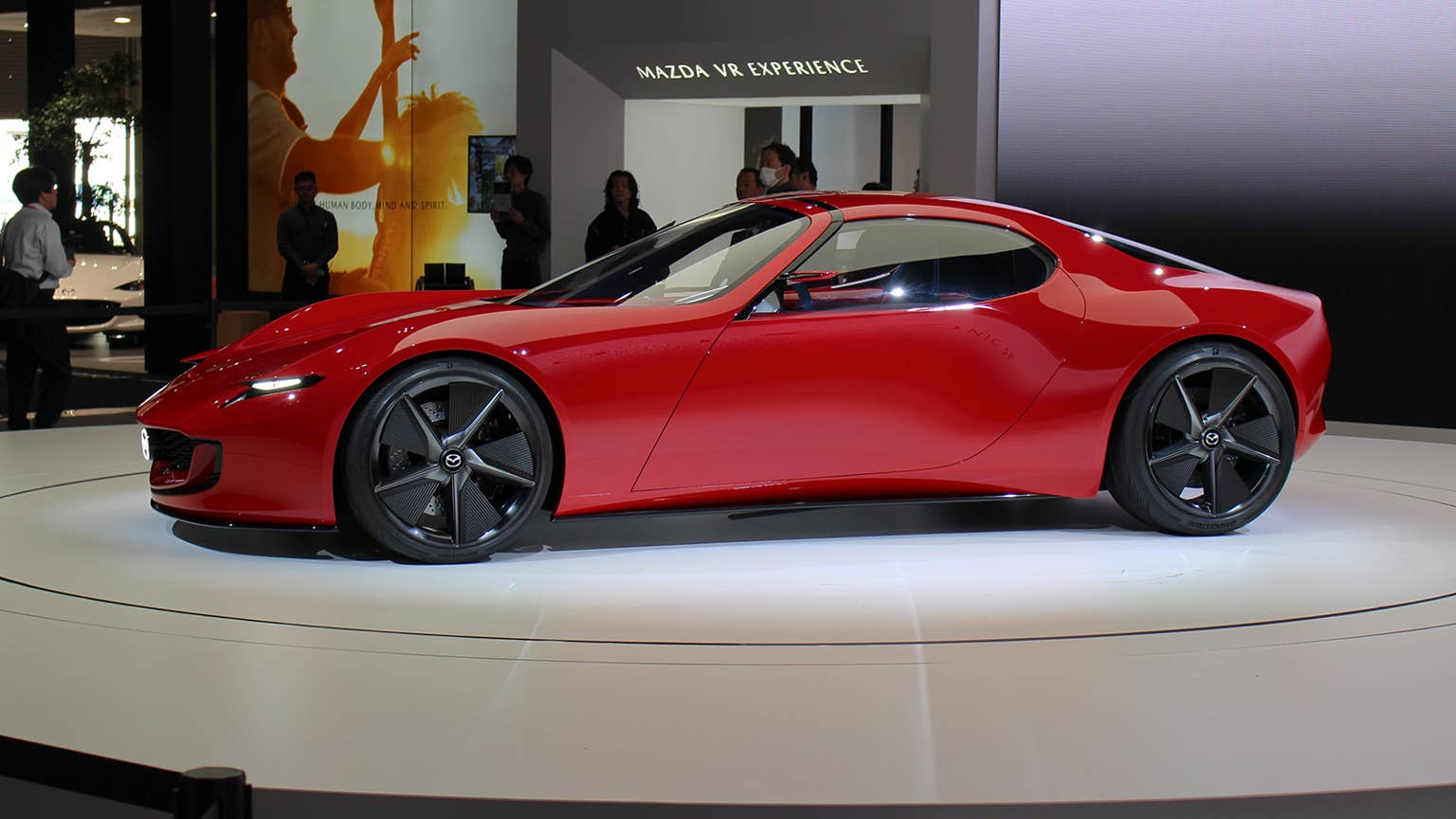
The MX-5 could be one possibility if Mazda wants to preserve its lightweight character while adding hybrid technology. Another potential candidate is a production version of the Iconic SP concept shown at the 2023 Japan Mobility Show.
The rotary engine could also find its way into more everyday Mazda models. A hybrid rotary Mazda3 or CX-5 could be possible applications for the technology.
Mazda’s history with the Wankel engine extends beyond sports cars, including its use in a bus. If the company succeeds in bringing rotary power back, the engine could therefore find applications across more than one type of vehicle.