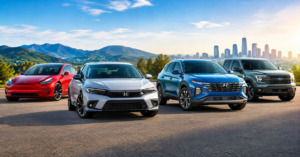

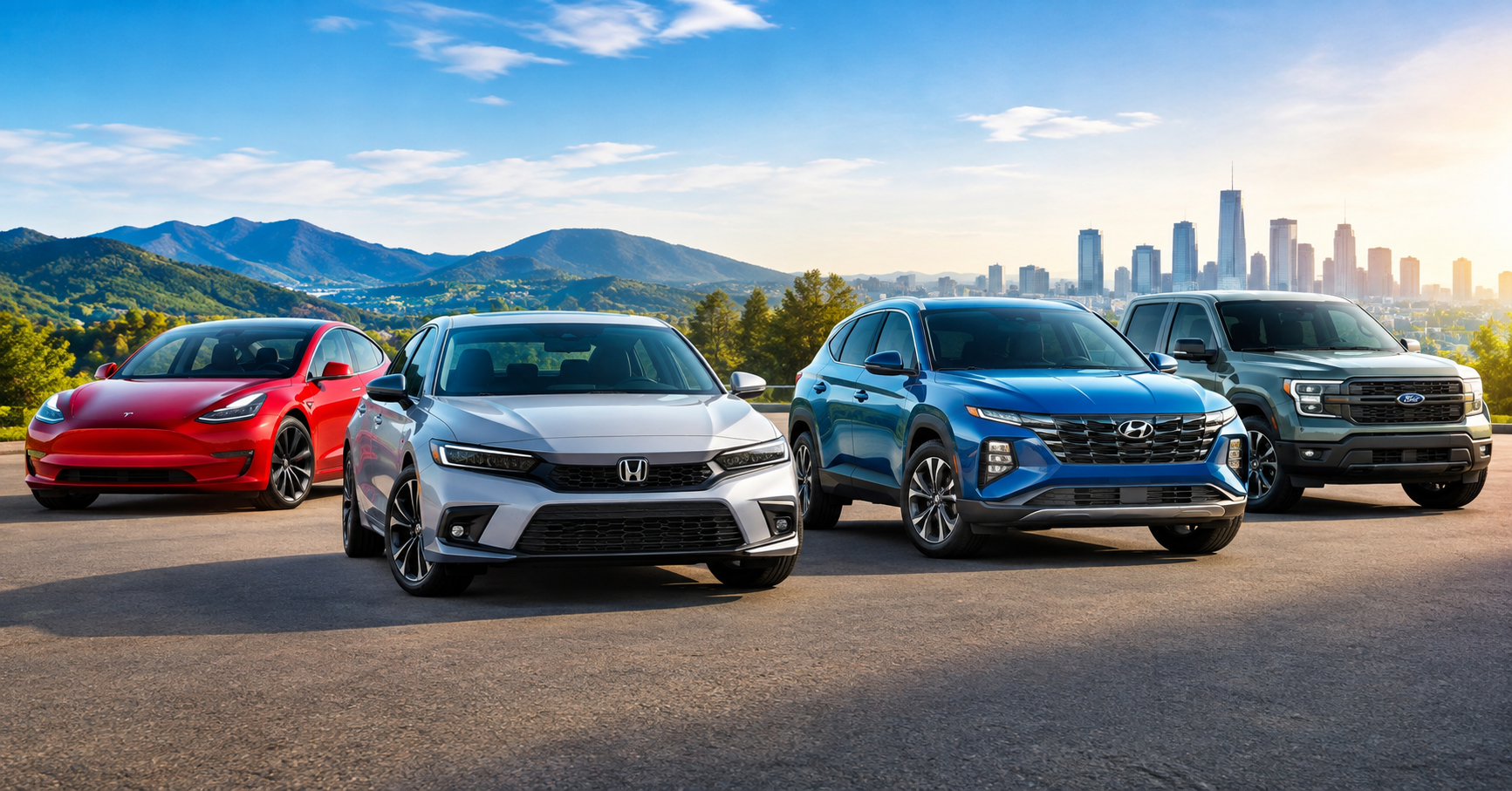
Buying a new car in 2026 is a different proposition than it was just a few years ago. The average new-vehicle transaction price reached $50,089 in August 2026, according to Kelley Blue Book and Cox Automotive, putting even ordinary new vehicles well beyond what many shoppers would consider affordable.
That is what makes identifying the best new cars 2026 buyers should consider more complicated than simply picking the newest or most expensive models. A good choice needs to make sense after the test drive, at the fuel pump or charging station, in the insurance bill and throughout years of ownership.
Our 10-model shortlist focuses on that balance. It includes vehicles recognized by independent automotive evaluators, models with strong current safety credentials and products that address very different needs, from commuting and family transportation to electric driving and truck capability.
How We Chose the Best New Cars of 2026
There is no single vehicle that is perfect for every American driver. A commuter covering 15,000 miles a year has different priorities from a family that needs three rows, while an EV shopper may care more about charging speed than towing capacity.
For this list, the emphasis is on value, usability, efficiency, safety, driving quality and ownership practicality. We also considered independent testing and current market conditions rather than relying solely on manufacturer specifications.
Safety is particularly important in 2026. The Insurance Institute for Highway Safety, or IIHS, tightened its requirements for its awards this year, placing greater emphasis on rear-seat protection and crash-avoidance technology.
Pricing was also considered within each vehicle category. Comparing a compact sedan directly with a three-row SUV based only on sticker price would be misleading. The better question is whether a vehicle delivers strong value for its intended use.
The 10 Best New Cars 2026 Buyers Should Consider
1. Honda Civic Hybrid — Best All-Around Compact Car
The 2026 Honda Civic Hybrid makes a strong case for being the most broadly appealing vehicle on this list. It combines the traditional strengths of a compact Honda with hybrid efficiency, useful interior space and the choice of sedan or hatchback body styles.
Edmunds selected the Civic Hybrid as its 2026 Top Rated Car, following track testing and extensive real-world driving. The hybrid can achieve up to 49 mpg combined, giving commuters a significant efficiency advantage without requiring them to make the switch to a fully electric vehicle.
The Civic’s conventional dimensions are another advantage. For buyers who spend most of their time commuting, navigating crowded parking lots or driving in urban areas, a compact car can be easier to live with than a large SUV.
The hatchback version adds additional flexibility, while the sedan remains a straightforward choice for drivers who prioritize traditional passenger-car proportions.
Why it stands out
- Up to 49 mpg combined.
- Available as a sedan or hatchback.
- Strong balance of efficiency and everyday practicality.
- Edmunds’ 2026 Top Rated Car.
- Compact dimensions make it easy to use as a daily driver.
The main compromise is price. Hybrid versions cost more than the entry-level Civic, and buyers who specifically want an SUV-like seating position will probably look elsewhere.
2. Hyundai Palisade Hybrid — Best Family SUV
Families looking for three rows have a particularly interesting option in the 2026 Hyundai Palisade Hybrid. The redesigned SUV can seat up to eight people and combines the practicality of a large family vehicle with hybrid efficiency.
Edmunds named the Palisade Hybrid its Top Rated SUV and Best of the Best for 2026. The vehicle can achieve up to 34 mpg combined, an important figure for shoppers who need the space of a large SUV but do not want to accept the fuel consumption associated with many traditional three-row vehicles.
The Palisade’s appeal is less about being inexpensive and more about what buyers receive for the money. Three-row space, family-oriented practicality and hybrid power combine in a package positioned below the territory of many luxury-brand SUVs.
Still, buyers should remember that this is a large vehicle. Parking and maneuvering in tight urban environments can be more difficult than with a compact crossover. And because the 2026 model represents a new generation, long-term reliability information is naturally more limited than it is for an established model.
3. Hyundai Ioniq 5 — Best Electric SUV
The 2026 Hyundai Ioniq 5 is one of the strongest choices for shoppers who want an electric crossover without giving up interior space or fast charging capability.
Edmunds selected it as its 2026 Top Rated Electric SUV. The Ioniq 5 stands out for its spacious cabin, distinctive design and ability to make quick use of compatible public fast chargers.
For an EV buyer, however, the vehicle itself is only part of the equation. Charging access can determine whether an electric car is convenient or frustrating.
A shopper with reliable home charging may experience ownership very differently from someone who depends entirely on public chargers. Highway driving, winter temperatures and driving speed can also affect real-world range.
That makes the Ioniq 5 particularly attractive to buyers whose daily routines fit its charging requirements, rather than simply those attracted to its technology.
Why it stands out
- Spacious and flexible cabin.
- Fast public charging capability.
- Distinctive crossover design.
- Edmunds’ 2026 Top Rated Electric SUV.
- Strong alternative to conventional gasoline SUVs.
4. Tesla Model 3 — Best Electric Sedan
The 2026 Tesla Model 3 takes a different approach to EV transportation. Instead of an SUV body, it offers sedan proportions and an emphasis on electric efficiency and range.
Edmunds named the Model 3 its 2026 Top Rated Electric Car. In Edmunds’ independent EV Range Test, the Long Range AWD version covered 338 miles.
Range is one of the most important numbers for an EV, but it should not be the only consideration. Buyers also need to evaluate charging access, interface preferences and the overall ownership experience.
The Model 3’s minimalist cabin and controls will appeal to some drivers more than others. Tesla’s approach to driver assistance and its ownership ecosystem are also considerations that shoppers should evaluate before purchasing.
For someone who wants an electric sedan and places a high value on driving range, the Model 3 remains a significant 2026 option.
5. Ford Maverick — Best Affordable Truck
Not every truck buyer needs a massive pickup. The 2026 Ford Maverick demonstrates why compact pickups remain relevant for drivers who want an open bed without accepting the size and cost of a full-size truck.
Edmunds named the Maverick its 2026 Top Rated Truck. It is available with hybrid and turbocharged powertrains, can be equipped with all-wheel drive and offers up to 4,000 pounds of towing capacity.
That combination gives the Maverick unusual versatility. It can serve as a commuter during the week while still providing useful truck functionality for home projects, recreation or light towing.
There are obvious limitations. The bed and cabin are smaller than those of midsize and full-size pickups, and buyers who regularly tow heavy loads will need a more capable truck.
Availability can also matter. Popular configurations may be harder to find at advertised prices, meaning shoppers should compare actual dealer inventory and transaction prices rather than assuming the lowest advertised figure is readily available.
6. Toyota Camry — Best Traditional Hybrid Sedan
The 2026 Toyota Camry remains a compelling option for drivers who want proven sedan practicality combined with a hybrid powertrain.
Unlike some newer vehicles that rely heavily on dramatic styling or cutting-edge interfaces, the Camry focuses on the fundamentals: comfortable transportation, efficiency, passenger space and straightforward usability.
It also earned an IIHS Top Safety Pick+ award for 2026. That matters because IIHS significantly increased the requirements for its awards this year.
The Camry’s biggest disadvantage is also one of its defining characteristics: it is a sedan. Buyers who regularly carry bulky cargo, need maximum rear-seat flexibility or simply prefer the elevated seating position of an SUV may find a crossover more suitable.
For shoppers who specifically want a traditional four-door hybrid, however, the Camry deserves serious consideration.
7. Hyundai Kona — Best Small SUV Value
The 2026 Hyundai Kona illustrates one of the most important trends in the new-car market: shoppers do not have to spend $50,000 to get a vehicle with strong modern safety credentials.
The Kona earned an IIHS Top Safety Pick+ award, and IIHS identified it as the least expensive small SUV among its award winners at the time of its 2026 announcement, with a starting price of $25,500.
That positioning makes it particularly relevant in a year when average new-vehicle prices are hovering around $50,000.
The Kona is not intended to replace a large family SUV. Rear-seat and cargo capacity are more limited, and lower trims may not offer every feature buyers want.
But for a single driver, couple or small family, its smaller footprint and comparatively accessible price can make more financial sense than moving into a larger SUV.
8. Mazda CX-50 — Best-Driving Compact SUV
The 2026 Mazda CX-50 is aimed at buyers who want the practicality of a crossover without completely giving up driving enjoyment.
The CX-50 earned an IIHS Top Safety Pick+ award in 2026. Its appeal, however, goes beyond safety. Mazda has traditionally emphasized steering response and road manners, giving the CX-50 a more engaging character than many mainstream crossovers.
That can make a difference for buyers who spend significant time behind the wheel and want their vehicle to feel like more than basic transportation.
The tradeoff is packaging. Rear-seat and cargo space are not class-leading, and the ride can feel firmer than some competitors.
In other words, the CX-50 makes sense for the driver who values the experience of driving as much as the practical benefits of owning an SUV.
9. Kia K4 — Best Affordable Sedan
At the lower end of the new-car market, the 2026 Kia K4 deserves attention because affordability does not necessarily mean sacrificing current safety technology.
IIHS named the K4 a Top Safety Pick+, and its 2026 award information lists a starting price of $22,290.
That puts the K4 far below the industry’s $50,089 August average transaction price.
The K4 is particularly relevant for first-time new-car buyers, commuters and households that want to keep the purchase price under control. Its conventional sedan configuration also makes it straightforward transportation for everyday use.
The downside is flexibility. A sedan cannot match the cargo versatility of a hatchback or SUV. Buyers may also give some ground in perceived brand reputation and resale strength compared with established leaders such as Honda and Toyota.
10. Rivian R1T — Best Electric Pickup
The 2026 Rivian R1T occupies a very different position from the Kia K4 or Hyundai Kona. It is not a value leader, but it demonstrates how far electric pickup capability has progressed.
Edmunds named the R1T its Top Rated Electric Truck. In Edmunds’ testing, a dual-motor version equipped with the Max battery achieved 390 miles, while the truck offers up to 11,000 pounds of towing capacity.
Those figures make the R1T relevant to buyers who want an electric vehicle but refuse to give up truck capability.
There is an important financial caveat: the research brief lists a starting price of $74,885. That places it firmly in the premium portion of the market.
Towing can also reduce real-world EV range substantially, and Rivian’s service network is smaller than those of long-established automakers.
The R1T therefore belongs on this list as a capability-focused electric truck, not as an affordable recommendation.
What the 2026 New-Car Market Means for Buyers
The vehicles above make more sense when viewed against the broader market.
Cox Automotive reported an average U.S. new-vehicle transaction price of $50,089 in August 2026. The average MSRP was even higher at $51,852.
But averages can be deceptive. Vehicle categories vary enormously in price.
- Compact cars: $27,997 average transaction price.
- Subcompact SUVs: $31,149.
- Compact SUVs: $37,722.
- Midsize SUVs: $50,315.
- Full-size pickups: $67,446.
That explains why a $25,500 small SUV can represent a better value proposition for one buyer than a $40,000 crossover, even if the larger vehicle offers more equipment.
Safety Has Become More Important in 2026
Safety technology is also changing the way shoppers should evaluate new vehicles.
IIHS reported that 63 vehicles qualified for one of its 2026 awards, including 45 Top Safety Pick+ winners and 18 Top Safety Pick winners at the time of its March announcement.
More than a dozen Top Safety Pick+ vehicles started below $30,000. That is significant because it demonstrates that advanced safety performance is not limited to expensive luxury vehicles.
The 2026 Top Safety Pick+ requirements include strong performance in multiple crash tests, acceptable or good headlights and effective pedestrian and vehicle-to-vehicle front crash prevention systems. These technologies must also be standard for the award requirements.
IIHS also expanded its vehicle-to-vehicle front crash-prevention testing to include tests at 31, 37 and 43 mph and scenarios involving passenger cars, motorcycles and semitrailers.
For consumers, the practical lesson is simple: do not judge a vehicle’s safety solely by counting the driver-assistance features listed on its equipment sheet.
Look at independent crash-test results and determine which safety systems are actually standard on the trim you are considering.
Hybrid vs. EV vs. Gas: Which Should You Buy?
The best powertrain depends heavily on how the vehicle will be used.
Choose a hybrid if:
- You want better fuel economy without depending on charging infrastructure.
- You frequently take long road trips.
- You want an easier transition from a gasoline vehicle.
- Your daily driving includes significant stop-and-go traffic.
Choose an EV if:
- You have reliable home or workplace charging.
- Your daily driving pattern fits the vehicle’s range.
- You are comfortable planning longer trips around charging.
- You want to eliminate gasoline purchases during normal driving.
Choose a gasoline vehicle if:
- Low initial purchase price is a major priority.
- You frequently drive long distances without predictable charging.
- You need towing flexibility.
- Your local fuel infrastructure is substantially more convenient than charging.
There is no universally correct answer. The cheapest powertrain to operate on paper is not necessarily the cheapest choice for every household once purchase price, insurance, electricity or gasoline costs, financing, maintenance and annual mileage are included.
Are Electric Cars Becoming More Affordable?
The 2026 EV market is moving in that direction, although electric vehicles remain more expensive on average than the broader new-car market.
Cox Automotive reported an average new-EV transaction price of $54,813 in August 2026, down 2.7% from a year earlier. The average EV premium fell to 9.4%, compared with more than 16% a year earlier.
EV incentives also averaged 12% of transaction price, considerably above the industry’s 6.5% average.
However, buyers should be careful about assuming a federal tax credit will reduce the price of a 2026 vehicle. The federal clean-vehicle credit landscape changed after September 30, 2025, and eligibility can depend on the vehicle, acquisition date, buyer circumstances and other requirements.
State, utility and manufacturer incentives can still change the calculation, so shoppers should verify current programs before signing a purchase agreement.
What Makes a New Car a Good Buy in 2026?
The strongest purchase decision usually comes from looking beyond the monthly payment.
Before buying, compare:
- Transaction price: What are buyers actually paying rather than simply the advertised MSRP?
- Financing: How much interest will the loan add over its full term?
- Insurance: Is the vehicle expensive to insure compared with alternatives?
- Fuel or electricity: Estimate the cost using your actual annual mileage.
- Maintenance: Consider scheduled service, tires and likely repairs.
- Depreciation: A lower purchase price does not automatically mean lower long-term cost.
- Practicality: Make sure the vehicle fits your passengers, cargo and lifestyle.
- Safety: Check current IIHS and NHTSA information rather than relying on marketing language.
A buyer who spends $5,000 less on a vehicle but dislikes driving it, struggles with cargo space or faces significantly higher financing costs may not actually have made the better purchase.
Should You Buy Now or Wait?
There is no universal advantage to waiting until the end of the year.
Late-year shopping can sometimes bring incentives on outgoing model-year vehicles, but waiting can also reduce selection. Financing rates, inventory and manufacturer incentives change independently of one another.
Cox Automotive has also noted that prices can rise as the year progresses and newer model-year vehicles arrive, while incentives and inventory conditions vary by manufacturer and model.
The more useful strategy is to monitor the specific vehicle you want rather than waiting for an arbitrary calendar date.
If a vehicle is available at a competitive transaction price, has the configuration you need and fits your budget, there may be little benefit in waiting simply because a particular month is considered a traditional buying period.
Our 10 Picks at a Glance
| Vehicle | Best For | Key Strength |
|---|---|---|
| Honda Civic Hybrid | All-around compact | Efficiency and versatility |
| Hyundai Palisade Hybrid | Families | Three-row hybrid practicality |
| Hyundai Ioniq 5 | Electric SUV shoppers | Charging and interior space |
| Tesla Model 3 | Electric sedan buyers | Range and efficiency |
| Ford Maverick | Truck shoppers | Compact size and utility |
| Toyota Camry | Hybrid sedan buyers | Efficiency and safety |
| Hyundai Kona | Value-focused SUV buyers | Safety and affordability |
| Mazda CX-50 | Driving enthusiasts | Driving dynamics |
| Kia K4 | Budget-conscious buyers | Price and safety |
| Rivian R1T | Electric truck buyers | Range and towing capability |
Frequently Asked Questions
What is the best new car to buy in 2026?
For a broad range of buyers, the Honda Civic Hybrid is a particularly strong choice because it combines up to 49 mpg combined, sedan and hatchback configurations, practical dimensions and Edmunds’ 2026 Top Rated Car recognition.
What is the best family SUV for 2026?
The Hyundai Palisade Hybrid is a strong choice for shoppers who need three rows. It seats up to eight, offers up to 34 mpg combined and was selected by Edmunds as its 2026 Top Rated SUV and Best of the Best.
What is the safest new car in 2026?
There is no single safest vehicle for every category and buyer. Shoppers should compare current IIHS and NHTSA results by vehicle class. Among the models covered here, the Toyota Camry, Hyundai Kona, Mazda CX-50, Hyundai Ioniq 5 and Kia K4 earned IIHS Top Safety Pick+ recognition for 2026.
What is the best affordable new car in 2026?
The Kia K4 is one of the most compelling low-cost options in this group. IIHS lists a starting price of $22,290 and gives it a 2026 Top Safety Pick+ award.
Is a hybrid better than an EV in 2026?
It depends on the buyer. A hybrid can be a better fit for drivers without convenient charging access or those who regularly make long trips. An EV can make more sense for drivers with home charging and predictable daily mileage.
Are new cars still expensive in 2026?
Yes. Kelley Blue Book reported an average new-vehicle transaction price of $50,089 in August 2026. However, the average hides major differences between segments. Compact cars averaged $27,997, while subcompact SUVs averaged $31,149.
Are EV tax credits still available in 2026?
Federal clean-vehicle incentives changed after September 30, 2025, so buyers should not automatically assume that a 2026 purchase qualifies. State, local, utility and manufacturer incentives may still be available. Eligibility should be confirmed using current government guidance before purchase.
Does a five-star NHTSA rating mean a car is the safest?
No. NHTSA’s five-star program evaluates areas including crashworthiness and rollover resistance, while advanced driver-assistance testing is a separate component of its broader evaluation work. IIHS uses its own crash and crash-prevention tests and award criteria.
Bottom Line
The best new cars 2026 shoppers can buy are not necessarily the vehicles with the biggest screens, highest horsepower numbers or most expensive badges.
In a market where the average new vehicle costs roughly $50,000, value has become increasingly important. The Honda Civic Hybrid demonstrates how efficiency and practicality can work in a compact package. The Hyundai Palisade Hybrid offers a three-row solution for families. The Hyundai Kona and Kia K4 show that shoppers can find strong safety credentials without approaching the industry average transaction price.
EV shoppers have compelling choices in the Hyundai Ioniq 5, Tesla Model 3 and Rivian R1T, while the Ford Maverick provides an alternative for buyers who want genuine truck utility without stepping directly into the full-size pickup market.
The most important step is to match the vehicle to the way you actually drive. Compare real transaction prices, independent safety results, fuel or charging costs, insurance, financing and expected ownership needs.
That approach may not produce the flashiest vehicle in the showroom. But in 2026, it is far more likely to produce a car you will still be happy to own years after the new-car smell is gone.