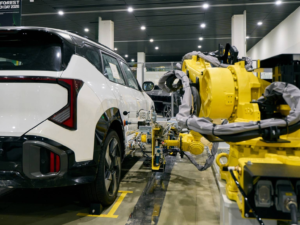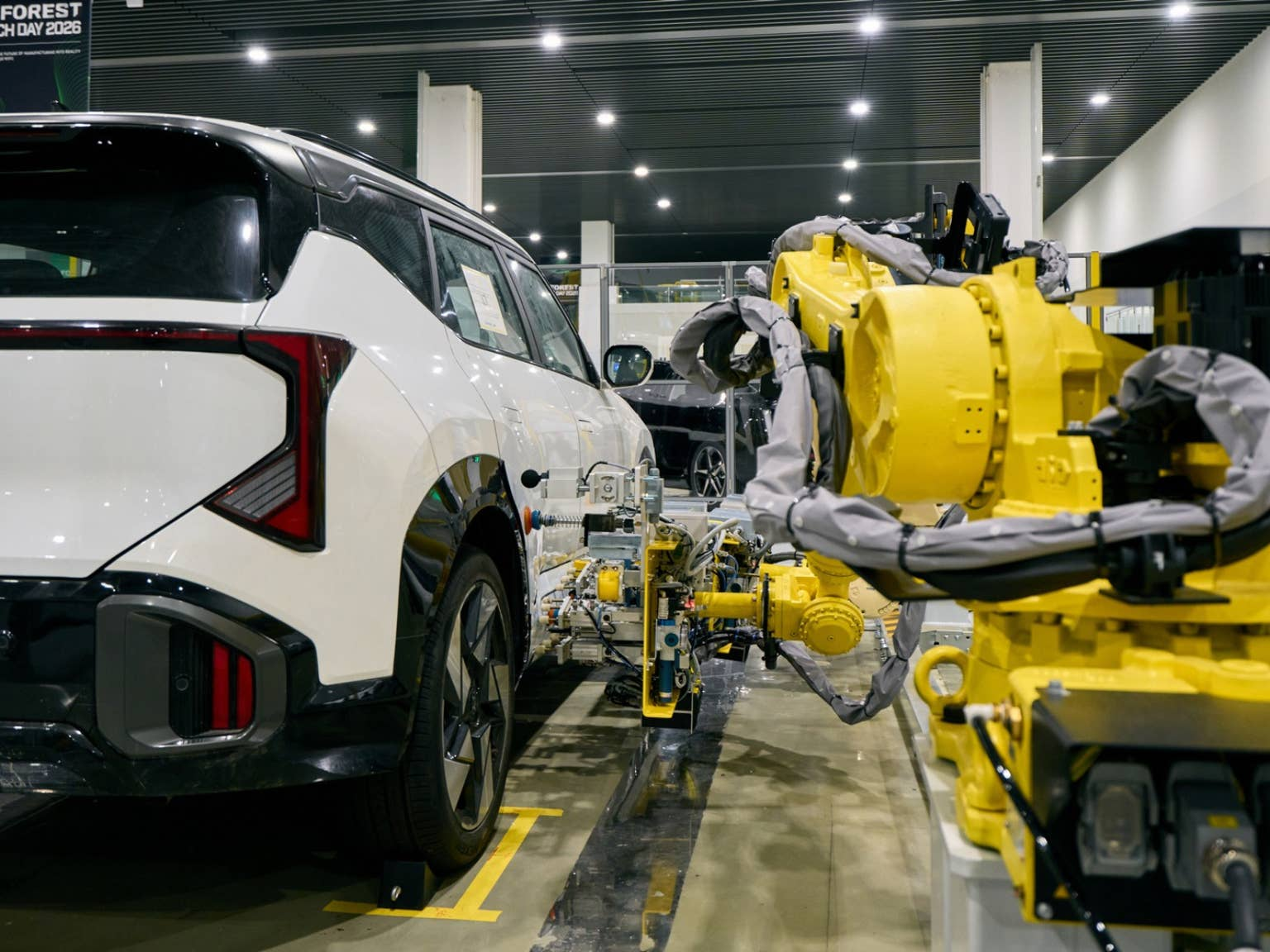
Hyundai Motor Group is accelerating its shift toward AI-powered manufacturing, introducing new technologies designed to make its factories smarter, more flexible and more efficient. Hyundai and Kia are showcasing about 200 manufacturing technologies at this year’s E-Forest Tech Day in South Korea, highlighting a future built around software-defined factories, artificial intelligence and advanced robotics. The initiative could eventually extend to the automaker’s U.S. production facilities as it works to expand manufacturing capacity in Georgia.
Hyundai and Kia Push Toward Software-Defined Factories
Hyundai Motor Group has grown into one of the world’s three largest automakers by sales, alongside Toyota and Volkswagen. Beyond developing competitive vehicles, the South Korean group plans to introduce more than 100 new and updated models by 2030 while transforming the factories responsible for building them.
Hyundai and Kia are pursuing this transformation through software-defined factories (SDFs), which use advanced software, artificial intelligence and automation to monitor, manage and optimize manufacturing processes in real time. These systems are designed to improve production efficiency and flexibility while reducing reliance on human intervention.
The group’s E-Forest brand focuses on smart factory technologies. At this year’s E-Forest Tech Day in South Korea, Hyundai and Kia are showcasing about 200 manufacturing technologies intended to support the transition to more connected and automated production facilities.
AI, Digital Twins and Robots Take Center Stage
Among the technologies on display are digital twins, AI agents and automated vehicle inspection systems. Digital twins create virtual replicas of physical factories, allowing manufacturers to simulate production processes, identify potential problems and test solutions before making changes to real-world operations.
Hyundai has also partnered with NVIDIA, the American technology company that has worked with automakers such as Volvo to develop more advanced automated driving systems. The partnership supports Hyundai’s efforts to advance the technologies needed for its software-defined factory strategy.
Energy management and advanced robotics are also part of the plan. Smarter energy-management technologies are intended to improve energy efficiency, while robotics projects include Atlas, a humanoid robot similar to Tesla’s Optimus that is expected to begin working in factories in 2028.
Kia has also previously revealed that it uses Apple Vision Pro to accelerate its vehicle design process, illustrating how the group’s adoption of new technology extends beyond factory-floor automation.
Could Hyundai’s U.S. Factories Benefit?
According to the company’s press release, the AI-driven and automated systems are intended for deployment at manufacturing plants in South Korea and overseas. That could eventually include Hyundai’s two U.S. factories in Alabama and Georgia.
The technology could support the expansion of Hyundai’s American manufacturing operations by improving production efficiency. One key target is the company’s Georgia Metaplant, where Hyundai plans to increase annual production capacity to 500,000 vehicles by 2028, up from the original target of 300,000.
However, the company has not confirmed that every technology showcased at E-Forest Tech Day will be implemented at its U.S. facilities. The stated plan is to deploy the systems at plants in South Korea and abroad as Hyundai and Kia continue developing their software-defined factory strategy.
High Costs and Cybersecurity Risks Remain Challenges
Although software-defined factories promise greater efficiency and flexibility, the transition presents challenges. Upgrading existing factory equipment to accommodate new technologies can be expensive, while greater reliance on connected digital systems introduces cybersecurity risks.
Jaguar Land Rover experienced a major production disruption following a cyberattack last year. The incident was described as the most economically damaging cyberattack in U.K. history, highlighting the potential consequences of attacks that disrupt manufacturing operations.
Automation also raises concerns about the effect of AI and robotics on factory employment. Humanoid robots such as Atlas could take over certain tasks, prompting concerns about what Hyundai’s labor union calls “employment shocks.”
Hyundai’s Smart Factory Strategy Is Still Developing
Hyundai and Kia are continuing to work toward their vision of software-defined factories, with E-Forest Tech Day serving as a platform to showcase emerging technologies and collaborate with industry partners.
The initiative brings together AI, digital twins, automated inspections, energy-management systems and advanced robotics as the automakers look to reshape manufacturing. While implementation costs, cybersecurity concerns and potential employment disruptions remain significant challenges, Hyundai and Kia are continuing to develop the technologies they hope will define their factories in the years ahead.