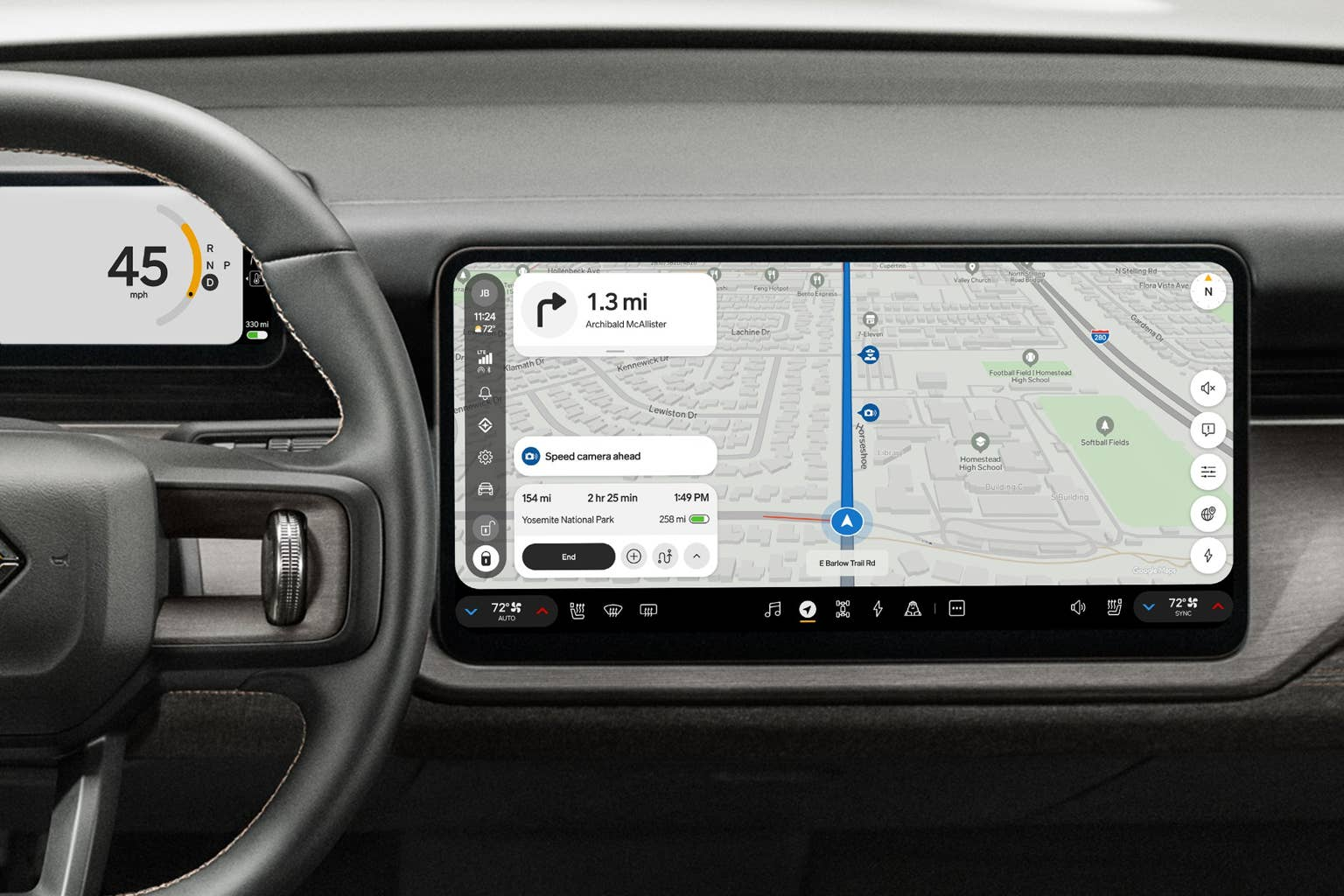
Rivian has begun beta testing its Point to Point supervised self-driving feature, giving a limited number of selected owners of its second-generation R1 vehicles and new R2 models an early opportunity to test the technology. The system combines Rivian’s existing hands-free driving capabilities with turn-by-turn navigation, allowing vehicles to follow planned routes that include turns, highway merges and surface streets while drivers remain responsible for supervising the vehicle.
The testing is part of Rivian’s Autonomy Early Access Program, which opened earlier this month. Initially limited to California and Florida, the program will help the automaker identify potential problems and gather feedback from owners as it works toward a public launch before the end of 2026, followed by a wider rollout in 2027.
Rivian Opens Its Self-Driving Beta Program to Selected Owners
The beta program gives Rivian an opportunity to evaluate its self-driving technology on real-world routes with help from vehicle owners. Although the company has already been testing the system on various routes, feedback from drivers could help identify flaws and usability issues that its development team may have overlooked.
Owners of refreshed R1T and R1S models, along with the new R2, can apply to participate if they have an active, paid $2,500 Autonomy+ subscription. However, the program is not currently open to Canadian owners or those with first-generation R1 vehicles.
California and Florida will serve as the initial testing locations, with additional states expected to follow. Rivian’s head of autonomy and AI, James Philbin, has said the company is targeting a public launch before the end of 2026, with a broader rollout planned for 2027.
Rivian CEO RJ Scaringe recently said that true self-driving cars will arrive before 2030. That timeline differs from an earlier prediction in which he said the technology would be available by 2026.
How Rivian’s Point to Point Self-Driving System Works
Rivian’s Point to Point feature builds on its Universal Hands-Free technology by integrating it with the vehicle’s turn-by-turn navigation system. Rather than simply maintaining a lane while the driver’s hands are off the steering wheel, the system can follow an entire planned route, including turns, highway merges and driving on surface streets.
Despite its expanded capabilities, Point to Point remains a Level 2 driver-assistance system. Drivers must keep their eyes on the road, remain alert and be ready to take control whenever necessary.
The technology uses Rivian’s in-house-developed Large Driving Model, a software system designed to interpret information gathered by the vehicle’s 360-degree sensor suite. That suite includes cameras, radars and solid-state LiDAR, which provide information the system uses to determine how the electric vehicle should respond.
However, the system is not infallible. Drivers must remain prepared for mistakes and be ready to intervene, even when the vehicle is following a planned route autonomously.
How to Apply for Rivian’s Autonomy Early Access Program
Owners interested in testing Point to Point must apply through the Autonomy Early Access tile in their account on Rivian.com. Only the primary account holder can access the application, meaning secondary users will not see the option or be eligible to test the technology while driving under their own profiles.
Rivian evaluates applicants based on their existing use of Autonomy features and their recent safety records. The assessment includes the frequency of alerts, such as forward-collision warnings.
Approved participants must meet ongoing testing requirements. These include using preview features each week, submitting reports through the vehicle’s touchscreen and completing a monthly survey.
Participants must also agree to share location and camera data under a non-disclosure agreement. These requirements allow Rivian to collect feedback and information as it continues developing the system.
Rivian Will Review Beta Participants Every 30 Days
Admission to the program does not guarantee continued access. Rivian will reassess participants every 30 days, and owners may be removed without warning.
The company may also decline applications or remove existing participants if it needs a broader mix of vehicle models and geographic locations for testing. As a result, even eligible owners who express interest may not be selected for the initial group.
Testing will begin in California and Florida, with expansion to other states depending partly on where interest is strongest. Owners who are not selected for the first group will not need to submit another application to remain eligible for future consideration.
Rivian’s Road to Wider Self-Driving Availability
Rivian’s Point to Point beta program marks another step in the company’s effort to expand its vehicles’ autonomous driving capabilities. By combining navigation with hands-free driving technology and collecting feedback from selected owners, the automaker is continuing to develop a system that can handle more of a planned journey.
For now, participation remains limited, geographic availability is restricted, and drivers must continue supervising the vehicle at all times. Rivian is targeting a public launch before the end of 2026, followed by a wider rollout in 2027.