The next-generation Tesla Roadster made an extraordinary impression with a prototype reveal featuring wall-climbing technology, a flying kickflip and a claimed zero-to-60 mph time of less than one second. Behind the dramatic demonstration are engineering calculations involving powerful fans, compressed nitrogen and rocket-style thrusters, although questions remain about whether the technology can translate into a reliable production vehicle.
How the Tesla Roadster Could Climb Walls
The prototype’s wall-climbing demonstration relies on a system designed to generate enormous suction beneath the vehicle. Four 20-kilowatt fans draw air from beneath a sealed aerodynamic skirt, creating an 11.5% vacuum.
The system reportedly produces approximately 10,360 pounds of artificial downforce. That would provide enough suction to hold a 4,400-pound vehicle against a ceiling without relying on conventional traction.
The technology represents a departure from a typical automotive reveal, with the Roadster demonstrating capabilities that appear closer to science fiction than traditional performance-car engineering.
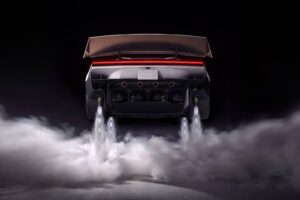
Rocket Thrusters Power the Flying Kickflip
The Roadster’s airborne demonstration relies on highly compressed nitrogen stored in composite tanks. The system reportedly holds 550 pounds of nitrogen compressed to 10,000 psi.
Ten strategically positioned thrusters direct the cold gas to generate a reported 18,000 pounds of thrust. That force would provide enough lift for the vehicle to hover for several seconds.
The calculations suggest the Roadster has sufficient onboard nitrogen to sustain a hover for approximately 6.7 seconds. Because the kickflip demonstration lasted around four seconds, the figures indicate that the maneuver is physically achievable under the stated conditions.
The technology has also raised questions about the relationship between Tesla’s automotive engineering and rocket technology, with the Roadster’s reveal prompting speculation about whether the demonstration also served as a promotional showcase for SpaceX.
Tesla Roadster’s Claimed Sub-Second Acceleration
The acceleration claims are similarly ambitious. The flagship “Rocket” trim reportedly features a 158-gallon nitrogen capacity and can generate up to 5.5 Gs of acceleration.
Based on those figures, the theoretical zero-to-60 mph time reaches just 0.55 seconds. The production car is also reported to target a top speed of 330 mph, a figure associated with an attempt to claim the production-car speed record.
The unveiling was impressive enough that even the Ferrari CEO reportedly gave it a perfect 10 out of 10.
Questions Remain About Production Feasibility
Although the engineering calculations support the possibility of the demonstrated stunts, proving a concept during a reveal is different from delivering a dependable mass-market vehicle.
The fans and aerodynamic skirts required to generate extreme downforce could present significant maintenance challenges. These components would operate close to the road surface, where they could experience constant wear and ingest fine debris.
As a result, owners could face regular replacements of complex components to keep the wall-climbing and other gravity-defying capabilities functioning as intended.
Can Tesla Deliver on the Roadster’s Promises?
Tesla has faced criticism over its record of delivering features initially promised for its vehicles, including the Cybertruck’s missing seating configurations and long-delayed battery extenders.
The calculations behind the Roadster’s air-thruster system and sub-second acceleration claims suggest that the proposed engineering has a mathematical basis. However, those calculations alone do not establish that the complete system will work reliably in a production vehicle.
Until the rocket-equipped supercar reaches customers with its advertised features intact, questions about its practical performance, durability and real-world capabilities remain unresolved.