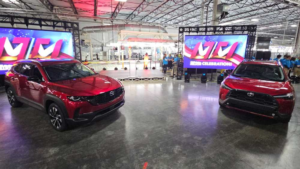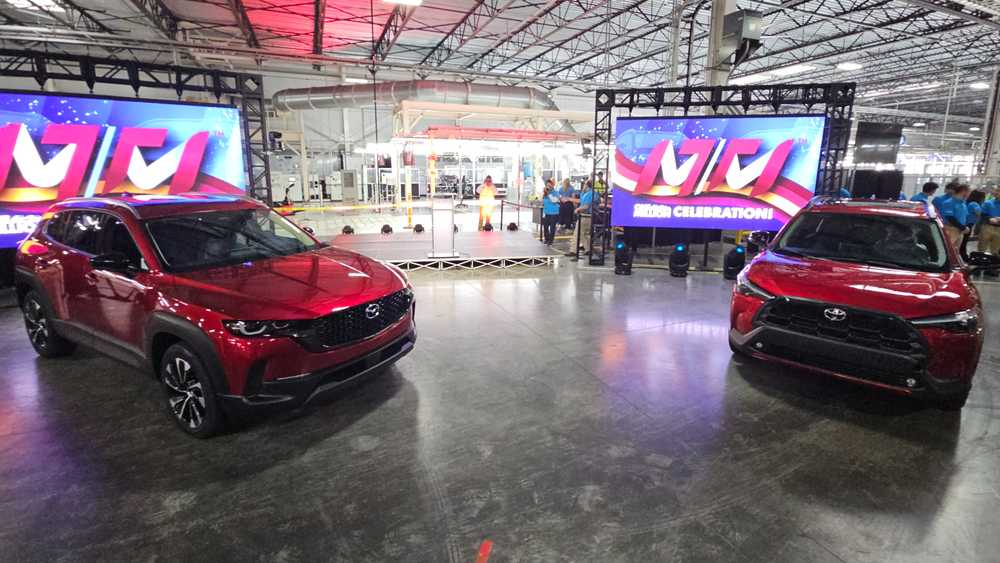
Mazda and Toyota are celebrating production of the 1 millionth vehicle at their $2.3 billion joint manufacturing plant in Huntsville, Alabama, five years after the facility began operations. The milestone highlights the success of their partnership, but Mazda is taking a cautious approach to expanding its U.S. manufacturing footprint despite growing sales and the cost of tariffs on imported vehicles.
Mazda Aims to Increase U.S. Vehicle Sales
The Huntsville facility, known as Mazda Toyota Manufacturing (MTM), can produce 300,000 vehicles annually across two shifts, with each automaker allocated capacity for 150,000 vehicles.
Last year, the plant produced nearly 136,000 Toyota Corolla Cross vehicles and approximately 120,000 Mazda CX-50s. Mazda recorded its two strongest U.S. sales years in 2024 and 2025, selling 424,382 and 410,346 vehicles, respectively.
Mazda North America CEO Tom Donnelly said the company was on track for what he expects to be its best year ever in 2026. He pointed to strong monthly performance, saying September was the company’s best month on record and October was expected to set another record.
Donnelly has established a target of reaching 500,000 annual U.S. vehicle sales by 2030. However, Mazda’s growth plans raise questions about whether the company will need additional manufacturing capacity to meet that goal.
Through September, Mazda’s U.S. sales totaled 310,268 vehicles, down 2.9% from the same period in 2025.
Will Mazda Expand U.S. Manufacturing?
While some automakers are increasing their investments in American factories to reduce exposure to tariffs on imported vehicles, Mazda is taking a more cautious approach. The company does not have a wholly owned assembly plant in the United States, leaving it more dependent on production facilities elsewhere.
Mazda builds the CX-30 for the U.S. market in Mexico, while its other vehicles are manufactured in Japan. Those imports face U.S. tariffs of 15%, putting Mazda at a competitive disadvantage compared with Nissan, Honda, Toyota, Volkswagen and Subaru, all of which operate factories in the United States.
Despite those challenges, Mazda appears reluctant to commit to a major expansion of its domestic manufacturing operations. Donnelly said the company believes it can reach 500,000 annual U.S. sales in an industry that is “fairly stable.”
He also emphasized that growth must involve “driving profitable volume,” indicating that Mazda is prioritizing financially sustainable sales rather than expanding production capacity simply to increase output.
Toyota Partnership Helps Mazda Manage Manufacturing Risks
The joint venture in Alabama allows Mazda to share manufacturing investment with Toyota, reducing its financial commitment and limiting risk while providing valuable experience in vehicle production.
The partnership has also helped Mazda expand its electrified lineup. In December 2024, the Huntsville plant began producing the CX-50 Hybrid, which uses Toyota’s 2.5-liter four-cylinder engine, three electric motors and a continuously variable transmission (CVT).
The hybrid model now accounts for approximately 35% of CX-50 sales, highlighting the importance of the joint venture beyond its manufacturing capacity.
Alabama Plant Supports Regional Jobs and Production
Mazda Toyota Manufacturing produces approximately 1,200 vehicles per day. Toyota’s “Apollo” assembly line accounts for about 600 vehicles daily, while Mazda’s “Discovery” line produces approximately the same number.
The facility employs 4,500 workers drawn from communities within a 75-mile radius of Huntsville. Its operations have provided an economic boost to the region while bringing together the manufacturing operations and corporate cultures of two Japanese automakers.
As the Huntsville facility marks its 1 millionth vehicle, the partnership remains central to Mazda’s U.S. manufacturing strategy. The company is targeting 500,000 annual U.S. sales by 2030 while emphasizing profitable growth and taking a cautious approach to expanding its manufacturing footprint.