BMW has opened its first U.S. battery assembly plant in Woodruff, South Carolina, marking a major step in the company’s American manufacturing strategy as production of the all-electric BMW iX5 gets underway at Plant Spartanburg. The November 13 opening capped a two-day program highlighting BMW’s $36.1 billion annual economic impact on South Carolina, its expanding supplier network, and the growing role of artificial intelligence in vehicle production.
The new University of South Carolina study puts BMW’s economic contribution to the state well above its 2022 figure of $26.7 billion. Beyond the financial impact, the company’s manufacturing operations are increasingly tied to domestic steel production, automated logistics, workforce development and the next generation of electric vehicles.
BMW’s Economic Impact on South Carolina Reaches $36.1 Billion
Economist Joseph Von Nessen of the University of South Carolina’s Darla Moore School of Business presented the latest findings alongside BMW Manufacturing CEO Robert Engelhorn during an event in downtown Greenville. WYFF anchor Jane Robelot hosted the program, which included the mayors of Greenville, Spartanburg, Greer and Woodruff.
The study found that BMW supports 55,327 jobs across South Carolina and generates $4.4 billion in wages and salaries. One of its most significant findings was a jobs multiplier of 4.2, meaning every 10 jobs at BMW Manufacturing support another 32 jobs elsewhere in the state.
Von Nessen compared that figure with the 1.7 average multiplier for South Carolina manufacturers. He also said BMW’s economic growth since 2022 amounts to nearly 20% after inflation.
Plant Spartanburg’s statewide employment footprint increased by an average of 3.3% annually between 2017 and 2025, more than twice the growth rate for South Carolina overall. A nationwide version of the economic impact study is expected in early 2027.
Plant Spartanburg Exports BMW Vehicles to 120 Countries
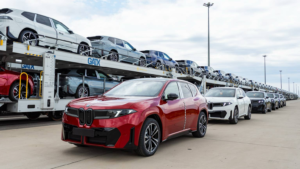
Exports remain an important part of BMW’s economic contribution. Engelhorn said Plant Spartanburg produces approximately 1,500 vehicles daily, shipping half of its output to 120 countries.
That export activity has made BMW the largest U.S. car exporter by value for more than a decade. Engelhorn also expressed support for free trade, while BMW is reportedly highlighting its Spartanburg expansion as it seeks tariff relief from the Trump administration.
The facility works with more than 400 U.S. suppliers, reflecting the importance of domestic sourcing to BMW’s manufacturing operations.
How Nucor’s Recycled Steel Is Used in the BMW iX5
Steel is one of the most important materials in BMW’s production process, particularly as the company prepares its electric vehicles. Wayne Copeland, who leads steel purchasing for BMW’s plants in the Americas, said BMW imports only about one-third of the steel required for its South Carolina operations.
Plant Spartanburg consumes approximately 400,000 metric tons of steel annually. Around 10% goes to BMW’s own press shop, which opened two years ago next to the plant and produces approximately 10,000 stamped parts daily. The remaining steel is supplied to outside stamping companies.
Steel accounts for about 35% of the BMW iX5’s material composition. According to BMW, steel represents 18% of supply-chain carbon dioxide emissions in a typical midsize electric SUV, compared with 41% for battery cells.
Approximately half of the iX5’s flat steel comes from electric arc furnaces that operate largely using scrap metal. Across the entire vehicle, the iX5 contains approximately 2,080 pounds of secondary material, representing roughly one-third of its composition.
Nucor Supplies 27,000 Tons of Steel for BMW’s X5
Nucor, the largest U.S. steelmaker, has received an award to supply approximately 27,000 tons of steel for the BMW X5. The material comes from its mill in Berkeley County, near Charleston, and will cover approximately 100 body-in-white components.
Nucor says its electric arc furnace steel produces an average of 0.77 tons of greenhouse gas emissions per ton, compared with 2.32 tons for coal-based blast-furnace steel. All steel BMW purchases from the company belongs to its Econic RE grade, manufactured using renewable electricity.
The steelmaker also addressed questions about whether scrap-based production can deliver advanced high-strength steel grades. Nucor said its first steel supplied to BMW was a complex-phase grade and that it is now developing 1180 multiphase steel for series production.
The partnership also includes a recycling arrangement designed to return manufacturing scrap to the steelmaking process. Since late 2024, scrap from BMW’s press shop has been shipped back to Nucor’s Berkeley mill.
The program processed approximately 17,000 gross tons during its first year, with roughly 20,000 tons expected this year. The recycled material is intended to return as steel for future X5 vehicles.
Steel deliveries represent only a small portion of Plant Spartanburg’s overall logistics activity. Approximately 3.3 million parts arrive at the facility every day through more than 1,000 truckloads.
BMW Uses AI to Reduce Logistics Decisions From Eight Minutes to 45 Seconds
BMW receives components from approximately 750 tier-one supplier locations across North America, with about half based in the United States. The company tripled its supplier base between 2015 and 2024 and expects the number to exceed 850 next year.
Thirty-eight suppliers are now located within 20 miles of Plant Spartanburg. During the semiconductor shortage, BMW also flew chips into Greenville-Spartanburg International Airport to help keep production moving.
Managing the arrival of thousands of parts requires rapid decisions. Previously, employees had to check 15 separate systems to determine which delivery trailer should be unloaded next, a process that took approximately eight minutes per trailer.
That delay was significant for a production line operating with a 90-second takt time. BMW’s logistics and IT teams worked with AWS to develop Titan, a tool that consolidates information from those systems into one interface and evaluates more than 30 parameters to generate a single score for each container.
The system has reduced the decision-making process from eight minutes to just 45 seconds.
BMW said its teams used coding agents, including GitHub Copilot, to develop Titan in a few months. Enterprise software projects of this type typically take between one year and 18 months.
The company is also organizing three-day AI hackathons, during which employees temporarily leave their regular responsibilities to develop automation tools for their own work processes.
BMW Uses AI Agents in Board-Level Decisions
BMW’s use of artificial intelligence has expanded beyond factory operations into senior management. The company said AI agents now participate in board-level decisions.
One agent, nicknamed Mr. Flexibility, evaluates production scenarios in real time. Its tasks include examining what would be required to manufacture 10,000 additional BMW iX3 vehicles in 2028, taking production capacity, suppliers and logistics into account.
The system allows BMW to examine different manufacturing requirements without relying on multiple rounds of communication between departments.
BMW Plans Driverless Vehicle Movement at Spartanburg in 2027
BMW plans to introduce Automated Driving In-Plant at Plant Spartanburg in 2027, making it the company’s fifth facility to use the technology. The system allows newly assembled vehicles to move off the production line without a driver behind the wheel.
While Titan manages incoming deliveries, Automated Driving In-Plant is designed to handle the movement of finished vehicles leaving the assembly line.
The cars do not require additional hardware. Lidar sensors installed around the facility track their positions, while cloud software developed by Swiss partner Embotech plans their routes and controls their movement through the vehicles’ drive-by-wire systems.
BMW has already recorded more than one million driverless vehicle movements at its facilities in Dingolfing, Leipzig, Regensburg and MINI Plant Oxford. The system currently handles approximately 3,500 movements daily.
At Spartanburg, BMW demonstrated an initial application that moves completed vehicles toward shipping. Two additional applications are planned for next year, including one operating deeper inside the production process.
BMW i Ventures Invests in Technology Startups
Embotech is also part of BMW i Ventures’ investment portfolio. The company’s venture capital division manages $1.1 billion across three funds and has invested in more than 100 startups.
Its current $300 million fund focuses on investments in North America, Europe and Israel.
BMW Tests AI Cameras for Real-Time Vehicle Inspections
BMW’s artificial intelligence projects also include technology developed internally by its Spartanburg IT research team. The group, which built a customer chatbot with OpenAI in 2021 before ChatGPT existed, presented a project called spatial human amplification.
The technology uses a small camera attached to an employee’s safety glasses. The camera sends video to an AI model running locally on a phone, allowing the system to identify and record inspection steps as employees complete them.
The checks include components such as the fuel flap, sun visor and vehicle displays. Inspectors currently trigger each inspection manually, repeating the process across hundreds of vehicles every day.
Working with academic partners, including MIT, BMW found that the model could learn a new action using approximately 20 videos. At an end-of-line inspection station in Spartanburg, the system achieved approximately 98% accuracy.
Another test involving 500 videos from 5 Series production at a different BMW plant produced accuracy of around 99%.
The technology is also being tested in the paint shop, where cameras attached to employees’ glasses monitor the installation of silicone caps. BMW identified this as a critical manufacturing step that fixed cameras cannot observe.
The company also collaborated with the Savannah College of Art and Design to explore integrating cameras and microphones into a future smart uniform. BMW has since transferred the project to its headquarters for a wider rollout.
BMW Uses Video AI to Evaluate Dealer Service Work
BMW is already using similar video-based artificial intelligence technology at dealerships in Brazil and Mexico. Service technicians record videos of work performed on customer vehicles, generating more than 15,000 videos each month.
Through its Startup Garage program, BMW identified Twelve Labs, whose AI model now evaluates the videos for clarity and correct terminology.
The resulting scores are used in a technician recognition program that previously relied on subjective opinions.
BMW Expands Technician Training to Support Electric Vehicle Production
Despite its growing use of automation, BMW continues to emphasize the importance of employees who can evaluate technology and recognize when its results need to be questioned.
Paul Sinanian, head of talent and training at Plant Spartanburg, described AI as a tool that requires human oversight. He compared relying on an unchecked AI response to tightening a bolt without checking whether its threads had become misaligned.
Sinanian has also changed the apprenticeship curriculum, reducing its technical content from 100% to 75% to create more room for teamwork and resilience training.
BMW Scholars Apprenticeship Program Supports Future Workers
BMW’s main workforce development initiative is BMW Scholars, a two-year apprenticeship program based on the German model. The company pays for students to earn associate degrees at Greenville Tech, Spartanburg Community College, Tri-County Tech or Piedmont Tech while they work up to 30 hours per week.
Participants are subsequently hired by BMW. The program currently has approximately 130 apprentices, recovering from a decline to just five during the COVID period.
A high school version that began with three students has expanded to 51 participants. Another initiative scheduled to launch in January will help adults without high school diplomas earn a GED and move into production employment within 12 months.
BMW’s outreach also begins before students enter eighth grade, when South Carolina students select a career cluster. The company brings guidance counselors and teachers to its facilities and hosts FIRST Robotics competitions for children as young as fourth grade.
Sinanian said early engagement is important, pointing to the average age of licensed electricians in the United States, which he put at 57.
His team also developed the change allowing companies to use South Carolina’s Retrain SC funds for employee reskilling. BMW is introducing a youth apprenticeship bill in January.
BMW Opens Plant Woodruff, Its First U.S. Battery Assembly Facility
The opening of Plant Woodruff represents another important part of BMW’s American electric vehicle strategy. Located on a former peach farm approximately 15 miles from Plant Spartanburg, the facility covers more than one million square feet and employs around 300 people.
Another 250 robots work alongside employees to assemble Gen6 high-voltage battery packs. Workers received virtual reality training before production began.
Gov. Henry McMaster joined BMW executives for the November 13 opening ceremony, officially marking the launch of the company’s first U.S. battery assembly plant.
BMW iX5 Production Begins at Plant Spartanburg
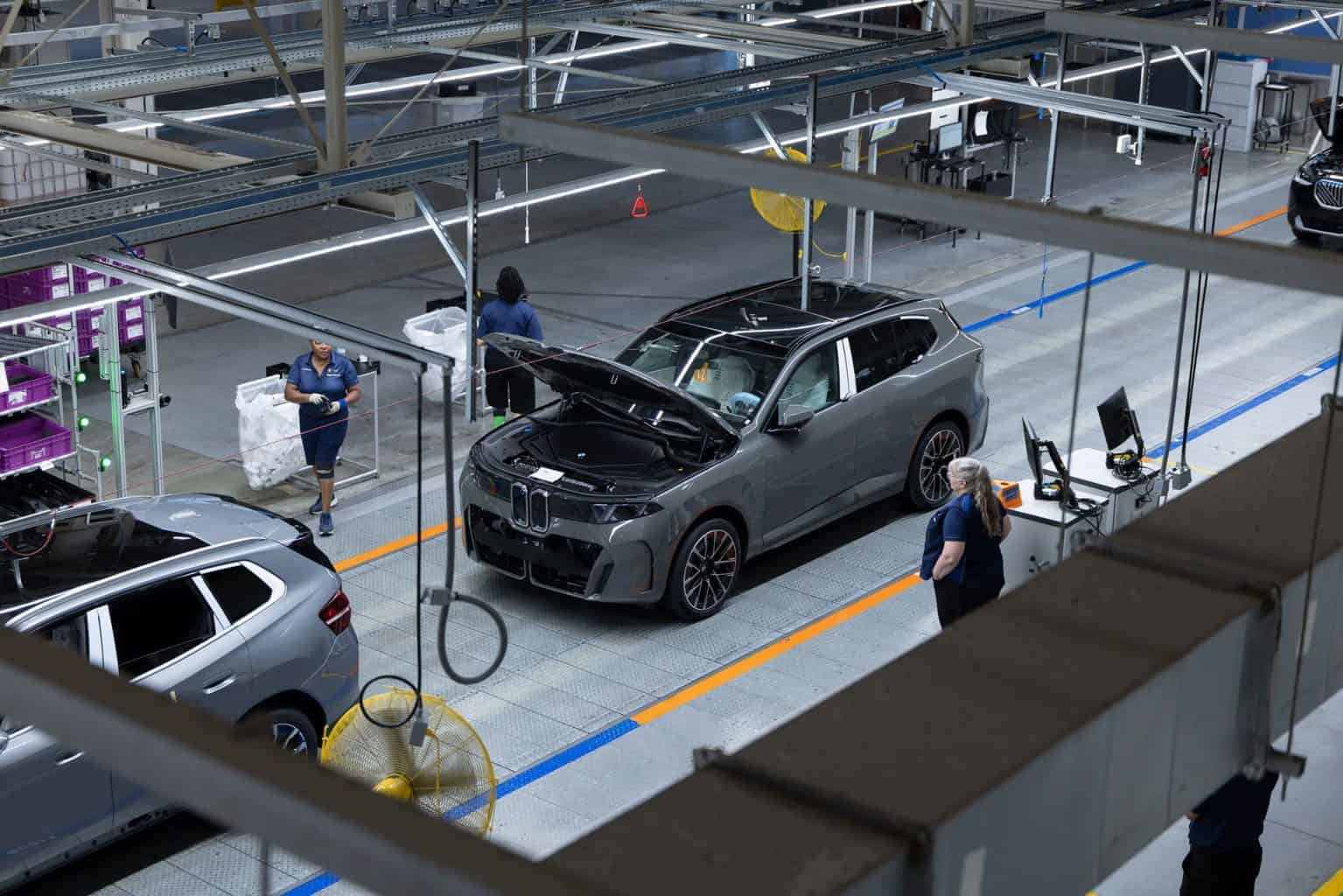
Production of the fully electric BMW iX5 has now started at Plant Spartanburg, with output running at approximately 70 vehicles per day. The model is the first fully electric BMW to be manufactured in the United States.
Until now, every electric BMW sold in the U.S. had been imported. BMW plans to offer at least six fully electric models in the American market by 2030.
However, BMW has reportedly told suppliers to expect 60,000 electric vehicles in 2027, down from an earlier forecast of 100,000. Wittmann continued to describe electromobility as BMW’s most important growth area.
In early November, BMW also announced additional battery cell partnerships, including an agreement with LG Energy Solution for the U.S. market.
The iX5’s battery pack has a capacity of 144 kWh, with its cells and supply arrangements forming another part of BMW’s expanding electric vehicle manufacturing strategy.
The BMW X5 Connects the Company’s Past and Electric Future
The BMW X5 has a long history at Plant Spartanburg. The first example rolled off the production line in 1999, and BMW says it was also the first series-production vehicle from the company to use CO2-reduced steel.
Twenty-seven years later, the same model name has become the first fully electric BMW built in the United States. Its battery is assembled at a former peach farm nearby, while artificial intelligence helps coordinate the parts arriving at the production facility.
BMW’s latest developments bring together domestic battery assembly, recycled steel, advanced automation and expanded workforce training. Although the X5 badge remains unchanged, the manufacturing technology and processes behind the vehicle have undergone a significant transformation.