

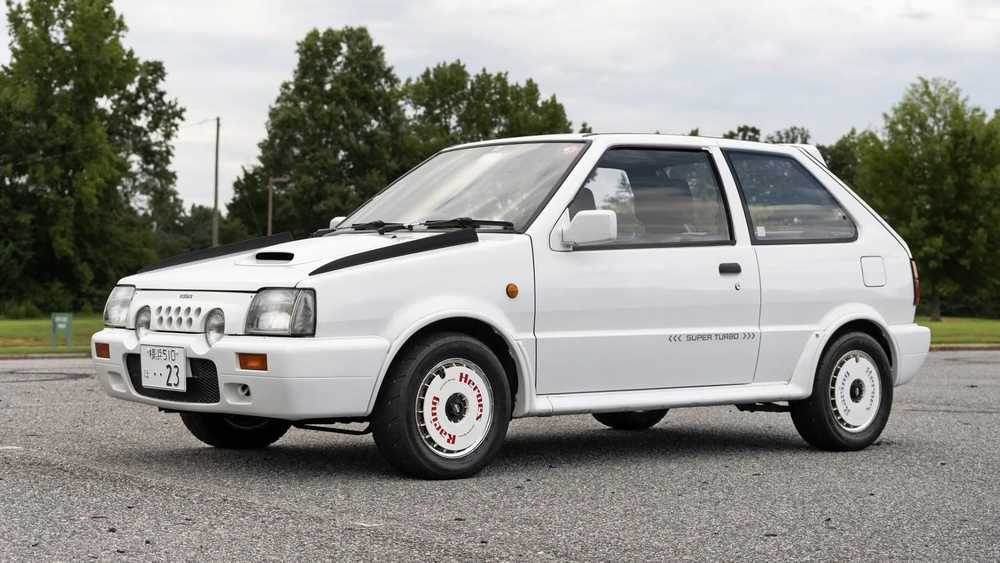
The Nissan March Super Turbo took an unconventional path to performance when it debuted in Japan in January 1989. Rather than relying on a large-displacement engine, Nissan engineered a lightweight front-wheel-drive hot hatch powered by a compact 930.6-cc engine equipped with both a supercharger and a turbocharger, creating one of the most distinctive performance cars of its era.
A Hot Hatch Built Around a Sub-1.0-Liter Engine
Nissan introduced the road-going March Super Turbo shortly after unveiling the competition-focused March R. Both models were powered by the MA09ERT inline-four engine, producing approximately 108 horsepower at 6,400 rpm and 96 lb-ft of torque at 4,800 rpm.
While those figures appeared modest compared with many contemporary hot hatches, the March Super Turbo’s lightweight design made them far more significant. The manual-transmission version weighed less than 1,700 pounds, giving it roughly 141 horsepower per metric tonne (2,204 pounds).
The engine also delivered about 117 horsepower per liter, an impressive specific output for a single-overhead-cam engine with two valves per cylinder. Its aluminum alloy block and cylinder head helped reduce weight, while electronic fuel injection supported performance.
The defining feature, however, was its dual forced-induction system. A crank-driven supercharger provided immediate low-speed response, while an exhaust-driven turbocharger supplied stronger performance at higher engine speeds.
Designed for Everyday Use With Hidden Performance
Although the March Super Turbo retained the practical layout of a five-seat economy hatchback with a steel unibody, several exterior details hinted at its engineering. These included a hood intake feeding the intercooler, additional exterior trim, a rear spoiler, and large front fog lights.
Rather than being based on a dedicated sports car platform, the March Super Turbo combined everyday practicality with an unusually advanced powertrain beneath its compact body.
Why Nissan Chose a 930.6-cc Engine
The engine’s unusually small displacement was dictated by FIA homologation regulations. Competition rules applied a 1.7 equivalency multiplier to forced-induction engines, and Nissan wanted the car to qualify for rally competition in the up-to-1,600-cc class.
Applying the multiplier to the engine’s actual 930.6-cc displacement resulted in an equivalent capacity of 1,582.0 cc, keeping it just below the 1.6-liter limit.
Using Nissan’s existing 987-cc engine would have exceeded the classification threshold. To meet the requirement, engineers reduced the bore to 66.0 mm while retaining the 68.0 mm stroke, lowering displacement to the desired figure.
According to Nissan’s heritage collection, a NISMO-prepared March equipped with both a turbocharger and supercharger had already competed in the 1987 Little Dynamite Cup one-make circuit racing series using the earlier 987-cc engine. Nissan later installed the reduced-displacement MA09ERT engine in the March R for rally competition before introducing the March Super Turbo production model with the same basic powertrain.
How the Twin-Charged System Worked
Nissan assigned different operating ranges to each compressor to maximize performance across the rev band.
At low engine speeds, the ASN-09A Roots-type supercharger generated immediate boost, improving throttle response and helping offset the engine’s small displacement. As engine speed and exhaust flow increased, the Hitachi HT10 turbocharger became the primary source of boost.
An electromagnetic clutch disengaged the supercharger at a predetermined point, reducing mechanical drag and allowing the turbocharger to manage higher engine speeds.
This arrangement produced a broad, usable power delivery, with peak torque arriving at 4,800 rpm and maximum power at 6,400 rpm. The setup was particularly suited to rally driving, where varying corner speeds and changing conditions demanded responsive performance.
Packaging the system required fitting a belt-driven supercharger, turbocharger, intercooler, bypass plumbing, clutch controls, fuel injection, and other hardware into a compact engine bay, resulting in considerable mechanical complexity.
Lightweight Design Maximized Performance
The March Super Turbo’s modest power output was amplified by its low curb weight. Nissan paired the engine with a five-speed manual transmission featuring a 4.167:1 final drive ratio and a front viscous-coupling limited-slip differential.
The differential helped transfer power effectively through the front wheels, improving traction and allowing drivers to maintain strong acceleration when exiting slippery corners while reducing wheelspin from an unloaded front wheel.
The Road Version Preserved the Rally Car’s Engineering
The competition-focused March R was lighter than the March Super Turbo and was sold as a rally-oriented vehicle without requiring owners to remove unnecessary comfort features before competing.
By contrast, the March Super Turbo retained the March R’s fundamental mechanical configuration while adding a more complete interior for everyday road use, creating a practical production hot hatch that shared its rally-inspired engineering.
A Unique Moment in Performance Car Development
As turbocharger technology advanced, manufacturers were increasingly able to achieve broad torque delivery using smaller, more efficient turbochargers without adding a mechanically driven supercharger. That eliminated much of the additional plumbing, controls, weight, and maintenance associated with twin-charged systems.
Although the Nissan March Super Turbo was neither the most powerful nor the fastest performance car of the late 1980s, it stood apart because its engineering was shaped directly by motorsport regulations. Its lightweight construction, compact engine, and sophisticated twin-charged powertrain made it one of the most distinctive hot hatches of its time.