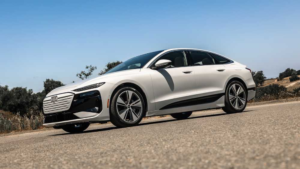


Nissan says it has fundamentally changed the way it develops vehicles as it works to compete with the rapid pace of Chinese automakers. By combining artificial intelligence with a streamlined product development process, the company reduced development time for its new-generation Skyline to 26 months, bringing it close to the 24-month timeline commonly associated with “China Speed.”
China Speed Raises Pressure Across the Auto Industry
According to the report, German automakers typically require at least seven years to develop a new vehicle, while Japanese manufacturers generally take five to six years, depending on the model. Chinese automakers, by comparison, aim to complete development in just 24 months.
Legacy automakers have described this accelerated approach as “China Speed.” Driven by software-first vehicle designs, lower costs, and government subsidization, the strategy has enabled Chinese manufacturers to compete aggressively on price while gaining market share.
Nissan Accelerates Development With AI
Nissan’s new-generation Skyline was developed in 26 months, a timeline the report says was made possible largely through the use of artificial intelligence. Automotive News also reported that AI is only one part of a broader transformation within the company.
Kazuyuki Yamaguchi, one of Nissan’s corporate executives for product development, said the company carried out an extensive overhaul of its development process and organizational mindset.
“We have totally changed the process. Chinese players are intensifying the competition, so we need to be competitive enough. We need to introduce attractive products into the market more quickly. Otherwise, we won’t survive. It’s a very simple message,” Yamaguchi said.
The all-new Skyline/Infiniti Q50 serves as the first application of the revised process, with Nissan planning to apply the same development approach to future models.
Four Principles Behind Nissan’s Faster Development
Nissan attributes its shorter development cycle to four key principles: prioritizing specifications, maximizing vehicle platforms, simplifying development teams and project management, and increasing the use of artificial intelligence.
On vehicle specifications, Yamaguchi said Nissan is concentrating investment on the areas where each vehicle delivers the greatest value for its intended market.
“We polish what the car excels at and focus our investment in the strongest aspects. We set the target by trying to look at the balance, rather than doing everything perfectly,” he said.
The company also plans to expand platform sharing, with more models using common chassis, powertrains, and design elements.
Nissan has also simplified project leadership. Previously, each project involved a program director, a product planning manager, and a chief vehicle engineer. Under the revised structure, the program director also oversees product planning while working closely with the chief engineer, reducing operational complexity and limiting conflicting decisions.
Artificial intelligence will also play a larger role by assisting development and reducing the need for very early prototypes. That allows engineers to build test vehicles that are closer to production specifications and require less refinement.
Balancing Speed and Quality
The report notes that increasing development speed can come with trade-offs, particularly when it comes to accuracy. It says Nissan’s challenge will be finding the right balance between faster product development and maintaining quality.
The report also states that Chinese automakers are not immune to the effects of accelerated development. Some technologies and aspects such as chassis tuning can feel unfinished, although updates delivered through over-the-air software or rolling production changes can address those issues.
According to the report, Nissan’s experience as a legacy automaker may help it avoid some of those pitfalls while adapting to a faster development model. At the same time, it says legacy manufacturers will need to become more agile as competition continues to intensify.