
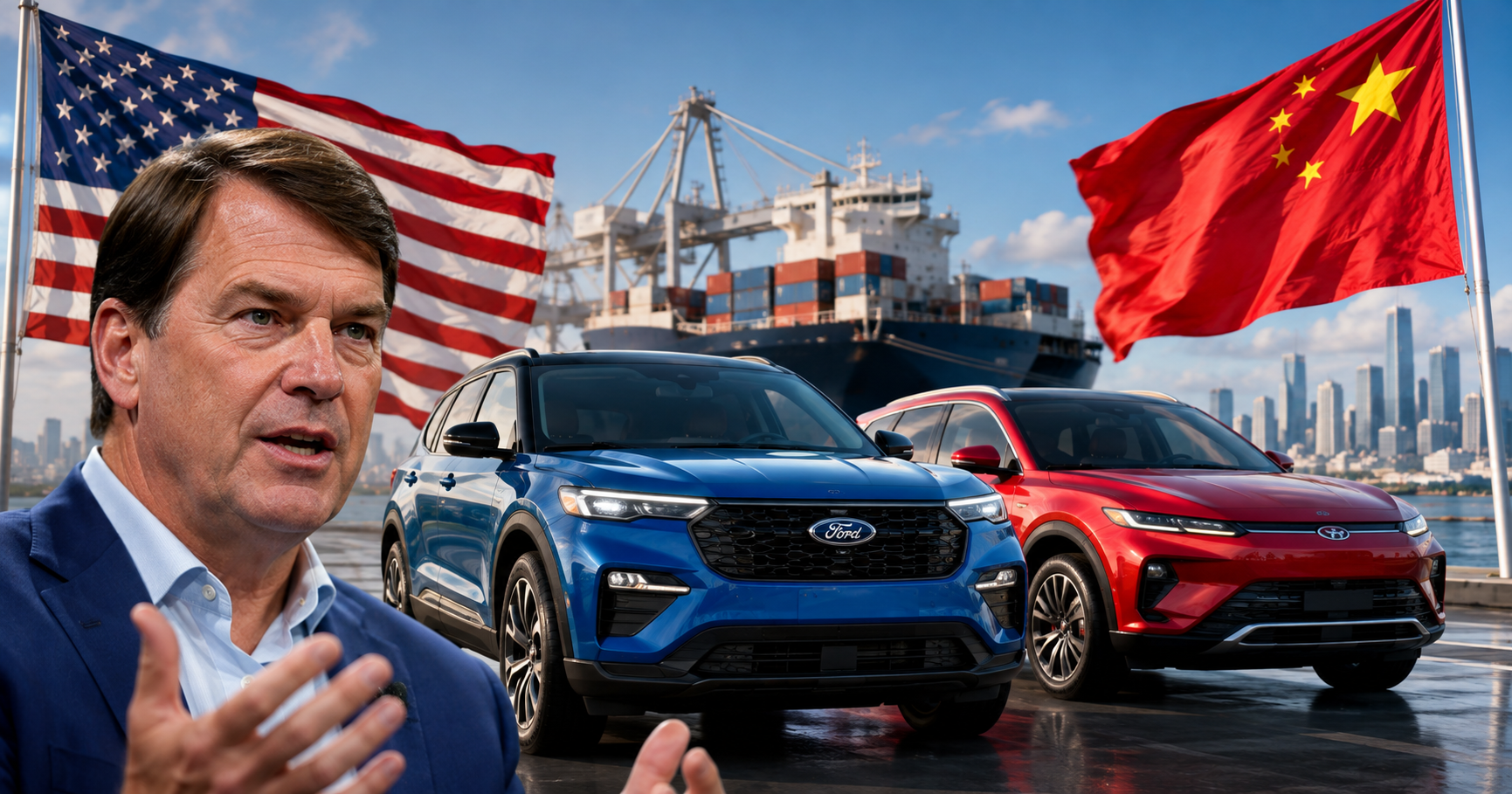
Ford CEO Jim Farley believes Chinese automakers could enter the U.S. market within the next five to 10 years despite existing trade barriers. According to Reuters, Farley shared the outlook during a July 30 town hall with employees as Ford continues developing new affordable electric vehicles to compete on cost and efficiency.
Farley Sees Chinese Automakers Entering the U.S.
Jim Farley has repeatedly described Chinese automakers as an existential threat to the U.S. auto industry, citing their leadership in cost and manufacturing efficiency. He has also warned that allowing Chinese vehicles into the United States would be damaging to American manufacturing.
According to Reuters, Farley told Ford employees during a July 30 town hall that the company is preparing for the possibility that Chinese automakers could enter the U.S. market within the next five to 10 years, despite numerous trade barriers.
Reuters, citing three people who viewed the meeting, reported that Farley and other senior Ford executives said during a question-and-answer session that Chinese automakers are more likely to enter toward the latter part of that time frame. The report noted that this is the first time Ford executives have provided such a specific timeline.
Trade Barriers Remain in Place
The comments come as the U.S. Senate considers expanding restrictions on Chinese vehicle sales.
The United States currently applies tariffs of about 100% on Chinese vehicles. In addition, U.S. Commerce Department rules prohibit Chinese software beginning with the 2027 model year and Chinese hardware beginning with the 2030 model year.
At the same time, Chinese automakers have expanded their presence in neighboring markets. The article states they have captured 17% of the Mexican market, while Canada permits sales of up to 49,000 electric vehicles per year under a reduced tariff rate. According to the article, many auto industry experts view Canada as a test market because of its similarities to the United States.
Ford’s UEV Platform Targets Lower Costs
Earlier this month, Ford Executive Chair Bill Ford said at an Axios event that the company must “go toe-to-toe with China.”
“We can’t expect to keep them out forever, and we have to be able to beat them at their own game,” he said.
Ford’s response includes the development of a new family of affordable electric vehicles built on its Universal Electric Vehicle (UEV) platform. The platform is being developed by an internal skunkworks team based in California with the goal of matching the cost and efficiency achieved by Chinese automakers.
Affordable EV Lineup Planned
The first vehicle based on the UEV platform will be a midsize electric pickup truck with a projected starting price of about $30,000.
Deliveries are expected to begin in 2027 from Ford’s Louisville Assembly Plant in Kentucky.
Ford plans to build a total of five affordable vehicles on the UEV platform, including the midsize electric pickup, a small SUV, and a sedan.
As Ford prepares its next generation of affordable electric vehicles, company executives say they are planning for a future in which Chinese automakers could eventually compete directly in the U.S. market.