
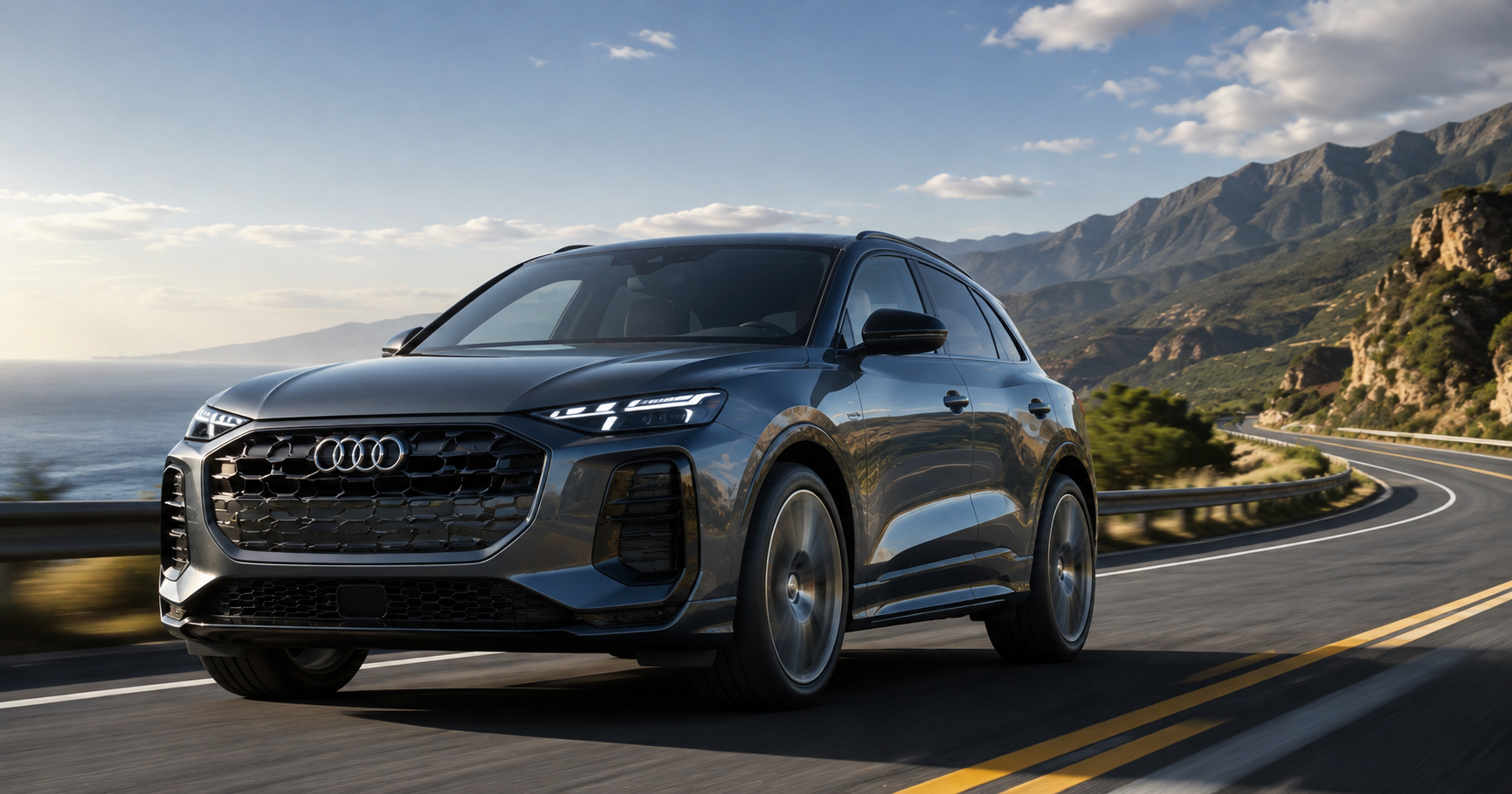
Audi plans to introduce hybrid models to its U.S. lineup as the automaker responds to declining sales and limited electrified offerings. Audi of America President Vito Paladino said the company is evaluating which segments and models should receive hybrid power as it works to expand its portfolio.
Audi Looks to Expand Its Hybrid Lineup
After focusing heavily on electric vehicles, Audi is preparing to bring hybrids to the U.S. market. The move follows a first half of 2026 in which the company’s U.S. sales fell 17%, while electric vehicles accounted for just 2.5% of its total sales.
Speaking at the launch of the Q9 three-row SUV, Audi of America President Vito Paladino told Automotive News, “We will have hybrids in our lineup.” He added, “We’re looking at which segments, which models do we need to further extend the offering.”
Two Hybrid Models Already Planned
Audi has already announced two upcoming hybrid vehicles, although neither is expected to have a major impact on overall sales volume.
One is the Nuvolari, a 1,000-horsepower supercar powered by a Lamborghini engine that will be limited to just a few hundred units worldwide. The other is the RS 5, which is expected to be less exclusive than the Nuvolari but still relatively uncommon. Both models are scheduled to arrive in the United States next year.
Audi Trails Rivals in the U.S. Hybrid Market
Hybrid vehicles account for nearly 20% of new vehicle sales in the United States, a share that is expected to increase. That figure is more than double the market share of electric vehicles, while Audi’s own EV sales represent only a small fraction of its total U.S. volume.
Several of Audi’s luxury competitors already offer extensive plug-in hybrid lineups. BMW sells six plug-in hybrid models, including the X5 SUV. Mercedes-Benz offers nine, including the GLC and GLE SUVs. At Lexus, all but two gasoline-powered models are available with a hybrid, plug-in hybrid, or both.
New Models Create Additional Challenges
According to the report, many of Audi’s newest vehicles were launched without hybrid powertrains because the company expected electric vehicles to attract those buyers in the U.S. market.
Adding hybrid systems during the middle of a model cycle could require significant changes and increase costs. Even the new Q7 and Q9 were not originally designed with hybrid powertrains, although both feature V6 and V8 engines.
Global Portfolio Could Speed Up U.S. Rollout
Paladino said Audi’s global lineup provides opportunities to introduce hybrid models without waiting for complete vehicle redesigns.
“Because of our global portfolio, there’s opportunities that you don’t have to wait for a refresh,” Paladino said. “If we see the business opportunity, which we do in this case here, we’re willing to do the right thing.”
While Paladino did not identify which U.S. models will receive hybrid technology or provide a timeline, the report suggests some of Audi’s best-selling vehicles could gain electrified powertrains before long, including the possibility of a plug-in hybrid RS Q5 variant.
Hybrid Expansion Aligns With Audi’s Technology Strategy
The report notes that Audi has long promoted its “Vorsprung durch Technik,” or “progress through technology,” slogan. Globally, the company already offers hybrid versions of nearly all of its European models, meaning many of those vehicles are already available for potential introduction to the U.S. market.
According to the report, the remaining decision centers on which models Audi will certify for sale in the United States and how quickly the company chooses to bring them to market.
Audi’s planned expansion of its hybrid lineup reflects its effort to broaden customer choice in the U.S. while evaluating which models and segments offer the strongest business opportunity.