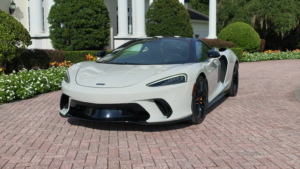


The Hennessey Blackbird has been unveiled as the company’s second full-production hypercar, taking a dramatically different approach from the outgoing Venom F5. Instead of chasing bigger horsepower figures or adding hybrid or electric technology, the new model focuses on driver engagement with a naturally aspirated V8, a gated manual transmission, and a screen-free interior.
Blackbird Follows the Venom F5 With a Different Mission
The Hennessey Venom F5 is approaching the end of its production run, with half of the planned 99 cars already built and delivered. The remaining vehicles are expected to be completed in 2028.
Its successor, the Hennessey Blackbird, takes a different direction. Rather than pursuing higher horsepower or introducing all-wheel drive, hybrid technology, or electric power, the new hypercar has been designed to prioritize the driving experience.
John Hennessey’s vision of an “American Carrera GT” is reflected in the Blackbird, which features a 6.2-liter naturally aspirated V8 co-developed with Ilmor Engineering. The engine is expected to produce approximately 800 to 850 horsepower while revving beyond 9,000 rpm.
Hennessey says the powerplant will be the highest-revving and most powerful naturally aspirated V8 ever, exceeding the 670-horsepower output of the Corvette Z06’s 5.5-liter V8.
Power is sent exclusively to the rear wheels through a six-speed gated manual gearbox. According to Hennessey Director of Design Nathan Malinick, the transmission is a traditional manual rather than a simulated system.
Lightweight Construction Targets Hypercar Performance
The Blackbird features a bespoke carbon-fiber chassis and carbon-fiber bodywork. Hennessey is targeting a curb weight below 3,000 pounds.
The company estimates the hypercar will accelerate from 0 to 60 mph in 2.5 seconds and reach a top speed of 220 mph.
Why Hennessey Chose a Different Approach
Although the Blackbird produces significantly less power than the Venom F5, Hennessey says the decision was intentional.
Speaking ahead of the vehicle’s reveal, Nathan Malinick explained that many Hennessey customers own large collections of vehicles, and the company wanted the Blackbird to complement rather than replace the Venom F5.
“I think the expected thing for us would be like 3,000+ horsepower and 400 miles an hour and just more ridiculous numbers. But right off the bat, that kind of got eliminated as the path forward because it would sort of make the F5 irrelevant and do a disservice to our customers,” Malinick said.
He also said the company wanted to create a car centered on an authentic connection between driver and machine, without electric motors, all-wheel drive, turbochargers, or large digital displays.
Design Inspired by Motorsport and Aerospace
The Blackbird’s styling draws inspiration from Italian automotive designers, motorsport, and aerospace engineering. The hypercar is named after the Lockheed SR-71 Blackbird, with several design details referencing the aircraft.
A speedform of the SR-71 appears on the dashboard, while the rear vertical stabilizers automatically deploy at 71 mph and are positioned at a 71-degree angle. According to Malinick, the angle was an unintended coincidence that fit the design.
The four-outlet diamond-shaped exhaust arrangement was inspired by the Bell X-1 supersonic rocket plane built in 1945.
The interior continues the aviation theme with similarly arranged air vents and instrumentation. Buyers can choose an optional analog clock instead of the standard “Whiskey Compass” inspired by the SR-71 cockpit.
Exterior details also reflect motorsport influences, including Formula 1-inspired side pods, a front splitter shaped by Formula 1 design cues, a roof-mounted intake feeding the naturally aspirated engine, and high-mounted mirrors inspired by classic Le Mans race cars. The car also retains a traditional physical ignition key.
One of the Blackbird’s signature design elements is its gullwing doors, which extend into the side sill to improve entry and exit while adding visual drama.
“Number one, who doesn’t like the gullwing? It’s just the coolest door out there … seeing them drive slowly with the doors up is just a bit of theater and drama. Performance is cheap nowadays. People are more interested in how it makes you feel, or even how you’re perceived, and that’s part of the whole experience,” Malinick said.
Screen-Free Cabin Focuses on Driver Engagement
The Blackbird’s cabin emphasizes physical controls instead of touchscreen technology. Leather replaces extensive exposed carbon fiber because the car is intended to be driven comfortably over long distances.
Drivers can connect a phone to play music, but vehicle functions remain controlled through physical switches, climate controls, and a large central tachometer. The only display is a camera-based rearview mirror required for global homologation.
Practicality also played a role in the interior layout. The front trunk can hold two large carry-on suitcases, while the cabin includes four cupholders, space for a cowboy hat, and additional storage within the rear fenders for smaller duffel bags or up to 48 cans of cola.
Production Begins After 2029 Debut
The Hennessey Blackbird will make its public debut at The Quail, A Motorsports Gathering during Monterey Car Week on Aug. 14.
Production will be limited to 71 units, with pricing starting at $2.5 million before taxes. Manufacturing is scheduled to begin between 2029 and 2030, and more than two-thirds of the planned production has already been reserved.
The Blackbird marks a new direction for Hennessey’s production lineup, emphasizing an analog driving experience while introducing the company’s second full-production hypercar.