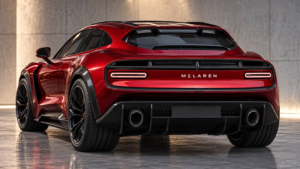


Dodge Copperhead SRT marks the return of a name first introduced as a concept in 1997, reviving a sports car project that never reached production. While the original Copperhead was designed as an affordable “Baby Viper,” the modern version adopts a significantly different performance-focused approach.
The Original Dodge Copperhead Was Designed as an Affordable Sports Car
The 1990s produced some of the automotive industry’s most ambitious concept cars, with manufacturers showcasing futuristic styling and advanced technology. As the decade neared its end, many companies shifted toward more conservative designs, but Dodge introduced the Copperhead as a different kind of sports car.
The concept had two primary goals: offer buyers who could not afford the Dodge Viper an eye-catching roadster and demonstrate that an affordable sports car did not have to sacrifice style.
By 1997, the Dodge Viper had spent about five years building a strong following among American sports car enthusiasts. However, its starting price of roughly $66,000 placed it beyond the reach of many buyers, leading some shoppers to choose alternatives such as the Chevrolet Corvette or Ford Mustang.
At the same time, interest in sports cars was growing. The introduction of the C5 Chevrolet Corvette in 1997, along with models including the Nissan 300ZX, Toyota Supra, and Jaguar XK8, reflected a renewed focus on performance across the segment.
1997 Detroit Auto Show Debut Drew Strong Interest
The Dodge Copperhead made its public debut at the 1997 Detroit Auto Show. Following the positive reception, Dodge announced a tentative production target of 2000, three years after the concept’s unveiling.
The proposed starting price of approximately $30,000 positioned the Copperhead more than $7,000 below the 1997 Chevrolet Corvette. Unlike the Corvette, however, the concept was not intended to use a traditional American V8 engine.
According to the report, public reaction at the auto show was highly positive, with many attendees asking about the vehicle’s price and expected availability.
Powertrain and Engineering Focused on Lightweight Performance
Although its styling echoed the Dodge Viper with muscular proportions and snake-inspired design cues, the Copperhead was powered by a naturally aspirated 2.7-liter V6 from Chrysler’s LH engine family.
The engine featured dual overhead camshafts and an all-aluminum construction. The Copperhead also served as one of the first test platforms for the engine.
Its chassis was loosely based on the Dodge Viper’s architecture but was extensively modified for a lighter vehicle with substantially less power. Power was delivered through a specially developed five-speed manual transmission with close gear ratios, while rear-wheel drive remained central to the car’s character.
The concept recorded a drag coefficient of 0.364, compared with 0.29 for the C5 Chevrolet Corvette.
Why the Dodge Copperhead Never Reached Production
Despite the enthusiasm surrounding its debut, the Dodge Copperhead never entered production.
After initially announcing plans to build the model by 2000 and beginning preliminary production studies, Dodge halted the project in 1999 and indefinitely shelved development.
According to the report, the primary reason was Chrysler’s merger with Mercedes-Benz. The merger gave Chrysler access to the Mercedes-Benz SLK-Class, which later became the foundation for the Chrysler Crossfire.
The Crossfire was eventually offered as both a coupe and convertible, including a high-performance SRT6 variant. However, it arrived in a market that also included the Honda S2000, Nissan 350Z, BMW Z3, and Porsche Boxster.
As a result, the Crossfire did little to strengthen Dodge’s position as a sports car manufacturer, and the company did not revisit the Copperhead concept for nearly three decades.
Dodge Copperhead Returns With an SRT Identity
The Dodge Copperhead name has now returned with an SRT badge, fulfilling a plan that dates back roughly 30 years while embracing a significantly different performance philosophy.
The original 1997 concept was envisioned as a lightweight, rear-wheel-drive roadster powered by a naturally aspirated 2.7-liter V6 producing 220 horsepower. Its mission was to provide accessible open-top performance without the Dodge Viper’s price or extreme power.
The modern Copperhead SRT replaces that formula with a stronger emphasis on contemporary performance technology.
The report states that its engine has not been confirmed. However, Stellantis has several potential options, including the Hurricane 4 and Hurricane 6 engines. It also notes that, with Stellantis returning V8 engines to its lineup, a naturally aspirated or supercharged V8 could also be considered.
The revived Dodge Copperhead SRT brings back a nameplate first introduced in 1997, reimagining a concept that never reached production while adopting a modern performance-focused direction.