
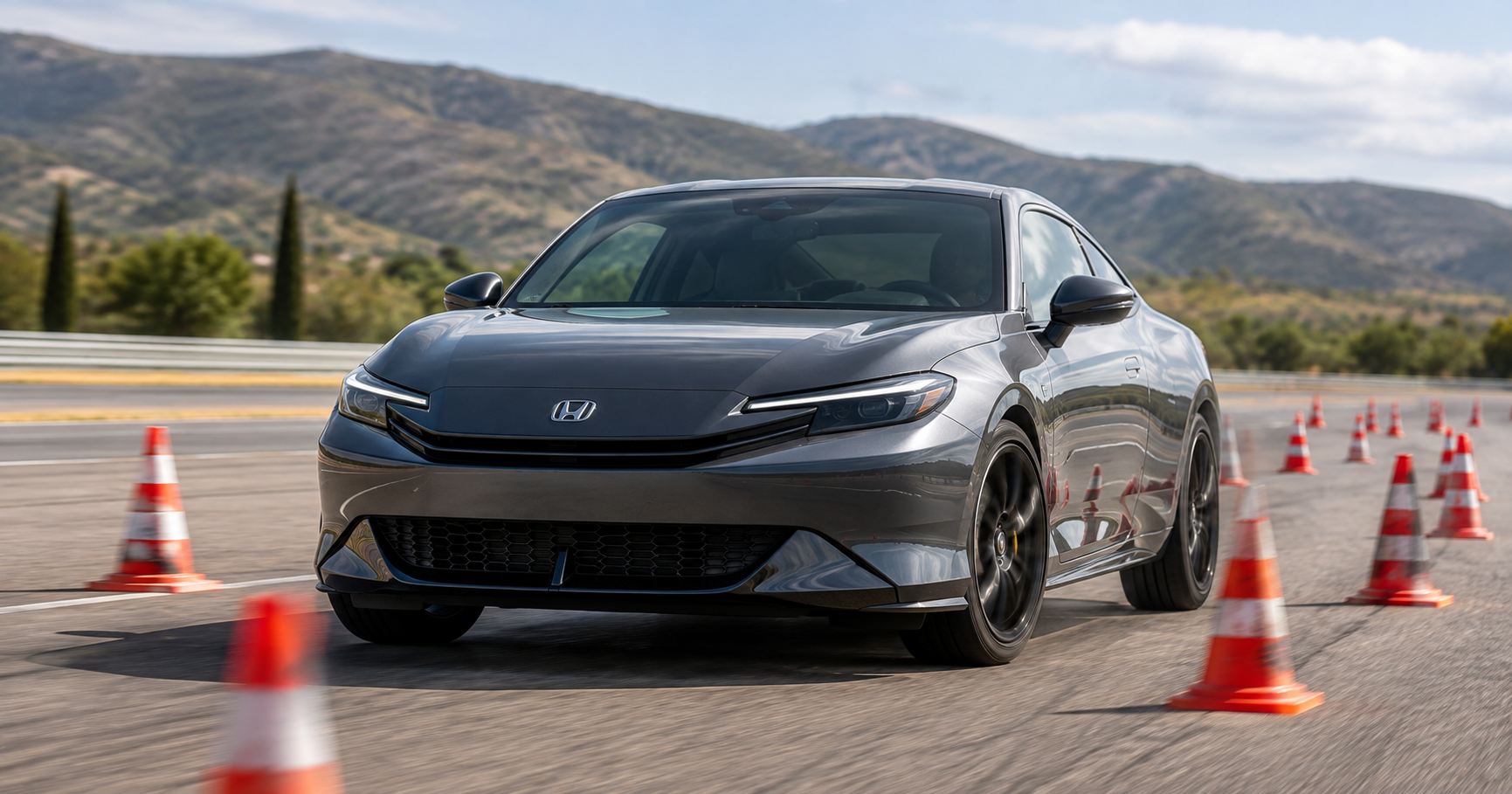
The Honda Prelude is more than a dressed-up Civic, and a demanding series of handling tests from Spain’s km77 offers evidence. With Civic Type R hardware, adaptive dampers and a hybrid powertrain driving the front wheels, the Prelude completed the moose test at 50 mph (80 km/h) while clearing every cone.
Honda Prelude Brings Type R Hardware
The return of the Honda Prelude has prompted comparisons with the Civic, but Honda gave the coupe more than the Civic’s underlying architecture. The Prelude also uses hardware from the Civic Type R, including a dual-axis front suspension, adaptive dampers and a faster steering rack.
Honda’s goal was to make the front-wheel-drive hybrid behave like a sports coupe rather than simply serve as an eco-friendly commuter. Whether that makes the Prelude worth its $42,000 sticker is another question, but km77’s testing provides a closer look at how the car handles demanding maneuvers.
Prelude Clears the Moose Test at 50 MPH
The Prelude performed strongly in km77’s slalom test. The tester reported smooth power delivery, no wheelspin drama at launch and quick, direct steering that required barely any movement between the cones. Body roll was also kept under control.
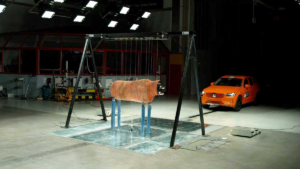
The more demanding moose test put those characteristics to a tougher test. With the Prelude in Sport mode, its adaptive dampers tightened, helping reduce body movement through the rapid left-right transitions.
The car completed the course at 50 mph (80 km/h), clearing every cone without requiring extreme steering corrections. That speed places the Prelude ahead of numerous more expensive and more powerful vehicles in km77’s extensive database.
Testers pushed the car beyond 50 mph, but the Continental PremiumContact 6 tires eventually reached their limit. At higher speeds, the Prelude began clipping cones and its stability control intervened.
Even under those conditions, the car remained predictable and easy to recover, without sudden snap oversteer or other major surprises.
Why the Moose Test Is Important
The moose test was originally developed in Sweden to simulate an emergency maneuver in which a driver quickly changes lanes to avoid a large animal, such as a moose, before returning to the original lane. The maneuver closely resembles evasive actions that may be required when encountering road debris or an unexpected obstacle at highway speeds.
Over time, the test has become a respected demonstration of chassis balance and emergency handling. It has also exposed weaknesses in some notable vehicles.
One of the most famous examples came in 1997, when the first-generation Mercedes-Benz A-Class rolled over during testing. Mercedes subsequently redesigned the suspension and made electronic stability control standard equipment.
More recently, several SUVs and pickups have struggled to match the speeds achieved by well-sorted passenger cars.
What the Test Says About the Prelude
The Honda Prelude’s 50-mph result will not settle debates over its $42,000 price or front-wheel-drive configuration. However, the km77 testing shows that Honda’s hybrid coupe can deliver handling characteristics that go beyond what its basic specifications might suggest.