
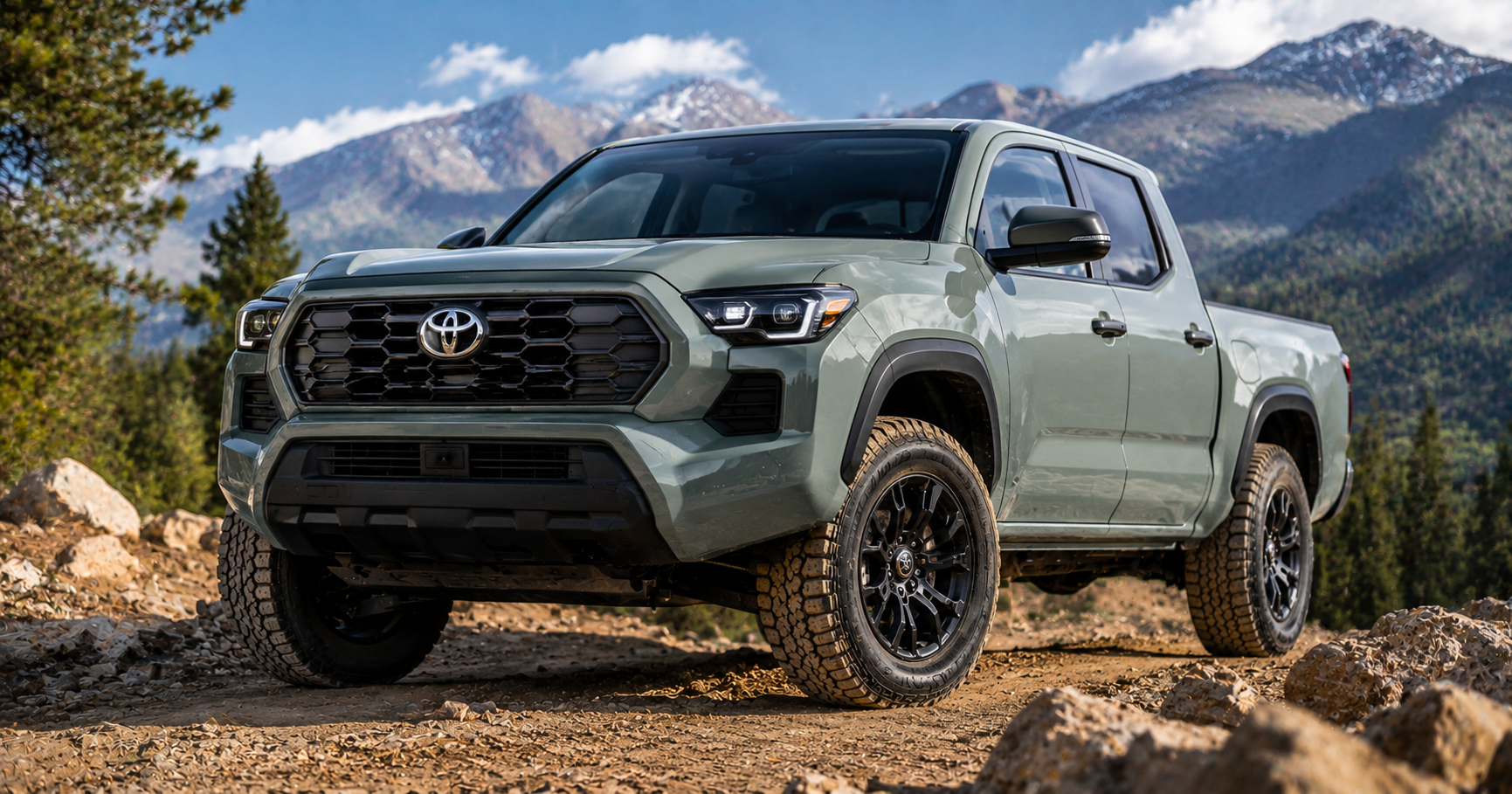
Toyota’s potential Ford Maverick rival appears to be gaining momentum, with a new patent filed with the United States Patent and Trademark Office detailing a truck-specific suspension mounting designed to address some of the structural challenges associated with unibody pickups.
Toyota Targets a Key Unibody Pickup Challenge
The Ford Maverick has become a major success, attracting buyers from Toyota and Honda. Honda recently trademarked a name that appears suited to a compact unibody pickup, while Toyota North America CEO Ted Ogawa alluded to the possibility of exploring the segment earlier this year.
The latest Toyota patent suggests the automaker is taking the opportunity seriously. It focuses on strengthening the structure around the rear suspension of a unibody pickup, where forces generated by the suspension can create challenges that are less pronounced in conventional vehicles.
In a typical unibody vehicle, the rear suspension connects to the body through strut towers located in the wheel wells. Toyota’s patent explains that when forces are transferred through the shock absorbers, those towers can be pushed inward.
Heavy cargo, driving through a dip in the road or a jump can increase those forces. While the resulting chassis movement may be mild and the structural components can return to their original shapes after the load is removed, Toyota notes that permanent deformation could eventually occur, potentially reducing structural rigidity.
Toyota’s Pickup-Specific Suspension Solution
Toyota’s patent proposes a component called a “strainer”, which would be added to the truck bed to distribute suspension forces more evenly.
The component features multiple beads, or creases added to sheet metal to improve bending strength. Toyota’s design also includes additional beads on the rear arch and welded nuts that secure the rear shocks to the body through the reinforced beads.
The goal is to prevent the inner wheel arches from deforming when the suspension is fully loaded.
The patent notes that a similar concept could be used on a crossover without the strainer. In that application, a rear cross-member could instead be used to manage the forces.
Could Toyota Use One Platform for a Pickup and Crossover?
The patent appears to point toward more than just a stronger unibody pickup. It also suggests Toyota could be exploring a single platform that serves both a crossover and a pickup.
A stronger structure could potentially improve the pickup’s off-road ability and towing capacity. Dealers have also asked Toyota for a compact truck, while camouflaged test vehicles spotted in South America suggest the automaker has taken those requests seriously.
It remains unclear whether Toyota is developing a subcompact Corolla-based pickup or a compact RAV4-based truck. Either option would represent a potential entry into the compact unibody pickup segment targeted by the Ford Maverick.
The possibility also raises the question of whether Toyota could eventually revive the Stout name for such a truck.