

BMW M is preparing to show North American enthusiasts what comes next for the M3 while looking back at the six generations that defined the nameplate. A new video highlights the evolution of the BMW M3 from the original E30 to the current G80 before pointing toward an electric future.
Six Generations of BMW M3 History
The video features all six generations of the BMW M3, presenting each model individually before ending with the message “40 Jahre M3.” The brief retrospective highlights how dramatically BMW’s performance sedan has evolved over four decades.
The original E30 M3 debuted in 1986 as a homologation special designed for touring-car racing. Its high-revving S14 four-cylinder produced 200 horsepower in its initial European specification, while widened bodywork and a large rear wing emphasized its motorsport purpose. Later Evolution models brought additional power, but the car’s racing success established the M3 name.
The E36 M3 moved the formula closer to what enthusiasts recognize today. It introduced six-cylinder power, greater refinement and increased everyday usability while retaining rear-wheel drive. Sedan and convertible versions also expanded the model’s appeal. However, the lower-output U.S.-specification E36 M3 did not receive the European car’s engine.
The E46 M3 Became an Enthusiast Favorite
For many enthusiasts, the E46 remains the M3 sweet spot. Its naturally aspirated S54 inline-six produced 333 horsepower in U.S. specification and could be paired with a six-speed manual transmission.
Sharp steering, an 8,000-rpm redline and restrained but muscular styling helped make the E46 a legend. BMW later pushed the formula further with the lighter and sharper M3 CSL.
The E9X Brought a Naturally Aspirated V8
The E9X generation represented another major change, replacing the inline-six with a naturally aspirated V8. BMW’s 4.0-liter S65 produced 414 horsepower in U.S. cars and revved beyond 8,000 rpm.
The engine gave the E90 sedan and E92 coupe a distinctive character, while the generation also became the final naturally aspirated M3 family.
Turbocharging Changed the M3 Formula
Turbocharging arrived with the F80 M3 and its S55 inline-six. The engine delivered substantially more torque than the outgoing V8, while BMW made another major change by separating the coupe and convertible from the M3 lineup and moving them into the M4 family.
The early F80 chassis could be unruly at times, but BMW continued developing the platform through Competition, CS and other special versions, pushing performance to another level.
The G80 M3 Redefined the Design
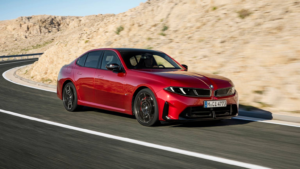
The current G80 generation became perhaps the most controversial redesign in M3 history, largely because of its enormous vertical kidney grilles. Beneath the divisive styling, however, the fundamentals remain focused on performance.
The G80 uses a powerful S58 inline-six and remains available with a six-speed manual transmission. Competition versions added M xDrive, while the M3 Touring expanded the lineup overseas.
BMW Prepares the Electric M3
The retrospective arrives as BMW prepares to introduce the next chapter of the M3. The BMW M Concept Neue Klasse previews the design and technology intended for the first electric M3.
Based on BMW’s Neue Klasse architecture, the concept uses four individually controlled electric motors along with an M-specific version of the Heart of Joy central computer. BMW has not yet disclosed the concept’s final range or power figures.
Neue Klasse M Concept Comes to North America
BMW unveiled the concept at Le Mans in June, but Monterey Car Week will give North American enthusiasts their first opportunity to see it in person.
The M Neue Klasse Concept will make its North American premiere at the House of M in California. After four decades defined by six generations of gasoline-powered M3s, BMW is preparing to show America a dramatically different seventh chapter for its iconic performance nameplate.