
The New Hyundai Tucson 2027 is shaping up to be one of Hyundai’s most dramatic redesigns yet. Instead of making subtle changes to an already successful formula, Hyundai has given its popular compact SUV an entirely new visual identity, combining a boxier body, sharper surfacing, full-width lighting and a more upscale interior.
The transformation matters because the Tucson is not a niche model. It is one of Hyundai’s best-selling vehicles globally and leads the automaker’s U.S. lineup by a significant margin. That makes the arrival of the next-generation Tucson a major event for Hyundai—and potentially one of the most important new compact SUVs heading toward showrooms.
Hyundai has so far treated the reveal primarily as a design preview, meaning many technical details remain under wraps. Still, the company has confirmed that the new Tucson is larger than the outgoing model, while the interior introduces a new dashboard concept expected to be closely related to Hyundai’s latest infotainment strategy.
Here is everything currently known about the New Hyundai Tucson 2027, including its redesigned exterior, interior technology, dimensions, expected powertrains, launch timing and what the changes could mean for shoppers considering a next-generation compact SUV.
2027 Hyundai Tucson Redesign: A Dramatic Change
The biggest story surrounding the 2027 Hyundai Tucson redesign is the styling. Hyundai has moved away from the softer, more intricate appearance of the current Tucson and embraced a much more geometric design.
The result is a compact crossover that looks wider, more upright and more substantial. Its body is dominated by horizontal lines and pronounced fender shapes, giving the SUV a rugged appearance without abandoning the futuristic design language that has become increasingly associated with Hyundai.
Hyundai’s latest Santa Fe and Palisade established the automaker’s growing preference for boxier SUVs. The next-generation Tucson takes that theme and adapts it for a smaller, more urban-oriented vehicle.
Rather than simply copying the larger SUVs, Hyundai has incorporated what it describes as its “Art of Steel” design direction. The approach emphasizes strong geometric forms and architectural-looking surfaces.
A More Upright and Sculpted Appearance
From the available design reveal, the new Tucson looks significantly more assertive than its predecessor. Pronounced fender flares give the sides a muscular appearance, while the heavily sculpted surfaces create more visual depth.
The design also benefits from the vehicle’s increased dimensions. The larger body allows Hyundai’s designers to give the SUV a more planted stance, particularly when combined with the large wheels and broad front and rear styling.
That combination should help the Hyundai Tucson 2027 compete visually in one of the most crowded segments of the U.S. market.
Full-Width Lighting Gives the New Tucson a Futuristic Look
Lighting is one of the most distinctive elements of the New Hyundai Tucson 2027. The front incorporates a slim light bar for the daytime running lights, while a corresponding rear light bar creates a cohesive appearance from front to back.
The lighting signature gives the SUV a distinctly modern character. Hyundai has also incorporated an illuminated H motif at both ends, making the headlights and taillights appear visually connected to the broader design.
That futuristic appearance is balanced by the SUV’s squared-off body and prominent fenders. The result is not simply a sleek crossover; it is a vehicle that attempts to combine ruggedness with sophistication.
This distinction could become increasingly important as compact SUV buyers look for vehicles that feel distinctive without moving into luxury-brand pricing.
The New Hyundai Tucson 2027 Is Bigger
Although the design is the most obvious change, the New Hyundai Tucson 2027 also grows in virtually every major exterior dimension.
Hyundai has confirmed that the next-generation model is longer, wider and taller than the 2026 Tucson. The wheelbase has also been extended, while rear-seat headroom and cargo practicality are expected to benefit from the additional space.
Here is how the dimensions compare with the outgoing model:
| Dimension | 2027 Hyundai Tucson | 2026 Hyundai Tucson | Difference |
|---|---|---|---|
| Wheelbase | 109.6 inches | 108.5 inches | +1.1 inches |
| Length | 185 inches | 182.7 inches | +2.3 inches |
| Width | 75 inches | 73.4 inches | +1.6 inches |
| Height | 66.3 inches | 65.6 inches (FWD) | +1.3 inches |
| Second-row headroom | 40.6 inches | 39.5 inches | +1.1 inches |
Why the Extra Size Matters
The increase in size is more than a styling exercise. The additional length, width and wheelbase can make a meaningful difference to passengers and everyday usability.
The wheelbase grows by 1.1 inches, while overall length increases by 2.3 inches. Width increases by roughly 1.6 inches, creating a broader footprint for the new-generation SUV.
Hyundai also says the vehicle provides more second-row headroom. Rear passengers get 40.6 inches compared with 39.5 inches in the 2026 Tucson.
The rear doors are another practical improvement. Their opening angle increases from 73 degrees to 83 degrees, making it easier to get into the second row.
That could be especially useful for families installing child seats, loading passengers or simply accessing the rear seats in tight parking situations.
2027 Tucson Interior: A More Premium Cabin
The exterior may attract attention first, but the cabin could ultimately be one of the most important improvements in the 2027 Tucson.
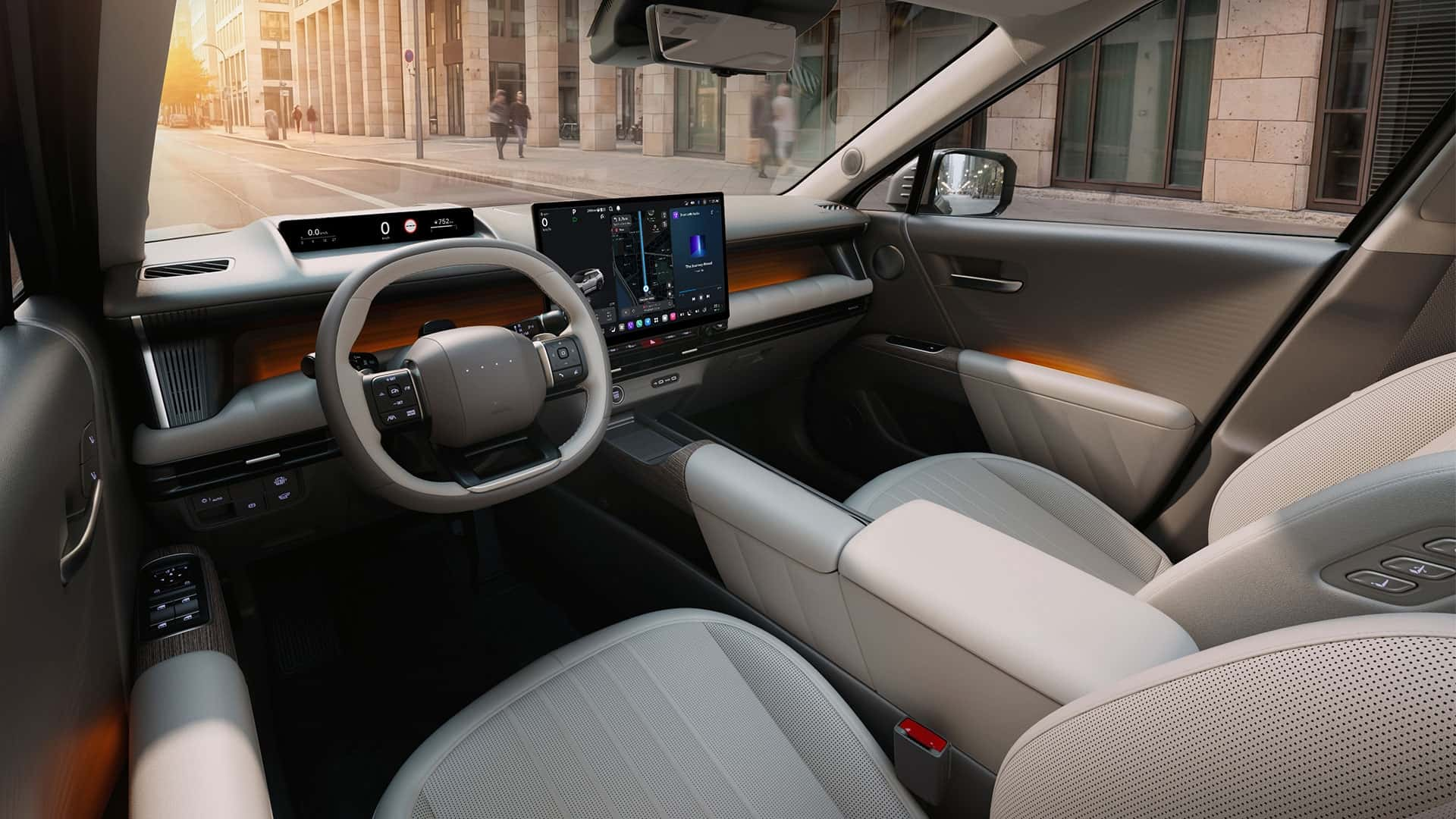
Hyundai has redesigned the dashboard with a horizontal layout, a large central touchscreen and a slim digital instrument display positioned directly in front of the driver.
The design is closely related to the direction Hyundai is taking with other upcoming models, including the redesigned Elantra. The objective appears clear: create an interior that feels more sophisticated without removing the physical controls that drivers still use frequently.
Hyundai Keeps Physical Controls
One of the more encouraging details is that Hyundai has not abandoned conventional controls beneath the large central display.
As automakers increasingly move climate and vehicle functions into touchscreens, physical controls can provide a welcome alternative for frequently used functions. The Tucson’s interior appears to preserve a row of traditional controls beneath the main screen.
For drivers who prefer straightforward operation, that could become one of the cabin’s most appealing features.
Premium Materials and Ambient Lighting
The interior shown by Hyundai features light-colored upholstery, soft-looking materials, perforated surfaces, wood-like trim and ambient lighting.
Those details reinforce the broader strategy behind the redesign. The New Hyundai Tucson 2027 is not merely trying to become larger; it is attempting to move the perceived quality of the Tucson closer to vehicles from higher segments.
The combination of a wide dashboard, slim driver display and large center screen gives the cabin a modern appearance, while the physical controls help keep it from becoming entirely screen-dependent.
Will the New Tucson Get Hyundai’s Pleos Infotainment?
One of the biggest technology questions surrounding the New Hyundai Tucson 2027 concerns Hyundai Pleos.
Hyundai has introduced Pleos as part of its next-generation software and infotainment strategy, and the new Tucson’s cabin appears designed around that technological direction.
The company has not provided every specification for the Tucson’s infotainment system, so the exact screen size and feature set remain unconfirmed. However, the dashboard layout strongly suggests that the 2027 Hyundai Tucson will be an important model for Hyundai’s new software-focused cabin architecture.
How the Pleos System Could Change the Tucson
For Tucson shoppers, the significance of Pleos extends beyond having a larger screen.
Modern vehicle infotainment systems increasingly serve as the central interface for navigation, connectivity, vehicle settings and digital services. A new software architecture could therefore influence how owners interact with the SUV for years after purchase.
The exact Tucson implementation remains to be confirmed, but the new dashboard appears prepared for a significantly more advanced digital experience.
2027 Hyundai Tucson Powertrain: What We Expect
Hyundai has not yet released complete technical specifications for the next-generation Tucson. That means horsepower, torque, fuel economy and final drivetrain details should not be treated as confirmed at this stage.
However, the current Tucson lineup provides a reasonable indication of the powertrain strategy Hyundai could continue developing.
The current model offers gasoline, hybrid and plug-in hybrid configurations. The expected formula for the next generation could therefore remain familiar rather than completely reinvented.
- A 2.5-liter inline-four gasoline engine.
- A hybrid system pairing a turbocharged 1.6-liter inline-four with an electric motor.
- A plug-in hybrid using the same 1.6-liter turbocharged engine with a more powerful electric motor and larger battery.
- Front-wheel drive as the basic layout, with all-wheel drive available.
These details should be considered expectations based on the current model rather than final specifications for the Hyundai Tucson 2027. Hyundai could make changes before the vehicle reaches production.
Could the 2027 Tucson Get an Extended-Range EV Powertrain?
Another unanswered question involves Hyundai’s plans for extended-range electric vehicles.
Hyundai CEO José Muñoz has said the automaker plans to launch its first extended-range EVs in 2027. What remains unclear is whether the next-generation Tucson will be among the first Hyundai vehicles to receive that technology.
For now, there is no confirmation that an extended-range Tucson is coming. The possibility is nevertheless worth watching because the compact SUV segment is rapidly evolving as automakers search for alternatives between conventional hybrids and fully electric vehicles.
2027 Hyundai Tucson XRT, N Line and N Versions
The rugged styling of the New Hyundai Tucson 2027 naturally raises questions about performance and off-road-oriented variants.
Hyundai has already shown that a new Tucson XRT is planned. The XRT name has become associated with a more adventurous interpretation of Hyundai SUVs, making it a logical match for the new Tucson’s more rugged design.
The situation is less certain for the N Line and N performance variants.
The U.S. previously received a Tucson N Line, but that model was discontinued for 2026. Although it added sportier styling, it did not provide additional horsepower.
Hyundai has not confirmed whether the redesigned Tucson will receive another N Line or a genuine N performance model. At least one such version has been rumored, but it remains unconfirmed.
How the New Hyundai Tucson 2027 Compares With the Competition
The compact SUV market is extremely competitive, with established rivals including the Toyota RAV4 and Honda CR-V. That makes differentiation critical.
The 2027 Hyundai Tucson redesign takes a different approach from simply trying to make the vehicle look more aerodynamic or minimalist. Hyundai is leaning into a distinctive, almost architectural appearance.
The boxier proportions could appeal to buyers who increasingly associate upright SUV styling with capability and practicality. At the same time, the futuristic lighting and upscale cabin are intended to prevent the Tucson from looking utilitarian.
That combination could give the Tucson an important advantage: visual identity.
Design vs. Familiarity
There is always a risk when an automaker radically changes a successful vehicle. Existing customers may prefer the familiarity of the outgoing model, while new buyers may be attracted by the fresh design.
Hyundai appears willing to take that risk with the next-generation Tucson. The company has already used dramatic generational design changes across its SUV lineup, and the Tucson follows the same philosophy.
Because the Tucson is such an important seller, however, the mechanical strategy may remain comparatively conservative. Hyundai has made substantial changes to the exterior and interior, which reduces the need to reinvent the vehicle underneath at the same time.
What We Know About the 2027 Hyundai Tucson So Far
Hyundai has deliberately revealed the vehicle in stages. The current presentation focuses heavily on design, leaving important technical questions unanswered.
Here are the most important confirmed and unconfirmed points:
Confirmed
- The Tucson is entering its fourth generation.
- The exterior receives a completely new design.
- The interior has been substantially redesigned.
- The vehicle is larger than the 2026 Tucson.
- The wheelbase measures 109.6 inches.
- The vehicle measures 185 inches long and 75 inches wide.
- Second-row headroom increases to 40.6 inches.
- Rear doors open to 83 degrees.
- A new Tucson XRT is planned.
Not Yet Confirmed
- Final horsepower and torque figures.
- Official fuel-economy ratings.
- Exact infotainment screen size.
- Final Pleos feature list for the Tucson.
- Whether an N Line version will return.
- Whether a Tucson N performance model will arrive.
- Whether the Tucson will receive Hyundai’s extended-range EV technology.
When Will the New Hyundai Tucson 2027 Be Available?
The redesigned Tucson is expected to go on sale in Korea later this year, with other markets following in 2027.
That timing explains why some important specifications are still unavailable. Hyundai has provided an early look at the vehicle, but a complete technical reveal is expected closer to its market launch.
For U.S. shoppers, the key question will be when Hyundai provides specific information about American-market trims, powertrains, pricing and availability.
Until those details are released, buyers should view the current reveal as a preview of the vehicle’s direction rather than a complete specification sheet.
What the 2027 Tucson Redesign Means for Buyers
For shoppers considering a compact SUV, the New Hyundai Tucson 2027 could represent a particularly significant change.
First, the larger dimensions should make the vehicle more accommodating. The extra rear headroom and wider body could improve everyday usability, while the increased rear-door opening angle should make loading passengers easier.
Second, the cabin appears substantially more upscale. Hyundai is clearly targeting buyers who want modern technology and premium-looking materials without necessarily stepping into a luxury SUV.
Third, the new design gives the Tucson a stronger visual personality. In a market filled with familiar crossover shapes, Hyundai is betting that a bold appearance can become a selling point rather than a liability.
Finally, the expected continuation of gasoline, hybrid and plug-in hybrid choices could give buyers multiple ways to approach electrification, assuming Hyundai retains a similar lineup for the new generation.
Why the New Tucson Could Be One of Hyundai’s Most Important Models
The significance of the Hyundai Tucson 2027 goes beyond its styling.
Hyundai sold about 234,000 Tucson models last year, according to the information provided for the reveal, putting the model well ahead of the Elantra in the U.S. lineup. With that level of demand, Hyundai has a strong incentive to preserve the qualities that made the current vehicle successful while modernizing the areas where buyers expect progress.
The strategy appears to be exactly that.
The exterior changes dramatically, but the basic SUV concept remains recognizable. The interior becomes more sophisticated, but Hyundai retains conventional controls. The vehicle gets larger, but the company is expected to continue offering familiar gasoline and electrified powertrain choices.
In other words, Hyundai is changing the Tucson where customers can immediately see and feel the difference while potentially avoiding unnecessary disruption underneath.
Bottom Line: Is the 2027 Tucson Worth Waiting For?
The New Hyundai Tucson 2027 has not yet revealed every piece of the puzzle, but the pieces Hyundai has shown are significant.
The fourth-generation SUV adopts a dramatically more rugged and futuristic design, grows in virtually every dimension and introduces a cabin that appears substantially more premium than the outgoing model.
The larger body should improve passenger space, while the redesigned dashboard sets the stage for Hyundai’s next-generation infotainment technology and potentially its Pleos software platform.
The biggest unanswered questions concern powertrains, pricing, equipment, U.S. specifications and the possibility of additional performance or electrified variants. Those details will ultimately determine whether the new Tucson is merely an attractive redesign or a genuine step forward in the compact SUV segment.
For now, though, Hyundai has accomplished something important: it has made the next Tucson impossible to confuse with its predecessor.
With its squared-off body, full-width lighting, larger dimensions and more sophisticated cabin, the New Hyundai Tucson 2027 looks ready to make a much bigger statement when it reaches global markets.
2027 Hyundai Tucson FAQ
What is new on the 2027 Hyundai Tucson?
The 2027 Hyundai Tucson enters its fourth generation with a completely redesigned exterior and interior. It is also longer, wider and taller than the 2026 model, with a longer wheelbase and more second-row headroom.
How big is the 2027 Hyundai Tucson?
The new Tucson measures 185 inches long, 75 inches wide and 66.3 inches tall. Its wheelbase measures 109.6 inches.
Will the 2027 Tucson have Hyundai Pleos?
The new Tucson’s redesigned dashboard appears intended to accommodate Hyundai’s new Pleos infotainment strategy, but Hyundai has not yet released the complete technical specifications or final feature list for the Tucson.
Will the 2027 Hyundai Tucson be available as a hybrid?
Hyundai has not released the complete 2027 powertrain specifications. The current Tucson offers gasoline, hybrid and plug-in hybrid powertrains, making continued electrified options a reasonable expectation, but final specifications should be confirmed by Hyundai.
Will the 2027 Tucson have all-wheel drive?
The current information indicates that the next-generation Tucson is expected to retain front-wheel drive as a basic configuration while offering all-wheel drive. Hyundai has not yet published the complete final drivetrain specification.
Will there be a 2027 Tucson XRT?
Yes. Hyundai has shown that a new Tucson XRT is planned. The XRT should complement the redesigned SUV’s more rugged visual character.
Will Hyundai make a 2027 Tucson N Line or N?
Hyundai has not confirmed either version. A Tucson N Line was previously offered in the U.S. but was dropped for 2026. At least one sportier version has been rumored for the new generation.
When will the 2027 Hyundai Tucson go on sale?
The new Tucson is expected to go on sale in Korea later in 2026, with other markets expected to follow in 2027. Exact U.S. timing and specifications have not yet been announced.
Is the 2027 Tucson bigger than the 2026 Tucson?
Yes. The new Tucson is 2.3 inches longer, 1.6 inches wider and approximately 1.3 inches taller than the outgoing model. Its wheelbase increases by 1.1 inches, while second-row headroom rises by 1.1 inches.
What makes the 2027 Tucson different from the current model?
The biggest differences are the fourth-generation design, larger dimensions, more angular bodywork, full-width lighting, a redesigned premium-oriented interior and the expected adoption of Hyundai’s latest infotainment technology.