
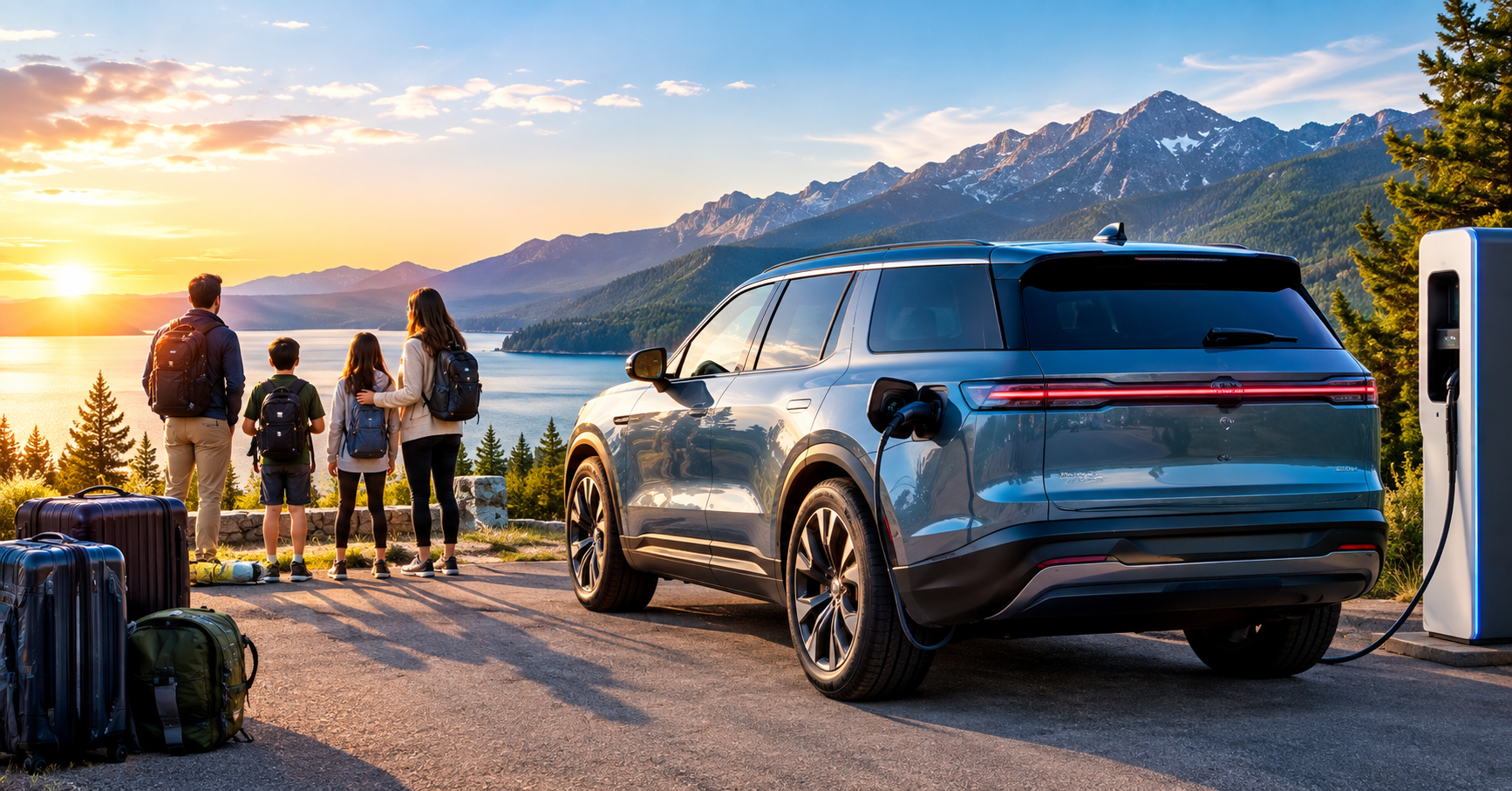
For families planning long road trips in 2026, choosing the Best 3 Row Electric SUV for Family travel is no longer simply about finding an EV with three rows of seats. The real question is whether the vehicle can carry a full family, luggage and road-trip gear while delivering enough range and charging speed to keep the journey moving.
The 2026 market offers several compelling answers. From the family-focused Kia EV9 and Hyundai Ioniq 9 to the adventure-ready Rivian R1S and long-range Lucid Gravity, today’s three-row electric SUVs cover a surprisingly wide range of needs and budgets.
But there is an important catch: EPA range alone does not tell the whole story. A vehicle with 350 miles of advertised range can still require more planning than expected if charging stops are slow. Likewise, a huge maximum cargo figure means little to a family traveling with all three rows occupied if there is barely enough room behind the third row for luggage.
That is why this guide looks beyond headline numbers. It examines range, charging, third-row usability, cargo space, towing, pricing and the practical realities of taking a three-row EV on a 300- to 400-mile family trip.
The 7 Best 3 Row Electric SUV Options for 2026
The 2026 U.S. market has nine three-row electric SUVs on sale, with prices ranging from roughly $55,000 to more than $105,000 depending on model, trim and equipment. The seven models below represent a broad cross-section of what families can consider.
- Kia EV9 — Value and everyday family practicality
- Hyundai Ioniq 9 — Range, charging and cabin balance
- Rivian R1S — Adventure, towing and capability
- Lucid Gravity — Long-range luxury and performance
- Tesla Model X — Range and maximum cargo flexibility
- Volvo EX90 — Safety-focused electric family SUV
- Cadillac Escalade IQ — Full-size luxury and towing
1. Kia EV9: A Practical Family Starting Point
The Kia EV9 remains one of the most accessible ways to enter the three-row electric SUV segment in 2026. Its approximate starting price of $54,900 to $56,545, including destination depending on configuration, puts it near the lower end of a segment where prices can quickly climb toward six figures.
For family travel, the EV9’s appeal is not based on one spectacular specification. Instead, it combines space, usable range, fast charging and a family-friendly interior into one package.
Key EV9 Numbers
- Approximate starting price: $54,900–$56,545
- Maximum range: approximately 305 miles
- Best range configuration: Light Long Range RWD
- 10–80% DC fast charging: approximately 24 minutes under suitable conditions
- Cargo behind third row: about 20.2 cubic feet
- Maximum towing: up to 5,000 pounds
The EV9 is particularly interesting for families because 20.2 cubic feet behind the third row gives passengers considerably more useful luggage space than a simple maximum-cargo specification would suggest.
That distinction matters. When all three rows are occupied, the family cannot fold the third row down just to create additional luggage room. The space available behind those seats becomes the real-world cargo number.
The EV9 was also recognized by Kelley Blue Book as its 2026 Best 3-Row EV, with the award highlighting value, space and family-oriented packaging.
Who Should Consider the EV9?
The EV9 makes sense for families that want a dedicated three-row EV without immediately moving into luxury-SUV pricing. It is especially suited to daily school runs, commuting and occasional interstate trips where charging infrastructure is available along the route.
Its third row is better suited to children and shorter adult trips than extended journeys with larger adults, so families should test the seating arrangement before purchasing.
2. Hyundai Ioniq 9: A Strong All-Around Family EV
The Hyundai Ioniq 9 is one of the most significant three-row EV additions to the 2026 market. It combines a 335-mile EPA range in its rear-wheel-drive configuration with an 800-volt electrical architecture capable of taking advantage of high-power DC fast chargers.
For a family road trip, those characteristics address two of the biggest EV concerns: how far the SUV can travel and how long passengers must wait during charging stops.
Why the Ioniq 9 Stands Out
- EPA range: up to 335 miles
- Charging architecture: 800V
- Fast-charging capability: approximately 18–24 minutes for 10–80% under appropriate conditions
- Cargo behind third row: about 21.9 cubic feet
- Approximate starting price: $58,955–$60,605 depending on configuration and destination
The combination of approximately 21.9 cubic feet behind the third row and strong charging performance makes the Ioniq 9 particularly interesting for families who frequently travel with every seat occupied.
The research brief also cites Edmunds giving the Ioniq 9 an 8.4/10 score in its 2026 electric SUV rankings, with praise for its spacious three-row cabin, cargo capacity, upscale interior and rapid recharging.
That does not mean every family will have the same experience. Real-world range depends on speed, temperature, terrain, passenger load, weather and other conditions. However, the underlying combination of range and charging capability makes the Ioniq 9 one of the more road-trip-oriented options in the segment.
Best Use Case
Consider the Ioniq 9 if the priority is a balanced combination of passenger space, luggage capacity, range and charging speed rather than extreme towing capability or ultra-luxury equipment.
3. Rivian R1S: Built for Families That Leave the Pavement
The Rivian R1S takes a different approach. Rather than focusing primarily on value or urban family transportation, it targets buyers who want three rows combined with serious adventure capability.
Dual-motor versions start at approximately $76,990, while the Dual Max configuration can provide a headline range of around 410 miles. Quad-motor variants can produce as much as 1,025 horsepower.
Rivian R1S Highlights
- Approximate starting price: $76,990 for dual-motor configuration
- Maximum range: approximately 410 miles with Dual Max
- Fast charging: roughly 20–30 minutes in the class under suitable conditions
- Cargo behind third row: approximately 20+ cubic feet, depending on configuration
- Maximum towing: up to 7,700 pounds
- Quad-motor output: up to 1,025 horsepower
For a family pulling a trailer, carrying outdoor equipment or traveling toward remote destinations, the R1S provides capabilities that some family-focused electric SUVs do not match.
However, towing introduces an important complication: range can fall substantially when an EV is pulling a heavy trailer. A family should therefore plan charging stops based on expected towing consumption rather than relying on the vehicle’s unloaded EPA range.
Who Is the R1S For?
The R1S fits families who view their SUV as more than transportation. Camping equipment, bikes, trailers, rough roads and long-distance outdoor adventures are all scenarios where its capabilities become particularly relevant.
4. Lucid Gravity: Long Range Meets Three-Row Utility
The Lucid Gravity brings an unusual combination to the segment: three-row practicality with luxury-car performance and exceptionally long range.
The Gravity can offer up to 450 miles of EPA range in Grand Touring two-row configuration, while the three-row configuration is listed at approximately 437 miles. Its charging system can reach up to 400 kW, while output can reach 828 horsepower.
Lucid Gravity Highlights
- Approximate pricing: $81,550–$99,450 depending on configuration
- Three-row GT range: approximately 437 miles
- Maximum two-row GT range: up to 450 miles
- Peak charging: up to 400 kW
- Output: up to 828 horsepower
- Cargo behind third row: approximately 21.3 cubic feet
The Gravity is particularly relevant for drivers who want to reduce charging frequency on long journeys. A roughly 400-mile-plus EPA range gives the SUV a substantial buffer for highway travel, although actual road-trip range will vary.
The trade-off is financial. A three-row Grand Touring configuration approaches the $100,000 mark, placing it in a very different purchasing category from the EV9.
Performance Without Giving Up Family Space
Reviews cited in the research brief highlight acceleration around 3.4 seconds from 0 to 60 mph in certain configurations. That is remarkable for a three-row family SUV.
For most families, however, acceleration is unlikely to be the reason to choose the Gravity. Its more meaningful advantage for road trips is the combination of long range, fast charging and usable passenger capacity.
5. Tesla Model X: Range, Cargo and Charging Network Access
The Tesla Model X remains one of the better-known electric SUVs capable of carrying up to seven passengers, depending on configuration.
For 2026, the Model X offers approximately 335–352 miles of EPA range, while maximum cargo volume reaches 91.6 cubic feet with the rear seating folded.
Model X Highlights
- Approximate starting price: $91,630
- Plaid pricing: approximately $106,630
- EPA range: approximately 335–352 miles
- Maximum cargo: up to 91.6 cubic feet
- 0–60 mph: approximately 2.5–3.8 seconds depending on version
For families, the Model X’s biggest practical consideration is how the vehicle’s seating configuration affects luggage space. Maximum cargo capacity can be impressive, but families should examine how much usable room remains when all three rows are actually occupied.
The vehicle also uses Tesla’s charging ecosystem, which can be an important consideration for drivers who frequently travel long distances and have convenient access to compatible fast-charging locations.
What to Consider Before a Family Road Trip
The Model X’s distinctive falcon-wing doors can be useful in some parking situations but can also require attention to surroundings and overhead clearance. Families should evaluate how the doors fit their garage and regular parking environment.
6. Volvo EX90: A Safety-Focused Three-Row EV
The Volvo EX90 approaches the family EV market from a different direction, emphasizing safety, Scandinavian luxury and a comfortable three-row cabin.
The 2026 EX90 starts at approximately $76,695 and uses a 106-kWh usable battery. EPA range is approximately 276–305 miles depending on configuration.
Volvo EX90 Highlights
- Approximate starting price: $76,695
- Usable battery: 106 kWh
- EPA range: approximately 276–305 miles
- Seating: three rows
- Focus: safety and premium family transportation
The EX90’s range does not reach the highest figures in this group. For families regularly driving 300- to 400-mile interstate routes, charging strategy therefore becomes more important.
For everyday family use, however, a 276- to 305-mile EPA range can cover a substantial amount of routine driving before charging is necessary, particularly when the vehicle is charged overnight at home.
7. Cadillac Escalade IQ: Full-Size Electric Luxury
The Cadillac Escalade IQ takes the three-row EV concept to full-size luxury-SUV proportions. It is designed for buyers who want substantial interior space, long estimated range and serious towing capability.
Cadillac estimates approximately 460–465 miles of range, while the SUV uses a 205-kWh battery. Maximum output with Velocity Max reaches about 750 horsepower, and towing capacity can reach 8,000 pounds.
Escalade IQ Highlights
- Approximate base MSRP: $127,405 before destination
- Estimated range: approximately 460–465 miles
- Battery: 205 kWh
- Maximum output: approximately 750 horsepower
- Maximum towing: 8,000 pounds
- Charging: up to 350 kW
The Escalade IQ is not a conventional value proposition. Its size, luxury equipment and pricing place it near the top of the three-row electric SUV market.
Its physical dimensions also matter. A large SUV can provide excellent passenger and cargo space while becoming more challenging to maneuver in tight parking garages, older residential streets and crowded urban areas.
How These Three-Row EVs Compare for Family Trips
There is no single specification that determines whether an electric SUV is suitable for a family road trip. Range, charging time, third-row comfort and cargo capacity interact with one another.
| Model | Approx. Starting Price | Best Range | Charging | Cargo Behind 3rd Row | Primary Strength |
|---|---|---|---|---|---|
| Kia EV9 | $54,900–$56,545 | ~305 miles | ~24 min | 20.2 cu. ft. | Family value |
| Hyundai Ioniq 9 | $58,955–$60,605 | 335 miles | ~18–24 min | 21.9 cu. ft. | Range and balance |
| Rivian R1S | ~$76,990 | ~410 miles | ~20–30 min class | 20+ cu. ft. | Adventure and towing |
| Lucid Gravity | $81,550–$99,450 | ~437 miles in 3-row GT | Up to 400 kW | ~21.3 cu. ft. | Range and performance |
| Tesla Model X | ~$91,630 | ~352 miles | Fast-charging network | Configuration dependent | Range and cargo flexibility |
| Volvo EX90 | ~$76,695 | ~305 miles | Fast-charge capable | Family-focused | Safety and luxury |
| Cadillac Escalade IQ | ~$127,405 | ~460–465 miles est. | Up to 350 kW | Very large maximum cargo | Luxury and towing |
What Matters Most on a 300-Mile Family Road Trip?
Imagine a family leaving home with two adults, two children and another passenger occupying the third row. The SUV is packed with suitcases, backpacks, snacks and road-trip equipment.
This is where the specifications begin to tell a different story.
1. Range Is Only the Starting Point
A 300-mile trip does not necessarily require an EV with exactly 300 miles of EPA range. Drivers typically do not want to arrive at a charger with the battery nearly empty, particularly when traveling with children or when weather conditions are unpredictable.
A vehicle with 335 miles of EPA range can therefore provide a useful buffer over a 300-mile route, while an SUV with approximately 437 miles can provide considerably more flexibility.
Actual range can vary because of highway speed, temperature, wind, elevation changes, tire pressure, passenger load and use of climate control.
2. Charging Time Can Matter More Than Another 30 Miles of Range
Suppose two SUVs arrive at a fast charger with a similar battery percentage. If one can take advantage of a high-power charging station and recover a large amount of energy quickly, the family may spend less time waiting.
That is why 800V architectures are particularly interesting for road trips. Models such as the Ioniq 9 and EV9 can take advantage of high-power DC fast charging when the charger and vehicle conditions allow it.
The research brief indicates that many three-row EVs using 800V architectures can achieve approximately 10–80% charging in around 18–24 minutes at suitable 250–350 kW stations.
Charging performance is not guaranteed at every station. Battery temperature, charger availability, state of charge and the station’s actual output can all affect the result.
3. Cargo Space Behind the Third Row Is Critical
One of the easiest mistakes when shopping for a three-row SUV is focusing exclusively on maximum cargo capacity.
Maximum cargo volume normally requires folding one or more rows. That is not how a family road trip works when all seats are occupied.
For that reason, the usable cargo space behind the third row is often a more meaningful measurement.
Several vehicles in this group provide around 20 to 22 cubic feet behind the third row. That may be enough for several bags, but families with large suitcases, strollers, sports equipment or camping gear should physically test the cargo area.
How Much Range Does a Family Really Need?
For many U.S. interstate journeys, a practical target is roughly 270–350 miles of EPA range, particularly when the vehicle supports rapid DC charging.
The important point is not to treat the EPA figure as a guaranteed highway distance.
For example, a family driving 300 miles may want to plan a charging stop before reaching the end of the route rather than attempting to complete the journey on a nearly depleted battery.
A practical road-trip strategy is:
- Start the trip with a high state of charge.
- Identify compatible fast chargers along the route before leaving.
- Keep a backup charging location in mind.
- Allow extra energy for weather, traffic and detours.
- Use charging stops to combine eating, restroom breaks and stretching.
Home Charging for a Three-Row Electric SUV
Most family EV ownership becomes easier when charging happens at home overnight.
With a 240-volt, 48-amp setup delivering approximately 11 kW, a large battery around 100 kWh can theoretically require roughly nine hours to replenish from 10% to 100%, although real-world charging times vary.
This makes overnight charging particularly practical for daily family use.
A family might arrive home with 30% battery remaining, plug in overnight and start the following morning with enough energy for commuting, school runs and errands without visiting a public charger.
What About Federal EV Tax Credits in 2026?
Pricing needs special attention when comparing 2026 electric SUVs.
According to the research brief, the $7,500 federal new-EV purchase credit and $4,000 used-EV credit ended for vehicles acquired after September 30, 2025. The federal home-charger credit also expired June 30, 2026.
That means buyers shopping in 2026 should not automatically subtract a federal purchase rebate from the manufacturer’s advertised price.
Instead, buyers should investigate state incentives, utility programs, HOV-related benefits and dealer promotions that may apply to their specific location and purchase arrangement.
Which Three-Row EV Fits Different Family Scenarios?
For a Family on a Budget
The Kia EV9 sits near the lower end of the current three-row EV market and combines approximately 305 miles of maximum range with fast charging and useful third-row cargo space.
For Frequent Interstate Travel
The Hyundai Ioniq 9 combines a 335-mile EPA range with 800V charging and approximately 21.9 cubic feet behind the third row, making those specifications particularly relevant to frequent road-trippers.
For Outdoor Adventures
The Rivian R1S adds substantial towing and off-road-oriented capability. Its Dual Max configuration can provide approximately 410 miles of headline range, although towing can reduce range significantly.
For Maximum Long-Range Luxury
The Lucid Gravity and Cadillac Escalade IQ offer some of the longest stated ranges in the segment. The Gravity reaches approximately 437 miles in three-row Grand Touring configuration, while Cadillac estimates approximately 460–465 miles for the Escalade IQ.
For Safety-Focused Luxury
The Volvo EX90 targets buyers who prioritize a premium, safety-focused family environment and are comfortable with a range figure below the segment’s longest-range models.
How Much Does a Three-Row Electric SUV Cost in 2026?
The price gap between models is substantial.
An EV9 can begin around the mid-$50,000 range, while the Ioniq 9 begins around the upper-$50,000 to low-$60,000 range depending on configuration. Moving into models such as the R1S, EX90, Gravity and Model X pushes pricing considerably higher.
The Escalade IQ takes the segment into another category altogether, with a base MSRP of approximately $127,405 before destination.
This creates three broad shopping scenarios:
- Around $55,000–$65,000: Family-focused options such as the EV9 and Ioniq 9.
- Around $75,000–$85,000: Premium and capability-focused choices such as the R1S and EX90, with certain Gravity configurations entering this range.
- Around $90,000–$130,000+: Long-range luxury and high-end options such as the Model X, Lucid Gravity and Escalade IQ.
Actual transaction prices can differ from MSRP because of destination charges, options, incentives, dealer promotions and configuration.
What to Check Before Buying a Three-Row Electric SUV
Before signing a purchase agreement, families should test the SUV in conditions that resemble their actual use.
- Put an adult in the third row. Do not rely solely on photographs or specifications.
- Load your real luggage. Bring the bags you normally use on vacation.
- Measure cargo with all seats occupied. Maximum cargo volume can be misleading.
- Check charging locations along your regular routes.
- Compare the actual charging curve. Peak charging power alone does not tell the complete story.
- Calculate towing impact. If you tow, assume range will be substantially lower.
- Check home electrical capacity. An overnight charging strategy depends on having an appropriate electrical installation.
- Review local incentives. Federal purchase credits are not assumed for 2026.
The Bottom Line for Family EV Buyers
The Best 3 Row Electric SUV for Family travel depends heavily on how the vehicle will actually be used.
A family that mainly needs affordable three-row transportation may focus on the Kia EV9. A household that regularly drives long interstate distances may place greater importance on the Hyundai Ioniq 9’s range and charging combination. Outdoor-oriented buyers may focus on the Rivian R1S, while luxury shoppers interested in long-distance range have options such as the Lucid Gravity and Cadillac Escalade IQ.
The Tesla Model X remains relevant for buyers who value its range, cargo flexibility and charging ecosystem, while the Volvo EX90 provides another premium three-row alternative with a strong safety-focused identity.
Ultimately, the most useful comparison is not simply miles of range or horsepower. It is how many people the SUV can comfortably carry, how much luggage fits behind the third row, how quickly the battery can recover during a road trip and how much the complete purchase costs.
Those are the numbers that matter when the family is hundreds of miles from home and everyone wants to know one thing: how soon can we get back on the road?
Frequently Asked Questions
What is the best three-row electric SUV for family trips in 2026?
The leading choices depend on the family’s priorities. The Kia EV9 emphasizes value and family practicality, the Hyundai Ioniq 9 combines range and fast charging, the Rivian R1S focuses on adventure and towing, and the Lucid Gravity emphasizes long-range luxury and performance.
Which three-row EV has the longest range in 2026?
Among the models covered here, the Cadillac Escalade IQ has a Cadillac-estimated range of approximately 460–465 miles. The Lucid Gravity offers up to approximately 450 miles in two-row Grand Touring form and about 437 miles in three-row configuration.
How far can a three-row electric SUV travel on one charge?
Most three-row EVs in the 2026 market provide approximately 270–350 miles of EPA-rated range, while some long-range configurations exceed 400 miles. Actual highway range varies with speed, temperature, terrain, load and weather.
Which three-row electric SUV charges fastest?
Several models with 800V architectures can achieve approximately 10–80% DC fast charging in around 18–24 minutes under suitable conditions. Charging speed depends on the vehicle, battery temperature, charger output and state of charge.
Is the third row usable for adults?
Third-row comfort varies significantly. The Hyundai Ioniq 9 and Lucid Gravity are highlighted in the research as having relatively adult-friendly third rows, while some competing SUVs may be more suitable for children or shorter adult journeys.
How much cargo space do three-row EVs have?
Several models provide approximately 18–22 cubic feet behind the third row. This is often more useful for family-trip planning than maximum cargo capacity, which usually requires folding the rear seats.
Can a three-row EV tow a trailer?
Yes. Towing capacity varies considerably. The Kia EV9 can tow up to approximately 5,000 pounds, the Rivian R1S up to approximately 7,700 pounds and the Cadillac Escalade IQ up to approximately 8,000 pounds. Towing can significantly reduce driving range.
Are there federal EV tax credits in 2026?
The research brief states that the federal $7,500 new-EV purchase credit and $4,000 used-EV credit ended for vehicles acquired after September 30, 2025. Buyers should instead investigate applicable state, utility and other local incentives.
Is an EV practical for a 400-mile family road trip?
Yes, but trip planning is important. Families should identify fast chargers before departure, maintain an energy buffer and consider charging speed as well as EPA range. A vehicle with a high-power charging system can reduce the time spent at charging stops.