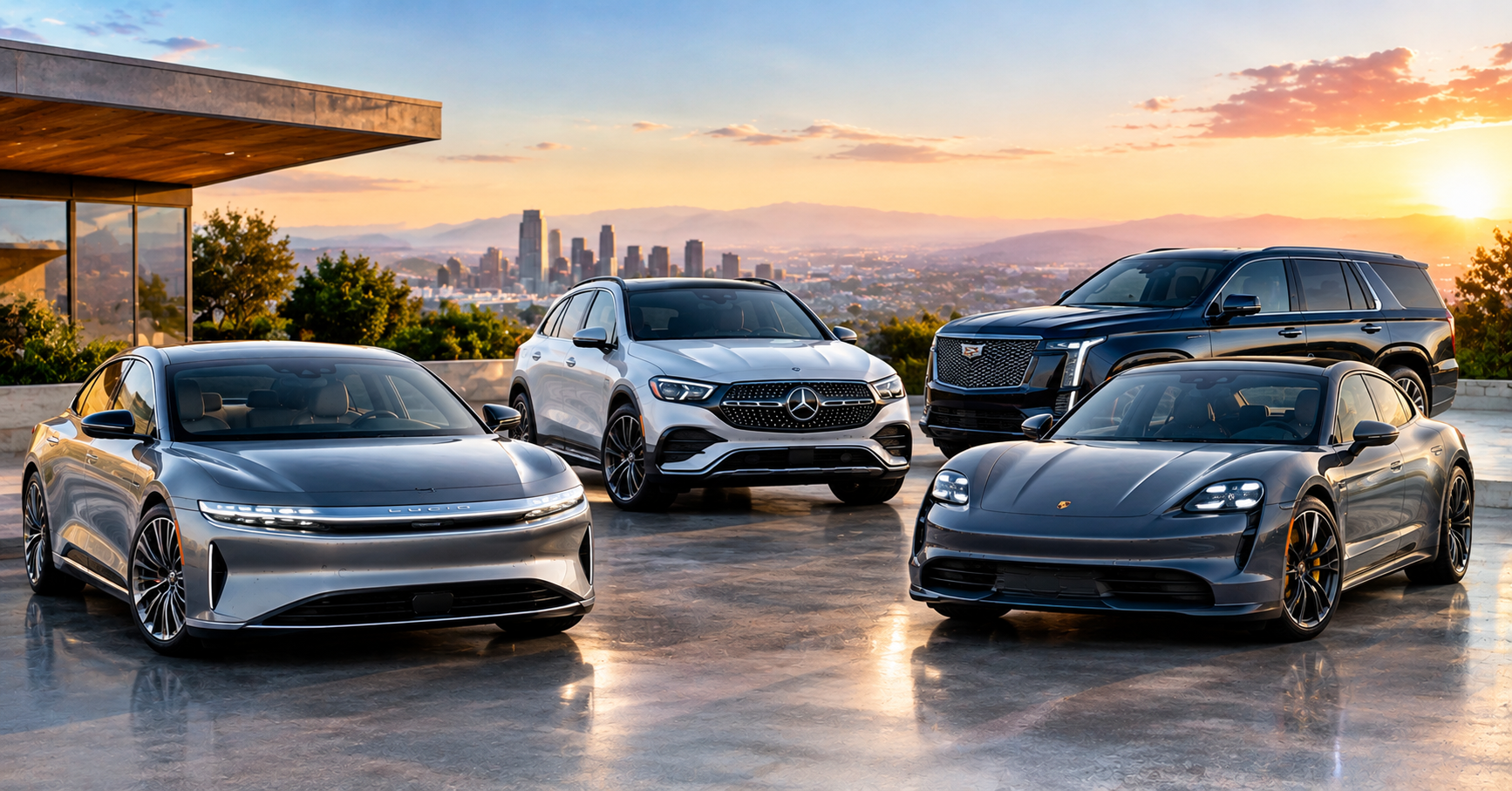
The best luxury electric cars 2026 has to offer combine premium comfort, advanced technology, impressive acceleration and increasingly competitive driving range. But choosing the right electric vehicle involves more than comparing horsepower or touchscreen sizes. Buyers must also consider charging speed, real-world range, cabin refinement, practicality and the total cost of ownership.
This guide examines 10 luxury electric vehicles worth considering in 2026. Using the supplied research from Edmunds, Car and Driver, MotorTrend, Cars.com and Cox Automotive, it compares their key strengths, starting prices, range estimates and potential drawbacks to help American shoppers find the right EV for their needs.
Quick Picks: Best Luxury Electric Cars 2026
- Best all-around luxury sedan: Audi A6 Sportback e-tron
- Best for long-distance range: Lucid Air
- Best performance sedan: Porsche Taycan
- Best everyday executive EV: BMW i5
- Best entry into BMW electric luxury: BMW i4
- Best flagship sedan: BMW i7
- Best midsize luxury electric SUV: Cadillac Lyriq
- Best performance electric wagon: Porsche Taycan Cross Turismo
- Best futuristic cabin: Mercedes-Benz EQE
- Best full-size electric SUV for range: Cadillac Escalade IQ
These selections address different priorities rather than establishing a universal winner. Buyers should verify current prices, equipment and official range estimates for their preferred configurations before purchasing.
What Is Changing in the Luxury EV Market in 2026?
The American electric vehicle market is evolving, although recent sales figures show that demand remains volatile. Cox Automotive estimated that U.S. EV sales reached 77,266 vehicles in July 2026, up 3.2% from June but down 41.5% year over year. Electric vehicles accounted for 5.6% of total new-vehicle sales that month.
Tesla remained the market leader by volume, recording 42,435 sales in July, or roughly 55% of total EV sales. These figures cover the broader electric vehicle market, but they illustrate the competitive environment facing luxury EV manufacturers.
Cox Automotive forecasts new EV sales stabilizing near 6% market share, while used-EV sales continue to reach record levels. For luxury shoppers, this creates two considerations: new models must justify their prices, and pre-owned electric vehicles may offer another route into premium ownership.
Range Is Improving, but Charging Still Matters
The average EV range has reached approximately 300 miles, according to the supplied Cox Automotive research, representing a 20% increase from 2021. Several luxury sedans now offer more than 400 miles of EPA-estimated range, while the Cadillac Escalade IQ delivered 558 miles in an Edmunds real-world test.
Range alone does not determine whether an EV is practical. Charging speed, network access, weather, driving speed and the availability of home charging can all influence the ownership experience.
Cars.com emphasizes efficiency, intuitive controls and charging speed in its EV evaluation criteria. These factors are especially important in luxury vehicles, where technology should simplify daily driving rather than make routine tasks more complicated.
Luxury EV Prices Require Careful Comparisons
Prices vary considerably across the segment. The BMW i4 starts at $59,250 in the supplied research, while the Porsche Taycan begins at $108,050. The BMW i7 starts at $107,250, and the Cadillac Escalade IQ begins at $127,405.
These differences reflect distinct vehicle sizes, performance targets and equipment levels. Buyers should compare the actual configurations they intend to purchase instead of relying exclusively on base prices. Optional equipment and performance upgrades can significantly change the final cost.
How We Evaluate the Best Luxury Electric Cars
A luxury EV should deliver more than rapid acceleration and a premium badge. A useful comparison considers the complete driving and ownership experience.
- Driving range: EPA estimates provide a standardized comparison, while independent testing shows how vehicles perform in real-world conditions.
- Charging capability: Charging speed and network access influence convenience on longer journeys.
- Ride comfort: Suspension tuning, cabin quietness and seat comfort affect daily driving.
- Interior quality: Materials, passenger space, fit and finish and control usability help define the luxury experience.
- Technology: Useful driver assistance and intuitive controls matter more than screen size alone.
- Performance: Acceleration and handling should match the vehicle’s intended role.
- Value: Purchase price, insurance, depreciation, warranty coverage and charging costs all deserve consideration.
The following selections draw on the supplied research from Edmunds, Car and Driver, MotorTrend, Cars.com and Cox Automotive. The goal is to match vehicles with different needs, not to suggest that one model is ideal for every luxury-EV buyer.
1. Lucid Air: Best for Long-Range Luxury Driving
The Lucid Air is a compelling option for drivers who want a luxury sedan capable of covering long distances between charging stops. Its combination of distinctive styling, strong acceleration and impressive range makes it an alternative to established German luxury sedans.
The supplied research lists a starting price of $72,400 and EPA-estimated range figures of approximately 420 to 480 miles, depending on configuration. Car and Driver rates the Air 10/10 in its luxury electric sedan rankings. MotorTrend also ranks the 2026 model first among flagship electric luxury cars, giving it a score of 9.5 out of 10.
Why the Lucid Air Stands Out
Range is its most obvious advantage. Drivers who regularly travel between cities may appreciate the potential to make fewer charging stops. That can make the Air appealing to buyers who want an electric vehicle without giving up long-distance flexibility.
Its premium positioning also emphasizes refinement and distinctive design. Smooth electric acceleration complements the comfort expected from a luxury sedan.
MotorTrend reports that the 2026 Air gains additional range and technology improvements, along with Supercharger access. This could expand charging options, although the practical experience will depend on route planning and charger availability.
What Buyers Should Consider
EPA estimates should not be treated as guaranteed real-world results. Edmunds has noted inconsistencies between the Air’s EPA range and its own testing, as well as concerns about fit and finish.
Buyers should compare configurations carefully because range, equipment and performance can differ by version. The final purchase price may also rise considerably with additional options.
Best for: Drivers who prioritize long-distance range, premium sedan comfort and distinctive electric performance.
2. Porsche Taycan: Best for Driving Enthusiasts
The Porsche Taycan approaches luxury electric motoring from a performance-first perspective. Rather than focusing primarily on maximum range or rear-seat comfort, it appeals to drivers who want a luxury EV with a sports-car character.
Car and Driver rates the Taycan 10/10 in its luxury electric sedan rankings. The supplied research lists a starting price of $108,050 and an EPA-estimated range of approximately 251 to 293 miles, depending on configuration.
Performance Takes Priority
The Taycan’s appeal lies in the relationship between acceleration, handling and driver engagement. Electric power delivery can provide immediate response while retaining the precise road manners expected from a performance-focused luxury vehicle.
That character makes the Taycan an alternative to more comfort-oriented electric sedans. It is worth considering for drivers who enjoy responsive handling as much as a premium interior.
Range and Price Trade-Offs
The Taycan’s listed range is lower than the Lucid Air’s, and its starting price places it toward the expensive end of the luxury-EV market. Drivers who frequently undertake long journeys should weigh those factors against its performance credentials.
Range, acceleration and equipment can differ across the Taycan lineup, so buyers should compare the exact versions they intend to test-drive.
Best for: Enthusiasts who value sporty handling and an engaging driving experience more than maximum range or a low purchase price.
3. Porsche Taycan Cross Turismo: Best Luxury Electric Wagon
Not every buyer wants a traditional sedan or a large SUV. The Porsche Taycan Cross Turismo combines the Taycan’s performance-oriented approach with a wagon body style that offers additional versatility.
The supplied research lists a starting price of $120,095, seating for five and an EPA-estimated range of 261 to 277 miles. Car and Driver also rates it 10/10.
A Different Kind of Practicality
The Cross Turismo gives shoppers an option between a low-slung performance sedan and a taller utility vehicle. Its wagon format may appeal to drivers who want a distinctive luxury car with more everyday versatility.
It preserves the performance emphasis associated with the Taycan name, making it an option for households that need additional utility but do not want a conventional SUV.
Where It Falls Short
The starting price is high, and the supplied research identifies limited rear headroom compared with an SUV as a potential drawback. Families who regularly transport taller passengers should evaluate the rear seating area in person.
Buyers should also compare cargo space with their actual needs. A wagon can be useful, but it does not automatically offer the same passenger height or loading flexibility as a large SUV.
Best for: Buyers who want electric performance, five-seat accommodation and wagon versatility.
4. Audi A6 Sportback e-tron: Best All-Around Luxury Sedan
The Audi A6 Sportback e-tron stands out for shoppers who want a balanced luxury EV rather than a vehicle focused exclusively on maximum range or outright performance. Edmunds ranks it as its top electric luxury car, gives it an 8.4/10 rating and praises its range, fast charging, quiet cabin and ride quality.
Those attributes address several important questions buyers face when considering an electric executive sedan. A comfortable ride can make commuting less tiring, quiet operation reinforces the premium atmosphere, and effective charging can simplify longer journeys.
Why It Works as a Daily Driver
Edmunds describes the A6 Sportback e-tron as a strong daily driver. Its combination of range, charging performance and ride comfort gives it broad appeal for drivers who use their cars for commuting, errands and regular intercity travel.
The supplied research also notes that the electric model effectively replaces the gasoline A6 in Edmunds’ assessment. That makes it an important option for existing A6 shoppers considering an all-electric vehicle.
Visibility and Cabin Considerations
Rear visibility is a concern identified in the supplied review, and Edmunds considers the cabin less plush than some competitors. These drawbacks illustrate why shoppers should test a vehicle rather than selecting it solely on ratings or specifications.
During a test drive, check the rear view, parking visibility, seating position and ease of adjusting climate settings. Try the charging process if a demonstration is available.
Best for: Drivers who want a refined luxury EV for everyday use, with a strong balance of range, charging and ride comfort.
5. BMW i5: Best Everyday Executive EV
The BMW i5 brings electric power to the familiar executive-sedan formula. It is aimed at drivers who want a premium cabin, modern technology and a comfortable daily vehicle without moving to a larger flagship sedan.
Edmunds rates the i5 8.2/10 and praises its cabin, technology and real-world range. The supplied research lists a starting price of $68,550. The lineup also includes the performance-oriented M60 version.
A Familiar Luxury-Sedan Experience
For drivers moving from a gasoline-powered executive sedan, the i5 offers a way to enter electric luxury. Its interior and technology are central parts of its appeal, while the electric drivetrain provides smooth acceleration.
The M60 option adds a performance dimension for buyers who want stronger acceleration. Shoppers should compare its price and equipment with the version they would otherwise choose.
Technology May Take Adjustment
Edmunds identifies touchscreen-heavy controls and numb steering as potential drawbacks. The interface deserves attention during a test drive because drivers frequently interact with climate, navigation and vehicle settings.
Spend time using the infotainment system before committing to a purchase. A sophisticated-looking cabin may feel less convenient if common functions require too many screen interactions.
Best for: Executive-sedan buyers who want a premium daily driver with modern technology and the option of higher performance.
6. BMW i4: Best Lower-Cost Entry to BMW EV Luxury
The BMW i4 offers a more accessible starting point than several high-end luxury electric vehicles in this guide. With a starting price of $59,250 in the supplied research, it provides an entry into BMW’s electric lineup without reaching the six-figure territory of the i7 or Porsche Taycan.
Car and Driver rates the i4 9.5/10 and lists EPA-estimated range of 278 to 333 miles, depending on configuration. The 2026 i4 Gran Coupe also gains a modest efficiency improvement, according to the supplied research.
Range and Price in Perspective
The i4’s range figures put it within a useful band for many daily driving patterns. The lower end may be sufficient for commuters who can charge at home, while versions near the upper end can offer more flexibility for longer trips.
Its starting price makes it a useful comparison point for shoppers weighing a smaller luxury EV against a larger executive sedan. The least expensive vehicle is not automatically the best value, however. Equipment, insurance, charging access and passenger needs all matter.
What to Check Before Buying
The supplied research notes that the i4 can feel expensive for its feature set and relies heavily on touchscreen controls. Buyers should compare standard equipment carefully and decide whether the interface feels natural to use.
Drivers who frequently carry rear-seat passengers should check the seating and cargo areas in person. The right body style depends on how the vehicle will be used, not simply on its badge or range estimate.
Best for: Buyers seeking a comparatively accessible luxury EV with useful range and BMW’s premium-car character.
7. Mercedes-Benz EQE: Best for a Futuristic Cabin
The Mercedes-Benz EQE emphasizes quiet electric performance, cabin space and technology. Edmunds gives it a 7.4/10 rating and highlights silent acceleration, a spacious interior and the availability of the brand’s Hyperscreen interface.
For shoppers who associate luxury with a calm cabin and a technology-rich environment, the EQE deserves consideration. Its character differs from the Porsche Taycan’s performance-first approach and the Lucid Air’s emphasis on long-range travel.
Comfort and Technology
Electric propulsion suits the EQE’s comfort-oriented approach. Smooth acceleration and quiet operation can make routine journeys more relaxing, while a spacious cabin can help the car serve as a premium commuter or executive vehicle.
The available Hyperscreen adds a visually striking technology option. However, a large display is useful only if its menus and functions remain understandable during everyday use.
Potential Drawbacks
Edmunds identifies confusing infotainment, modest acceleration in the base model and poor rear visibility as weaknesses. These are practical concerns, not merely specification-sheet details.
Buyers should evaluate the base model and any higher-performance alternatives separately. They should also test the rear view and parking aids before deciding whether the EQE suits their needs.
Best for: Luxury shoppers who prioritize a quiet ride, a spacious cabin and an advanced digital environment.
8. BMW i7: Best Chauffeur-Style Electric Luxury Sedan
The BMW i7 occupies the flagship end of the luxury electric sedan market. It is designed for buyers who want a large, premium vehicle with an emphasis on passenger comfort, technology and executive presence.
The supplied research lists a starting price of $107,250 and an EPA-estimated range of 285 to 301 miles, depending on configuration. Car and Driver gives the i7 an 8.5/10 rating.
Flagship Comfort and Presence
A large luxury sedan serves a different purpose from a smaller performance EV. The i7 is worth considering for buyers who regularly travel with passengers, prefer a substantial cabin and value the atmosphere associated with a flagship vehicle.
It can also suit owners who want electric propulsion without sacrificing the size and presence of a traditional executive sedan. The decision should center on comfort and passenger requirements rather than acceleration figures alone.
Price and Driving Character
The i7’s six-figure starting price makes it one of the more expensive options on this list. Car and Driver also notes that it is less engaging to drive than smaller BMW electric vehicles.
Buyers who want maximum driver involvement may prefer a smaller or more performance-focused model, while those who value a spacious flagship experience may find the i7’s priorities more appropriate.
Best for: Buyers seeking a large, technology-rich luxury EV for executive travel and passenger comfort.
9. Cadillac Lyriq: Best American Luxury Electric SUV Value
The Cadillac Lyriq brings American luxury styling and an SUV body to the electric market. It is a relevant choice for buyers who want a premium crossover rather than a low-slung sedan, particularly if passenger access and everyday utility are priorities.
The supplied research lists a starting price of $60,995 and notes that MotorTrend ranks the Lyriq first among electric midsize luxury SUVs. Edmunds, however, considers the BMW iX more polished, showing that different publications can reach different conclusions based on their evaluation criteria.
Why the Lyriq Deserves a Look
An electric luxury SUV offers a different ownership proposition from a sedan. The taller body can be more convenient for some passengers, and the SUV layout may fit households that regularly carry people and cargo.
The Lyriq’s starting price also positions it below several flagship luxury EVs in this guide. Buyers should still compare equipment and capabilities across specific trims, along with their preferred driving range and charging requirements.
Software and Charging Need Attention
The supplied research recommends scrutinizing the Lyriq’s software and charging experience. This is particularly relevant for EV shoppers because charging is part of routine ownership rather than an occasional feature.
Before buying, investigate the charging hardware and compatibility of the specific vehicle, review current software information and make sure its infotainment system is comfortable to use. If possible, try the navigation and charging-planning functions during a demonstration.
Best for: Buyers who want an American luxury electric SUV at a lower starting price than many flagship models.
10. Cadillac Escalade IQ: Best for Maximum Real-World Range and Presence
The Cadillac Escalade IQ takes the luxury electric SUV concept to its largest and most expensive extreme. It combines a full-size SUV format with a premium cabin and an unusually strong real-world range result.
According to the supplied research, the Escalade IQ starts at $127,405. Edmunds recorded 558 miles in its real-world range test and ranks it second among super-luxury electric SUVs.
Range That Changes the Conversation
A long real-world range can reduce the need for charging stops on extended trips. Edmunds’ 558-mile result is notable because it provides a testing-based reference point rather than relying only on an official estimate.
One test result should not be treated as a guarantee for every owner. Weather, driving speed, terrain, passengers and cargo can affect range. Buyers should check the official estimate for the exact model and configuration they intend to purchase.
Size and Price Are Major Considerations
The Escalade IQ’s size is both part of its appeal and a potential drawback. A large SUV can provide substantial road presence, but it can also be difficult to maneuver or park in tight spaces. Edmunds cautions that its dimensions compromise the driving experience.
The starting price also puts it beyond many luxury-EV budgets. Shoppers should decide whether they genuinely need a full-size electric SUV before paying for its additional size and capability.
Best for: Buyers who want an exceptionally large luxury electric SUV and place a high priority on long-distance range.
Luxury Electric Cars vs. Luxury Electric SUVs
Choosing between a luxury electric sedan and an SUV is one of the most consequential decisions in this market. The right answer depends on how the vehicle will be used, how many people it must carry and what the driver values most.
When a Luxury Electric Sedan Makes More Sense
Sedans such as the Lucid Air, Audi A6 Sportback e-tron, BMW i5 and Porsche Taycan appeal to buyers who want a lower, road-focused vehicle. Depending on the model, advantages may include strong range, a performance-oriented driving experience and a cabin suited to commuting or executive travel.
A sedan is worth considering if most journeys involve one or two occupants, if a large cargo area is unnecessary, or if handling and a lower driving position matter more than the flexibility of a taller body.
When a Luxury Electric SUV Makes More Sense
The Cadillac Lyriq and Escalade IQ represent two different approaches to electric luxury SUVs. The Lyriq offers a midsize format, while the Escalade IQ emphasizes full-size presence and long-distance range.
SUVs may suit families, drivers who regularly carry bulky items or buyers who prefer a taller seating position. However, vehicle dimensions, cargo capacity and rear-seat space vary considerably, so shoppers should inspect the exact model rather than assume all SUVs offer the same utility.
Consider a Wagon if You Want Both Performance and Utility
The Porsche Taycan Cross Turismo offers a middle ground for buyers who want a performance-oriented vehicle with a more versatile body style. It may be an alternative to an SUV for drivers who value a lower driving position but need more flexibility than a traditional sedan provides.
What to Know About Luxury EV Range and Charging
Range remains one of the first specifications shoppers compare, but the number alone cannot determine whether an EV is practical for a particular household.
EPA Range Is a Starting Point
EPA estimates provide a standardized way to compare vehicles, but actual range can differ. The Lucid Air’s 420-to-480-mile estimates, for example, should be interpreted according to the selected configuration, while the Escalade IQ’s 558-mile Edmunds result comes from a specific real-world test.
Before buying, ask which range figure applies to the exact trim and wheel configuration. Larger wheels or different equipment can affect efficiency, and the longest-range version may cost more than the entry model.
Home Charging Can Make Daily Ownership Easier
Drivers who can charge at home may find it easier to keep an EV ready for routine travel. They can replenish the battery while the vehicle is parked, subject to their home’s electrical setup and charging equipment.
Buyers who live in apartments or regularly park on the street should evaluate charging access before choosing an EV. Dependence on public charging may require additional planning, particularly when local chargers are busy or inconveniently located.
Plan Long Trips Around Charging Stops
Fast-charging capability matters most when traveling beyond the vehicle’s comfortable driving range. Compare manufacturer charging specifications, compatible networks and route-planning tools rather than relying on a general claim that a vehicle charges quickly.
For regular road trips, look at the actual charging stations along common routes. A vehicle with excellent range may still be inconvenient if compatible fast chargers are difficult to access where you travel.
Are Luxury Electric Cars Worth Buying in 2026?
Luxury EVs can be attractive for drivers who value quiet operation, smooth acceleration, modern technology and premium interiors. The strongest choice depends on whether those benefits align with the buyer’s budget and access to charging.
Reasons to Buy a Luxury EV
- Quiet, smooth driving: Electric propulsion can provide refined acceleration and low-vibration operation.
- Strong performance: Models such as the Porsche Taycan and BMW i5 M60 cater to drivers who want rapid acceleration.
- Increasing range: Several luxury models offer more than 400 miles of EPA-estimated range.
- More body styles: Buyers can choose among sedans, SUVs and performance wagons.
- Convenient home charging: For households with suitable equipment, charging can fit into an ordinary daily routine.
Reasons to Be Cautious
- High upfront prices: Several premium models start above $100,000.
- Variable real-world range: Official estimates may not match every driving situation.
- Technology complexity: Some models rely heavily on touchscreens and complicated infotainment menus.
- Charging limitations: Public charging convenience varies by location and route.
- Ownership costs: Insurance, depreciation, tires, repairs and warranty terms should be included in the budget.
The expiration of the federal EV tax credit also means shoppers should not assume a purchase will qualify for the same incentive previously available. Check current federal, state and local rules before calculating the final cost.
Should You Buy a New or Used Luxury EV?
A used luxury electric vehicle may offer access to premium materials, performance and technology at a lower purchase price than a comparable new model. Cox Automotive’s research indicates that used-EV sales are reaching record levels, making the pre-owned market worth investigating.
However, a lower price does not automatically make a used EV a better deal. Battery condition, remaining warranty coverage, charging compatibility, software support and maintenance history should all be considered.
Used Luxury EV Buying Checklist
- Review battery information. Request available battery-health reports and ask whether any battery-related repairs or warnings have been recorded.
- Check warranty coverage. Confirm the remaining vehicle and battery warranties, including transfer conditions.
- Verify charging compatibility. Make sure the vehicle can use the charging equipment and networks available to you.
- Inspect the software. Confirm that essential systems work correctly and review the manufacturer’s current support information.
- Compare the total price. Include insurance, registration, expected repairs and any charging equipment you need to install.
- Arrange an independent inspection. A qualified professional can help identify issues that may not be obvious during a short test drive.
Used luxury EVs can make sense for budget-conscious buyers, but the decision should be based on the condition and equipment of the individual vehicle rather than depreciation alone.
How to Choose the Right Luxury Electric Car
Before visiting a dealership, narrow your choices by deciding what matters most. A clear shortlist can prevent you from paying for performance, size or technology you will rarely use.
- Set a realistic budget. Include the vehicle price, insurance, charging installation and likely ownership expenses.
- Choose a body style. Decide whether a sedan, wagon or SUV best fits your passengers and cargo.
- Estimate your daily mileage. Compare that distance with the range of the configurations you are considering.
- Check charging access. Identify where you will charge at home, work and on longer trips.
- Test the technology. Use the navigation, climate controls and driver-assistance features before making a decision.
- Compare independent reviews. Read testing results alongside official manufacturer specifications.
- Review ownership protection. Understand warranty coverage, service availability and software support.
For maximum sedan range, start with the Lucid Air. For a performance-focused driving experience, compare the Porsche Taycan with other sport-oriented EVs. For a balanced executive daily driver, consider the Audi A6 Sportback e-tron and BMW i5. Buyers who want an electric luxury SUV can begin with the Cadillac Lyriq, while those seeking a much larger vehicle may evaluate the Escalade IQ.
These are starting points, not substitutes for a test drive. The best luxury electric car is the one that meets your needs without forcing you to compromise on the features that matter most.
Frequently Asked Questions
What is the best luxury electric car in 2026?
In the supplied research, Edmunds names the Audi A6 Sportback e-tron its top electric luxury car. Car and Driver gives 10/10 ratings to the Lucid Air, Porsche Taycan and Porsche Taycan Cross Turismo. The right choice depends on whether you prioritize everyday comfort, range, performance or wagon practicality.
Which luxury electric car has the longest range?
The Cadillac Escalade IQ stands out in the supplied research with 558 miles recorded in Edmunds’ real-world test. Among the sedans covered here, the Lucid Air offers approximately 420 to 480 miles of EPA-estimated range, depending on configuration. Real-world results vary with driving conditions.
What is the best luxury electric SUV in 2026?
The Cadillac Lyriq is a strong midsize option, and MotorTrend ranks it first in its electric midsize luxury SUV category. The Escalade IQ is worth considering for buyers who want a much larger vehicle and prioritize long-distance range. The BMW iX, Rivian R1S, Lucid Gravity and Genesis Electrified GV70 are additional alternatives identified in the supplied research.
Are luxury electric cars worth buying in 2026?
They can be worth considering for drivers who value quietness, acceleration, premium interiors and convenient charging. They may be less practical for buyers without reliable charging access or those who frequently travel long distances on routes with limited fast chargers. Budget, insurance and depreciation should also factor into the decision.
How much does a luxury electric car cost in 2026?
Prices vary widely. The supplied research lists the BMW i4 at $59,250, the BMW i5 at $68,550, the Lucid Air at $72,400, the Porsche Taycan at $108,050 and the Cadillac Escalade IQ at $127,405. These starting prices should be verified against current manufacturer listings and configurations.
Is the Lucid Air better for range than the Porsche Taycan?
The supplied figures favor the Lucid Air for range. Its EPA-estimated range is approximately 420 to 480 miles, compared with 251 to 293 miles for the Porsche Taycan. The Taycan is more explicitly performance-focused, so buyers should weigh range against driving character, price and equipment.
Should I buy a luxury EV or a hybrid?
A fully electric vehicle may suit drivers who have reliable charging access and want quiet electric operation without gasoline use during driving. A hybrid can be attractive to buyers who want electrification without depending entirely on public charging. The right choice depends on daily mileage, charging access, road-trip habits and budget.
Should I buy a new or used luxury electric vehicle?
A new EV offers a new-vehicle warranty and the latest available equipment, while a used model may have a lower purchase price. For a used EV, check battery condition, warranty coverage, charging compatibility, software support and service history before buying.
Should buyers wait for 2027 luxury EVs?
Waiting may make sense for shoppers who specifically want upcoming technology or models. The supplied research references the 2027 Audi Q6 e-tron, Cadillac Optiq, Cadillac Vistiq and Mercedes-Benz C-Class EV in previews and rankings. Buyers should confirm launch timing, specifications and pricing before postponing a purchase.
Final Verdict: Which Luxury EV Should You Buy?
The best luxury electric cars of 2026 serve different priorities. The Lucid Air is a compelling option for drivers who want long-range sedan travel, while the Porsche Taycan caters to enthusiasts who put driving character first. The Audi A6 Sportback e-tron offers a balanced approach to daily luxury, and the BMW i5 delivers an executive-sedan experience with electric power.
For shoppers who prefer an SUV, the Cadillac Lyriq provides a midsize luxury format, while the Escalade IQ targets buyers who want a full-size vehicle and exceptional tested range. The BMW i4, Mercedes-Benz EQE, BMW i7 and Porsche Taycan Cross Turismo round out the field with different combinations of price, comfort, performance and utility.
Before making a final decision, compare current pricing, verify the range of the exact configuration, test the infotainment system and map the charging options you would use most often. A luxury EV should fit your daily routine as well as your expectations for comfort and performance.
Ultimately, the right purchase is not necessarily the most expensive vehicle or the one with the longest range. It is the model that delivers the right combination of refinement, usability, charging convenience and value for the way you drive.