
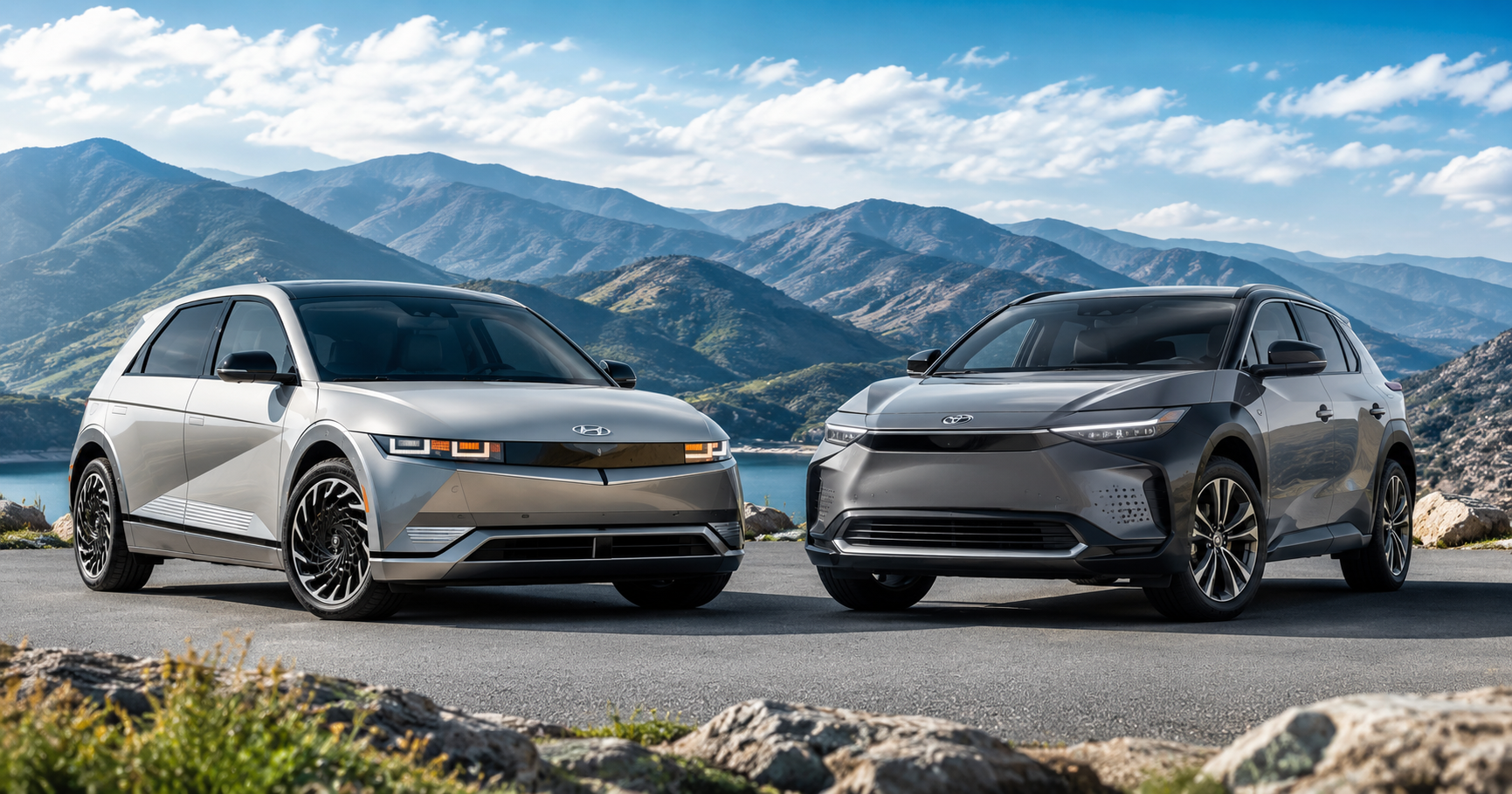
The race to build the best electric SUV has never been more competitive. As automakers push battery technology, charging infrastructure, and vehicle performance to new levels, buyers are benefiting from electric vehicles that are more capable, affordable, and practical than ever before.
But while these EVs compete in the same segment, they take very different approaches. Hyundai focuses on ultra-fast charging, futuristic styling, and premium features. Toyota emphasizes reliability, efficiency, and the convenience of native Tesla Supercharger access through its new NACS charging port.
So which electric SUV deserves a spot in your driveway?
In this comprehensive Hyundai Ioniq 5 vs Toyota BZ comparison, we’ll analyze performance, range, charging, interior quality, technology, safety, pricing, ownership costs, and overall value to determine which of these newest electric cars delivers the strongest package in 2026.
2026 Hyundai Ioniq 5 vs Toyota BZ: Quick Overview
The 2026 Toyota BZ represents a major transformation of Toyota’s previous bZ4X. The company simplified the name to “BZ” while significantly improving range, charging performance, power output, and pricing.
Meanwhile, Hyundai continues refining the highly acclaimed Ioniq 5, an EV that has already earned multiple global awards and remains one of the most respected electric crossovers on the market.
| Category | Hyundai Ioniq 5 | Toyota BZ |
|---|---|---|
| Starting Price | $35,000 | $36,350 |
| Maximum Range | 318 Miles | 314 Miles |
| Fast Charging | 18 Minutes (10-80%) | 26-30 Minutes (10-80%) |
| Maximum Horsepower | 320 hp AWD | 338 hp AWD |
| Cargo Space | 30 cu ft | Approx. 24 cu ft |
| Warranty | 10-Year/100,000-Mile Powertrain | 5-Year/60,000-Mile Powertrain |
At first glance, the specifications appear surprisingly close. However, once you dive deeper into real-world usability, several meaningful differences emerge.
Exterior Design and First Impressions
Hyundai Ioniq 5: Retro-Futuristic Excellence
The Ioniq 5 remains one of the most distinctive EVs on the road. Hyundai successfully blends retro-inspired hatchback proportions with futuristic design elements that make the vehicle look years ahead of many competitors.
Sharp pixel-style lighting, clean body surfaces, flush door handles, and a wide stance create an unmistakable identity.
Unlike many EVs that prioritize aerodynamic efficiency at the expense of personality, the Ioniq 5 manages to look both modern and memorable.
- Unique pixel LED lighting
- Wide wheelbase proportions
- Minimalist design language
- Premium visual presence
- Multiple new 2026 color options
Toyota BZ: Evolution Rather Than Revolution
Toyota took a more conservative approach with the redesigned BZ. While the styling updates improve the vehicle’s appearance, it still follows a traditional crossover formula.
The front fascia has been refined, aerodynamics have improved, and the overall design feels cleaner than the outgoing bZ4X. However, it lacks the visual excitement and uniqueness that make the Ioniq 5 stand out.
For buyers seeking understated styling, this may actually be a positive. For those wanting their EV to make a statement, Hyundai clearly holds the advantage.
Design Winner
Winner: Hyundai Ioniq 5
The Ioniq 5 continues to be one of the most visually distinctive electric vehicles available. Toyota’s redesign improves the BZ significantly, but Hyundai remains the design benchmark in this segment.
Performance and Driving Experience
Performance is often one of the biggest reasons consumers switch to electric vehicles. Instant torque, smooth acceleration, and quiet operation create a driving experience that many buyers find superior to gasoline-powered vehicles.
Hyundai Ioniq 5 Performance
The long-range rear-wheel-drive model produces 225 horsepower, while all-wheel-drive variants deliver 320 horsepower and 446 lb-ft of torque.
In testing, AWD models accelerate from 0 to 60 mph in approximately 4.4 seconds.
Power delivery feels immediate, smooth, and effortless. Whether merging onto highways or passing slower traffic, the Ioniq 5 always feels eager to respond.
Ride quality is another strength. The suspension balances comfort and handling effectively, making long-distance driving particularly enjoyable.
Toyota BZ Performance
Toyota made substantial improvements for 2026.
The AWD version now produces 338 horsepower, representing a dramatic increase compared to the previous generation. On paper, this gives Toyota a horsepower advantage.
However, real-world acceleration tells a different story.
Despite the higher horsepower figure, estimated 0-60 mph times remain around 6.5 seconds, noticeably slower than Hyundai’s AWD models.
The BZ prioritizes efficiency and comfort over sportiness, which many family buyers may appreciate.
Performance Comparison
| Metric | Ioniq 5 AWD | Toyota BZ AWD |
|---|---|---|
| Horsepower | 320 hp | 338 hp |
| Torque | 446 lb-ft | N/A |
| 0-60 mph | 4.4 sec | ~6.5 sec |
| Driving Character | Sporty | Comfort-Oriented |
Performance Winner
Winner: Hyundai Ioniq 5
Although Toyota boasts more horsepower on paper, Hyundai delivers stronger real-world acceleration, more engaging dynamics, and a more refined overall driving experience.
The Ioniq 5 N: A Performance EV Game Changer
No discussion of the newest electric cars would be complete without mentioning the extraordinary Hyundai Ioniq 5 N.
This high-performance variant transforms the family-friendly crossover into one of the fastest EVs on sale today.
- 601 horsepower standard
- 641 horsepower with N Grin Boost
- 0-60 mph in as little as 2.8 seconds
- Track-focused suspension tuning
- Advanced performance software
- Simulated gear shifts and engine sounds
While the reduced 221-mile range may not appeal to every buyer, enthusiasts looking for maximum excitement will find few EVs that deliver such a complete performance package at this price point.
Toyota currently offers nothing comparable within the BZ lineup.
Range and Real-World Efficiency
Range anxiety remains a major concern for first-time EV buyers. Fortunately, both vehicles offer enough range to satisfy most daily driving needs and long-distance road trips.
Hyundai Ioniq 5 Range
- 318 miles (RWD Long Range)
- 290 miles (AWD SE and SEL)
- 269 miles (Limited AWD)
- 245 miles (Standard Range)
The 318-mile estimate places the Ioniq 5 among the strongest performers in the compact electric SUV category.
Toyota BZ Range
- 314 miles (XLE FWD Plus)
- 300 miles estimated (Limited FWD)
- 288 miles (AWD)
- 236 miles (Base XLE FWD)
Toyota’s improvements are impressive. The jump from roughly 252 miles to 314 miles represents one of the largest year-over-year range increases we’ve seen in a mainstream EV.
Charging Speed and Charging Network Access
Charging performance is one of the biggest factors separating today’s electric vehicles. While range gets most of the headlines, charging speed often has a greater impact on daily usability and long-distance travel.
This is where the battle between the Hyundai Ioniq 5 and Toyota BZ becomes particularly interesting.
Hyundai Ioniq 5 Charging Performance
The Ioniq 5 continues to set the benchmark for charging speed in the mainstream EV segment thanks to Hyundai’s advanced 800-volt electrical architecture.
When connected to a compatible 350-kW DC fast charger, the Ioniq 5 can recharge from 10% to 80% in as little as 18 minutes.
Even more impressive, Hyundai claims the battery can gain approximately 68 miles of driving range in about five minutes under ideal conditions.
- 10–80% charging in 18 minutes
- 800V architecture
- Up to 350-kW charging compatibility
- Excellent charging curve
- Included Level 1 and Level 2 charging cable
Toyota BZ Charging Performance
Toyota made significant improvements for 2026, addressing one of the biggest complaints about the outgoing bZ4X.
The new BZ supports faster charging and now features a native Tesla NACS charging port.
This means owners can access thousands of Tesla Supercharger locations throughout North America without requiring a separate adapter.
The BZ can charge from 10% to 80% in approximately 26 to 30 minutes depending on trim level and charging conditions.
- 10–80% charging in 26–30 minutes
- Native Tesla NACS charging port
- Access to Tesla Supercharger network
- Up to 150-kW peak charging (FWD)
- AWD models limited to 100 kW
Which Charging System Is Better?
The answer depends on your priorities.
If maximum charging speed matters most, the Hyundai Ioniq 5 remains the clear winner.
If charging convenience and network availability are your primary concerns, Toyota’s native NACS port is a major advantage.
For most EV shoppers, however, charging speed still has a greater day-to-day impact than connector type.
Charging Winner
Winner: Hyundai Ioniq 5
Toyota has closed the gap substantially, but Hyundai’s 18-minute charging capability remains among the fastest charging experiences available at any price.
Interior Design and Passenger Comfort
Electric vehicles often offer more interior space than similarly sized gasoline-powered vehicles because EV platforms eliminate many traditional packaging constraints.
Both vehicles take advantage of this flexibility, but Hyundai executes it more effectively.
Inside the Hyundai Ioniq 5
The Ioniq 5’s cabin feels open, airy, and surprisingly spacious.
Its long wheelbase creates rear-seat legroom comparable to some midsize SUVs despite competing in the compact segment.
The dashboard features a minimalist layout with dual digital displays and a clean, modern appearance.
Premium materials and thoughtful ergonomics help the cabin feel more expensive than its price suggests.
Highlights
- Excellent rear-seat space
- Modern digital dashboard
- Flat floor design
- Comfortable seating
- Premium interior feel
Inside the Toyota BZ
Toyota’s cabin improvements are noticeable compared to the previous bZ4X.
The design is cleaner, technology integration is better, and overall quality feels more polished.
However, the interior still lacks some of the wow factor found in the Hyundai.
The BZ emphasizes practicality and simplicity rather than innovation.
That approach will appeal to many buyers who value familiarity over experimentation.
Interior Winner
Winner: Hyundai Ioniq 5
Toyota delivers a comfortable and practical interior, but Hyundai’s combination of space, design, and premium ambiance gives it the edge.
Cargo Capacity and Practicality
Families shopping for the newest electric cars often prioritize cargo capacity as much as range or performance.
Hyundai Ioniq 5 Cargo Space
- 30 cubic feet behind rear seats
- 59 cubic feet with seats folded
- Flexible storage solutions
- Flat cargo floor
The generous cargo area makes the Ioniq 5 ideal for road trips, grocery runs, sports equipment, and family vacations.
Toyota BZ Cargo Space
- Approximately 24 cubic feet behind rear seats
- Smaller overall storage area
- Functional layout
- Good everyday practicality
The BZ provides sufficient cargo capacity for most households, but Hyundai offers noticeably more usable space.
Practicality Winner
Winner: Hyundai Ioniq 5
Technology and Infotainment
Modern EV buyers expect advanced technology, and both manufacturers deliver impressive feature sets.
Hyundai Ioniq 5 Technology
- Dual digital displays
- Wireless connectivity
- Advanced driver-assistance systems
- Vehicle-to-Load (V2L) functionality
- Over-the-air software updates
The Vehicle-to-Load feature deserves special attention. It allows owners to power external devices, appliances, camping equipment, and even emergency household electronics directly from the vehicle’s battery.
Toyota BZ Technology
- Updated infotainment system
- Enhanced digital displays
- Tesla NACS integration
- Connected services
- Toyota Safety Sense suite
Toyota’s biggest technological advantage is its direct integration with the Tesla charging ecosystem.
For some buyers, access to the largest fast-charging network in North America may outweigh many other features.
Technology Winner
Tie
Hyundai offers more innovative vehicle features, while Toyota delivers superior charging-network convenience.
Pricing and Value Analysis
Value remains one of the most important considerations when comparing electric vehicles.
2026 Hyundai Ioniq 5 Pricing
| Trim | Price |
|---|---|
| SE Standard Range | $35,000 |
| SE Long Range | $37,500 |
| SEL | $39,800 |
| SE AWD | $41,000 |
| SEL AWD | $43,300 |
| Limited AWD | $48,975 |
2026 Toyota BZ Pricing
| Trim | Price |
|---|---|
| XLE FWD | $36,350 |
| XLE FWD Plus | $39,350 |
| XLE AWD | $41,350 |
| Limited FWD | $44,750 |
| Limited AWD | $46,750 |
The Ioniq 5’s aggressive price reductions make it one of the strongest EV values on the market.
In many comparable trim levels, Hyundai delivers more performance, faster charging, and greater practicality while remaining competitively priced.
Best Value Trim
Hyundai Ioniq 5 SEL RWD
This trim combines the maximum 318-mile range with strong equipment levels while remaining under $40,000.
Ownership Costs and Warranty Coverage
Hyundai Warranty
- 5-year / 60,000-mile limited warranty
- 10-year / 100,000-mile powertrain warranty
- 10-year / 100,000-mile EV battery coverage
Toyota Warranty
- 3-year / 36,000-mile basic warranty
- 5-year / 60,000-mile powertrain warranty
Warranty coverage remains one of Hyundai’s biggest competitive advantages.
Long-term owners gain substantial peace of mind from Hyundai’s industry-leading protection.
Ownership Winner
Winner: Hyundai Ioniq 5
Final Verdict: Which of the Newest Electric Cars Should You Buy?
The 2026 Toyota BZ is unquestionably a major improvement over the outgoing bZ4X. Toyota has addressed many previous shortcomings by increasing range, boosting performance, lowering pricing, and adding Tesla Supercharger compatibility.
For buyers who prioritize reliability, efficiency, and charging-network access, the Toyota BZ is now a legitimate contender in the compact EV segment.
However, the Hyundai Ioniq 5 remains the more complete package.
It charges significantly faster, offers more cargo space, provides stronger real-world performance, delivers a more premium interior, and includes one of the best warranties in the industry.
When evaluating range, practicality, charging speed, ownership costs, and overall driving experience, Hyundai consistently comes out ahead.
Overall Winner: Hyundai Ioniq 5
For most shoppers researching the newest electric cars in 2026, the Hyundai Ioniq 5 remains the benchmark compact electric SUV and the strongest choice in this head-to-head comparison.
Frequently Asked Questions
Is the Hyundai Ioniq 5 better than the Toyota BZ?
For most buyers, yes. The Ioniq 5 offers faster charging, a larger cargo area, a longer warranty, stronger performance, and a more premium interior.
Which EV has the longest range?
The Hyundai Ioniq 5 offers up to 318 miles of EPA-estimated range, while the Toyota BZ delivers up to 314 miles. The difference is minimal.
Does the Toyota BZ use Tesla Superchargers?
Yes. The 2026 Toyota BZ includes a native NACS charging port that allows access to Tesla Supercharger stations.
Which electric SUV charges faster?
The Hyundai Ioniq 5 charges significantly faster, reaching 80% battery capacity in approximately 18 minutes compared with 26 to 30 minutes for the Toyota BZ.
Which EV offers better value?
The Hyundai Ioniq 5 generally provides better value thanks to lower pricing on comparable trims, faster charging, superior warranty coverage, and greater practicality.