
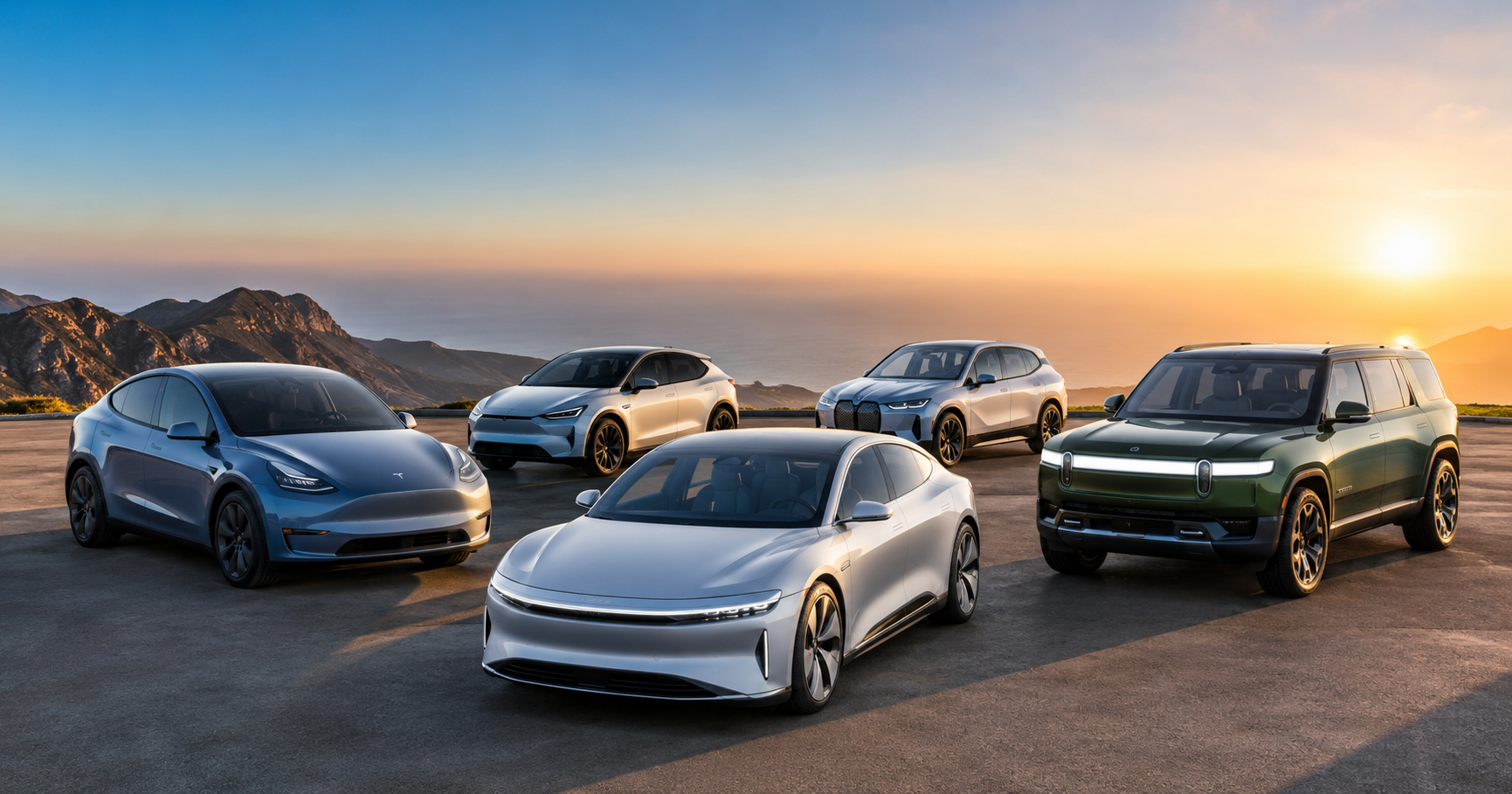
Electric Cars 2026 are entering a pivotal stage in the U.S. market. Buyers have more choices than ever, from affordable EVs priced below $30,000 to luxury electric vehicles approaching six figures, while the federal purchase tax credit is no longer available for most 2026 buyers. At the same time, charging infrastructure continues to expand, range has improved substantially, and automakers are introducing a broader mix of electric sedans, SUVs, trucks and performance models.
The result is a more complicated EV market, but also a more useful one for shoppers. The best electric car is no longer simply the model with the biggest battery or the longest EPA range. Price, charging capability, efficiency, interior space, software, reliability, home-charging access and expected ownership costs can matter just as much.
This guide examines the best electric cars 2026 shoppers should consider, including affordable EVs, luxury models, long-range electric cars, family SUVs and three-row EVs. It also explains electric car prices 2026, EV charging, battery range, upcoming electric vehicles and the differences between an EV and a hybrid.
Note: Specifications and market figures in this guide are based on research conducted by the Newest Cars editorial team. Where our research identifies an expected, uncertain, or estimated figure, it is presented as such rather than as a confirmed specification.
Electric Cars 2026: What Has Changed?
The U.S. electric-vehicle market looks very different in 2026 than it did during the rapid growth period of 2025. The expiration of the federal $7,500 new-EV purchase credit at the end of September 2025 removed a major nationwide purchase incentive, and EV sales subsequently declined. According to the supplied research, U.S. EV sales fell 27% year over year in the first quarter of 2026 to 216,399 vehicles.
However, the decline does not mean the EV market has stopped developing. Second-quarter sales increased 14.7% from the first quarter to 247,226 vehicles, although they remained 20.5% below the same quarter a year earlier. EVs represented approximately 5.8% of total new-vehicle sales in Q2 2026, compared with a 10.6% peak in Q3 2025 before the federal incentive expired.
The more important story for shoppers is product choice. The research identifies roughly 32 to 38 new EV models launching in the U.S. during 2026, making this one of the busiest years yet for electric-vehicle introductions.
Those products cover almost every major price and vehicle category. Buyers can consider a redesigned Nissan Leaf near the $30,000 mark, Chevrolet’s new Bolt program, mainstream electric SUVs such as the Equinox EV and Ioniq 5, premium vehicles such as the BMW iX and Porsche Macan Electric, and high-end models such as the Lucid Air and Cadillac Escalade IQ.
The market is therefore going through what the supplied research describes as a necessary reset. Automakers must persuade consumers to buy EVs without relying on the same federal incentive structure that helped drive demand in 2025. That makes affordability, utility, performance and the ownership experience increasingly important.
Best Electric Cars 2026
There is no single EV that is ideal for every driver. A commuter may value efficiency and low purchase price, while a family may prioritize cargo space and charging access. A road-trip driver may want 350 miles of range or more, while a luxury buyer may care more about interior quality and performance.
Based on the supplied research, the following models stand out in specific categories.
| Model | Starting Price | EPA Range | Charging | Best For |
|---|---|---|---|---|
| Hyundai Ioniq 6 | $35,615 | Up to 361 miles | Up to 257 kW | Overall value and efficiency |
| Chevrolet Equinox EV | $34,995 | 319 miles | 150 kW | Affordable electric SUV |
| Nissan Leaf S+ | $29,990 | Up to 303 miles | 100 kW | Affordable commuting |
| Tesla Model Y | $39,990 | Up to 327 miles | 250 kW | Families and road trips |
| Lucid Air Grand Touring | $138,000 | Up to 512 miles | 250 kW | Maximum range |
Best Overall Electric Car: Hyundai Ioniq 6
The Hyundai Ioniq 6 is the strongest overall recommendation in the supplied research because it combines a relatively accessible starting price with exceptional efficiency and range. The SE Standard RWD model is listed at $35,615 and can deliver up to 361 miles of EPA-estimated range.
That combination is particularly significant because range normally comes with a substantial price penalty. The Ioniq 6 demonstrates that shoppers do not necessarily need to spend luxury-car money to get a long-range EV.
The sedan also benefits from highly aerodynamic design, with a reported 0.21 coefficient of drag, and charging capability of up to 257 kW. The research gives the model a U.S. News score of 9.0 out of 10.
Who should buy it: Drivers who want a highly efficient EV with strong highway capability and long range without moving into luxury pricing.
Who should avoid it: Buyers who need SUV-like cargo flexibility, three rows or a truck bed.
Best Affordable Electric Car: Chevrolet Equinox EV
The Chevrolet Equinox EV is one of the strongest value propositions in the 2026 market. The research lists a starting MSRP of $34,995 for the LT FWD model and up to 319 miles of EPA range.
Its appeal is not based solely on price. The Equinox EV combines a mainstream SUV body style with a range figure that exceeds many considerably more expensive EVs. The supplied research also identifies it as U.S.-assembled.
For shoppers searching for the best affordable EV, this makes the Equinox EV particularly compelling. It offers more utility than a compact sedan while remaining below the average EV transaction price.
Biggest advantage: Strong range for the money.
Biggest drawback: Its 150-kW DC fast-charging capability is not as aggressive as the fastest 800-volt EVs.
Best EV for Commuters: Nissan Leaf
The redesigned Nissan Leaf is one of the most important affordable EVs in the research. The Leaf S+ is listed at $29,990 with up to 303 miles of range.
That makes the Leaf especially interesting for shoppers searching for an electric car under $30,000. It combines a relatively low entry price with more than 300 miles of advertised range, although buyers should remember that range varies by configuration and real-world conditions.
The Leaf makes the most sense for commuters who have predictable daily driving patterns and preferably access to home charging. A driver covering 30 to 60 miles per day may rarely need public charging.
Best EV for Families: Tesla Model Y
The Tesla Model Y remains one of the most practical choices for families because it combines SUV proportions, cargo capacity, strong range and access to Tesla’s Supercharger ecosystem. The supplied research lists a starting price of $39,990 for the Standard RWD model and up to 327 miles for the Long Range AWD version.
The Model Y is also identified as the best-selling EV in the U.S. within the supplied research and is listed with an IIHS Top Safety Pick+ designation.
For a family, the most important advantage may be the balance between price and practicality. It is significantly less expensive than many luxury electric SUVs while offering enough range for daily driving and many road trips.
Best Performance EV: Hyundai Ioniq 5 N
The Hyundai Ioniq 5 N represents a different interpretation of the electric car. Instead of focusing primarily on efficiency, it emphasizes acceleration, handling and driver involvement.
The research lists output of up to 641 horsepower in overboost mode, a claimed 0-to-60-mph time of 3.4 seconds, Drift Mode and N Grin Shift. Pricing begins around $67,000 according to the supplied research.
It is not the logical choice for someone shopping purely on operating cost. Its purpose is to demonstrate how electric powertrains can deliver serious performance without sacrificing the instant torque associated with EVs.
Best Luxury EV: Lucid Air
The Lucid Air occupies the premium end of the EV market, but its most important advantage is efficiency and range rather than simply luxury branding.
The Air lineup in the supplied research starts around $69,900 for the Pure RWD and extends to $138,000 for the Grand Touring. The latter can reach as much as 512 miles of EPA range, making it the range leader among production EVs in the supplied data.
For luxury shoppers, the Air combines a premium interior with exceptional aerodynamic efficiency and long-distance capability. The major drawback is obvious: the highest-range versions carry a substantial purchase price.
Best EV for Road Trips: Tesla Model 3 Long Range
The Tesla Model 3 Long Range is particularly attractive to long-distance drivers because it combines a 341-mile EPA range figure with access to the Tesla Supercharger network.
The research lists a starting price of $47,490 for the Long Range AWD configuration. Its appeal is less about having the absolute highest range and more about combining strong efficiency, highway range and charging access.
For road-trip buyers, the charging network can be nearly as important as the vehicle’s EPA range. A car with a 340-mile rating that can be charged conveniently may be more useful than a theoretically longer-range vehicle with limited charging access.
Best Electric SUVs 2026
Electric SUVs are at the center of the 2026 EV market. They offer the seating position, cargo flexibility and family practicality that American buyers increasingly expect, while the latest models can provide more than 300 miles of range.
| Model | Starting Price | Range | Seating | Best For |
|---|---|---|---|---|
| Hyundai Ioniq 5 | About $35,000 | Up to 318 miles | 5 | Overall SUV value |
| Chevrolet Equinox EV | $34,995 | 319 miles | 5 | Affordable SUV |
| Tesla Model Y | $39,990 | Up to 327 miles | 5 | Road trips and value |
| Hyundai Ioniq 9 | $67,920 | Up to 335 miles | 7 | Families |
| Lucid Gravity | $94,900 | Up to 450 miles | 7 | Luxury and range |
Best Overall Electric SUV: Hyundai Ioniq 5
The Hyundai Ioniq 5 is one of the most balanced EV SUVs in the research. Its starting price is listed around $35,000, while range can reach 318 miles depending on configuration.
The Ioniq 5’s 800-volt electrical architecture is a major advantage for shoppers who care about fast charging. The research lists charging capability in the roughly 220-to-257-kW range.
Its distinctive design and flexible interior also help differentiate it from conventional compact SUVs. It is especially well suited to buyers who want an EV that feels purpose-built rather than simply an electrified version of a gasoline crossover.
Best Affordable Electric SUV: Chevrolet Equinox EV
The Equinox EV is arguably the most straightforward answer for shoppers looking for an affordable electric SUV. At $34,995, it starts near the lower end of the EV market while providing 319 miles of EPA range.
That combination gives the Equinox EV an unusually strong range-per-dollar proposition. It is particularly attractive to buyers who want an electric SUV but do not want to pay the $50,000-plus prices associated with many larger EVs.
Best Electric SUV for Road Trips: Tesla Model Y
The Model Y’s road-trip strength comes from a combination of range, efficiency, cargo space and charging-network access. The Long Range AWD model is listed with up to 327 miles of EPA range.
For families who frequently travel between cities, charging availability can be more important than adding another 20 or 30 miles to an EPA rating. The Model Y therefore remains a practical road-trip choice even though several premium EVs offer substantially greater maximum range.
Best Luxury Electric SUV: Lucid Gravity
The Lucid Gravity is the range-focused choice in the luxury electric SUV category. The research lists a starting price of $94,900, up to 450 miles of range and seating for seven.
It also supports charging at up to 400 kW according to the supplied data. That combination makes it one of the most ambitious electric SUVs for long-distance travel.
The main consideration is price. At nearly $95,000 before options and other costs, the Gravity belongs to a very different segment from the Equinox EV or Ioniq 5.
Best Family Electric SUV: Hyundai Ioniq 9
The Hyundai Ioniq 9 is designed around the needs of larger families. It offers three rows and seating for seven, with up to 335 miles of range according to the supplied research.
Starting at $67,920, it occupies a middle ground between mainstream three-row EVs and more expensive luxury alternatives. The research also gives it an Edmunds overall score of 8.4 out of 10.
For families who regularly carry six or seven people, the Ioniq 9 makes more sense than trying to stretch a five-seat crossover beyond its intended capacity.
Best Performance Electric SUV: Kia EV9 GT
The Kia EV9 GT is identified in the research as a performance-oriented version of the three-row EV9. Its expected price is around $75,000, with expected output above 500 horsepower.
Because the supplied figures are expectations rather than confirmed final specifications, buyers should treat them accordingly. The important point is the direction of the product: Kia is extending performance EV technology into a practical three-row SUV.
Cheapest EVs in 2026
Price remains one of the biggest barriers to EV adoption. The federal purchase credit that previously reduced the effective price of qualifying new EVs is no longer generally available for 2026 purchases, so the starting MSRP matters more than it did in earlier years.
| Model | Starting Price | Range | Body Style |
|---|---|---|---|
| Chevrolet Bolt, 2027 model year | $28,995 | 262 miles | Hatchback |
| Nissan Leaf S+ | $29,990 | 303 miles | Hatchback |
| Chevrolet Equinox EV LT FWD | $34,995 | 319 miles | SUV |
| Hyundai Kona Electric | $33,550 | 261 miles | SUV |
| Hyundai Ioniq 6 SE Standard RWD | $35,615 | 361 miles | Sedan |
The supplied research identifies the Chevrolet Bolt program at $28,995 as the lowest-priced entry, followed by the redesigned Nissan Leaf at $29,990. An important distinction is that the Bolt is described as a 2027 model-year vehicle arriving in 2026, so shoppers should not confuse its model year with the calendar year of its arrival.
The Nissan Leaf is particularly interesting because it combines a sub-$30,000 starting point with more than 300 miles of stated range. That makes it difficult to judge affordable EVs by price alone.
The Chevrolet Equinox EV demonstrates the same principle from the SUV side. Spending roughly $5,000 more than the Leaf’s starting price can move a buyer into a larger vehicle with 319 miles of range.
Is the Cheapest EV the Best Value?
Not necessarily. The lowest MSRP may come with slower charging, fewer features, less interior space or a different body style than the buyer actually needs.
A shopper who drives only 30 miles per day and has home charging may benefit from choosing the least expensive EV. A driver who regularly travels 300 miles on the highway may find that paying more for faster charging and better highway efficiency provides greater practical value.
Luxury EVs in 2026
The luxury EV market has expanded well beyond the early premium models. Buyers can now choose between high-performance sedans, large electric SUVs, premium crossovers and long-range luxury cars.
Lucid Air
The Lucid Air is the standout range-focused luxury sedan in the supplied research. Its starting price is listed at $69,900 for the Pure RWD, while the Grand Touring reaches $138,000 and up to 512 miles of EPA range.
The Air’s strongest argument is efficiency. Its range does not come simply from using an enormous battery; aerodynamic design and powertrain efficiency are central to its performance.
Lucid Gravity
The Lucid Gravity brings the company’s range-first philosophy to the SUV market. With a listed starting price of $94,900 and up to 450 miles of range, it is one of the most capable luxury electric SUVs in the research.
Cadillac Escalade IQ
The Cadillac Escalade IQ is positioned at the upper end of the luxury SUV market. The supplied research lists a $130,300 starting price, 465 miles of maximum range and seating for seven.
Its appeal is primarily size, luxury and long-distance capability. It is not a value-oriented EV, but it demonstrates how far electrification has expanded into the full-size luxury SUV segment.
BMW iX
The BMW iX xDrive50 is listed at $76,600 to $87,250, depending on configuration, with up to 364 miles of range. It occupies the premium SUV space between mainstream electric crossovers and ultra-luxury models.
Porsche Macan Electric
The Porsche Macan Electric is listed at $92,250 and up to 332 miles of range. The research also identifies charging capability of up to 400 kW, making charging performance a significant part of its appeal.
Luxury EV shoppers should therefore compare more than cabin materials. Charging speed, range, software, driver assistance, ride comfort and battery efficiency can materially change the ownership experience.
Longest-Range EVs in 2026
The answer to the question “What is the longest-range EV in 2026?” is clear within the supplied research: the Lucid Air Grand Touring, with up to 512 miles of EPA-estimated range.
| Model | Maximum Range | Starting Price | Body Style |
|---|---|---|---|
| Lucid Air Grand Touring | Up to 512 miles | $138,000 | Sedan |
| Chevrolet Silverado EV | 493 miles | $55,395 | Truck |
| Cadillac Escalade IQ | 465 miles | $130,300 | SUV |
| GMC Sierra EV | 460 miles | $64,995 | Truck |
| Lucid Gravity | 450 miles | $94,900 | SUV |
| Lucid Air Pure | 420 miles | $69,900 | Sedan |
| Hyundai Ioniq 6 | 361 miles | $35,615 | Sedan |
Why EPA Range Matters
EPA range is a standardized estimate, not a promise of how many miles every driver will achieve. Actual range changes with temperature, speed, terrain, tire selection, passenger and cargo weight, climate-control use and driving style.
Highway driving is particularly important. An EV that achieves its best efficiency at moderate speeds can consume substantially more energy when driven at sustained highway speeds.
Cold weather can also reduce range. The supplied research notes that cold conditions can produce significant reductions, particularly because batteries operate less efficiently at low temperatures and cabin heating consumes additional energy.
Do You Really Need 500 Miles of Range?
For most drivers, probably not. A 500-mile EV is impressive, but a driver with reliable home charging may rarely use more than a fraction of that capacity between charges.
Long range becomes more valuable for people who frequently travel in rural areas, drive long highway distances, tow or have limited access to charging. For an ordinary commuter, efficiency and convenient charging may matter more than maximum battery capacity.
The supplied research cites a real-world highway estimate of about 410 miles for the Lucid Air Grand Touring at 75 mph, illustrating why EPA figures and highway driving results should not be treated as identical measurements.
Best 3-Row Electric SUVs 2026
Three-row electric SUVs are among the most important new categories in the EV market because large families need space that a five-seat crossover cannot provide.
| Model | Starting Price | Range | Seats | Positioning |
|---|---|---|---|---|
| Kia EV9 | $54,900 | 305–310 miles | 7 | Best value-oriented choice |
| Hyundai Ioniq 9 | $67,920 | Up to 335 miles | 7 | Family-focused |
| Lucid Gravity | $94,900 | Up to 450 miles | 7 | Luxury and range |
| Cadillac Escalade IQ | $130,300 | Up to 465 miles | 7 | Full-size luxury |
Kia EV9: Best Value Three-Row EV
The Kia EV9 is the most accessible three-row EV in the supplied comparison, with a starting price of $54,900 and up to roughly 305 to 310 miles of range depending on configuration.
Its seven-seat capacity and large-SUV packaging make it a strong choice for families who need three rows but do not want to enter the luxury segment.
Hyundai Ioniq 9: Best Family Three-Row EV
The Hyundai Ioniq 9 increases the emphasis on family comfort and range. It starts at $67,920 and offers up to 335 miles of range with seven-passenger seating.
For a family that routinely carries passengers on long trips, the additional range over the EV9 can be useful. It also provides a strong middle ground between mainstream pricing and premium alternatives.
Lucid Gravity: Best Long-Range Three-Row EV
The Gravity is the most compelling choice for buyers who want three rows without giving up long-distance range. Its 450-mile maximum range is significantly higher than the mainstream three-row EVs in the supplied data.
The tradeoff is price. At $94,900, it costs substantially more than the EV9 or Ioniq 9.
What Makes a Three-Row EV Practical?
Range alone is not enough. Families should consider how usable the third row is, how much cargo space remains when all seats are occupied, child-seat access, charging locations on family routes and the time required for road-trip charging.
New EVs Coming in 2026
The 2026 model year is unusually significant because dozens of new or substantially updated EVs are entering the U.S. market. Some are confirmed arrivals, while others have estimated or uncertain timing.
| Model | Brand | Body Style | Expected Price | Expected/Listed Range | Timing |
|---|---|---|---|---|---|
| Acura RSX | Acura | Compact crossover coupe | About $50,000 | 300+ miles | First half of 2026 |
| BMW iX3 | BMW | Midsize SUV | $61,500 | 434 miles | Summer/mid-2026 |
| Honda 0 Series SUV | Honda | Compact SUV | About $35,000 estimated | 300 miles | Late 2026 |
| Hyundai Ioniq 6 N | Hyundai | Performance sedan | About $67,000 estimated | Not available | 2026 |
| Jeep Recon | Jeep | Off-road SUV | About $60,000 estimated | About 230 miles | 2026 |
| Kia EV3 | Kia | Compact SUV | Below $35,000 | About 320 miles | Late 2026 |
| Mercedes-Benz CLA Electric | Mercedes-Benz | Compact sedan | About $48,000 | About 400 miles | 2026 |
| Rivian R2 | Rivian | Midsize SUV | About $45,000 | 300+ miles | Late 2026 |
| Subaru Trailseeker | Subaru | Midsize SUV | About $40,000 | 260+ miles | 2026 |
| Volvo EX60 | Volvo | Midsize SUV | About $60,000 estimated | 400 miles | 2026 |
Rivian R2
The Rivian R2 is one of the most important upcoming EVs because it aims to bring Rivian’s electric-SUV formula into a lower price class. The supplied research lists an expected starting price of about $45,000 and more than 300 miles of range, with late-2026 timing.
Kia EV3
The Kia EV3 could become an important affordable electric SUV if its expected U.S. positioning is maintained. The research lists a price below $35,000 and about 320 miles of range, with a late-2026 arrival.
BMW iX3
The new BMW iX3 is positioned as a premium midsize electric SUV. The supplied research lists a $61,500 price and up to 434 miles of range, with summer or mid-2026 timing.
Mercedes-Benz CLA Electric
The electric CLA is another important entry because it combines a compact luxury sedan format with an expected range around 400 miles. The supplied research lists pricing around $48,000.
Models With Uncertain Timing
Not every announced EV should be treated as guaranteed for the 2026 U.S. market. The research identifies the Honda 0 Series Saloon as delayed to 2027, while U.S. availability of the Polestar 5 is uncertain. Lucid Earth is also identified as a possible 2027 delay.
This distinction matters for buyers. An announced EV can be useful for understanding where the market is heading, but shoppers making a purchase decision should distinguish confirmed availability from expected timing.
Electric Car Prices in 2026
The average EV transaction price in July 2026 was $56,126 according to the supplied research. That figure is considerably higher than the $49,855 average transaction price for all new vehicles in the same month.
However, the EV price gap has been changing. The research reports an average EV transaction price of $55,300 in February 2026 and identifies an approximately $6,500 EV premium over internal-combustion vehicles at that point.
Prices also depend heavily on incentives. Manufacturer discounts represented 11.8% of average EV transaction prices in July, down from 15.8% in July 2025. That decline in discounting helps explain why average EV prices were rising again during the second half of 2026.
What Does an EV MSRP Include?
A vehicle’s advertised starting MSRP is not the same as the final amount a buyer pays. Destination charges, taxes, registration, dealer fees, options and financing costs can increase the transaction price.
That is particularly important when comparing a $34,995 EV with a $39,990 EV. The actual difference may be larger or smaller depending on equipment and dealer pricing.
Are There Federal EV Tax Credits in 2026?
According to the supplied research, the federal Section 30D new-EV purchase credit expired after September 30, 2025. The Section 25E used-EV credit also expired, while the commercial clean-vehicle credit was similarly identified as expired.
The research also notes that the home-charger Section 30C credit was active through June 30, 2026. Because the research date is August 16, 2026, that period has passed.
State programs can still vary significantly, however. The research gives examples ranging from Colorado incentives to New York and Massachusetts programs. Buyers should verify their specific state’s current program before including any incentive in a purchase calculation.
EV Charging Explained
Charging is one of the most important differences between owning an EV and owning a gasoline vehicle. Instead of refueling only at public stations, most EV owners can replenish their vehicles at home while the car is parked.
The U.S. charging network has also expanded significantly. The supplied research reports 250,406 public charging ports across 80,543 locations as of June 2026, including 73,951 DC fast-charging ports.
What Is Level 1 Charging?
Level 1 charging uses a conventional 120-volt household outlet. It requires no dedicated high-power charging installation, but it is slow.
The research estimates roughly 20 to 40 hours for a full charge depending on the vehicle and conditions. For a driver who covers only a few dozen miles per day, however, overnight Level 1 charging can sometimes provide sufficient energy.
What Is Level 2 Charging?
Level 2 charging uses 240-volt power and is substantially faster. The supplied research estimates approximately four to 12 hours for a full charge, depending on vehicle battery size and charger capability.
For many EV owners, Level 2 is the ideal home solution. The vehicle can be plugged in overnight, allowing the driver to start most mornings with a high state of charge.
What Is DC Fast Charging?
DC fast charging is designed primarily for road trips and situations where an EV needs a large amount of energy quickly. Instead of slowly replenishing the battery over several hours, a high-power DC charger can add substantial range in a relatively short stop.
The supplied research gives a typical 10-to-80% charging window of approximately 18 to 45 minutes for chargers in the 150-to-400-kW range, although the actual time depends on the vehicle, battery temperature, charger output and state of charge.
Why Charging Speed Is Not the Same as Charger Power
A 350-kW charger does not mean every EV will charge at 350 kW. The vehicle’s maximum charging capability determines how much power it can accept, and charging power normally declines as the battery approaches a high state of charge.
This is why a vehicle capable of accepting 250 kW can potentially spend less time at a fast charger than another vehicle with a lower charging ceiling, even if both batteries have similar capacities.
Home Charging vs. Public Charging
Home charging is generally the most convenient option for drivers who can install a charger. The supplied research estimates a Level 2 home-charging installation at approximately $500 to $2,500, depending on circumstances.
Public charging is more important for apartment residents, renters and road-trip drivers. Anyone without dependable home charging should investigate local charging locations before buying an EV.
How Much Does It Cost to Charge an EV?
The supplied research provides an illustrative calculation using electricity at $0.15 per kWh and EV efficiency of 3.5 miles per kWh. Under those assumptions, energy costs work out to about 4.3 cents per mile.
An 80-kWh battery would require approximately $12 of electricity to move from empty to full under the same simple calculation. Real-world costs vary by electricity rates, charging losses, battery size and whether charging occurs at home or at a public station.
Charging Networks
The U.S. charging landscape includes major networks such as Tesla Supercharger, Electrify America, EVgo and ChargePoint. Network availability varies by region, and compatibility can depend on the vehicle and charging connector.
For an EV buyer, the practical question is not simply “How many charging stations are in the country?” It is “Where are the chargers I will actually use?” A driver should examine charging options around home, work and common highway routes before choosing an EV.
EV Battery Range Explained
Battery range is the number most shoppers notice first, but it is also one of the easiest EV specifications to misunderstand.
EPA range is an estimate produced through standardized testing. It allows shoppers to compare vehicles using a common reference point, but it cannot reproduce every real-world driving condition.
What Affects EV Range?
- Speed: Highway speeds generally consume more energy than slower urban driving.
- Temperature: Cold weather can significantly reduce usable range.
- Cabin heating and cooling: Climate control uses electricity that otherwise could move the vehicle.
- Driving style: Hard acceleration and high speeds reduce efficiency.
- Terrain: Hills and mountain roads can increase energy consumption.
- Tires and wheels: Different tire and wheel configurations can affect efficiency.
- Passenger and cargo weight: Additional weight requires more energy.
- Drivetrain: AWD configurations can have different efficiency characteristics from RWD versions.
How Much Range Do You Actually Need?
For a commuter traveling 40 miles each weekday, an EV with 250 miles of EPA range may be more than sufficient, especially with home charging. For a driver regularly covering 250 miles between cities, a 300-mile vehicle may provide more practical comfort.
Buyers should also think about charging opportunities rather than treating range as an isolated number. A 300-mile EV with a charger at home and fast chargers along major routes can be easier to live with than a 400-mile EV for someone who lacks home charging.
EV Battery Life and Degradation
The supplied research estimates typical battery degradation of roughly 10% to 20% after 10 years or 100,000 miles, although actual results vary. It also notes that many manufacturers provide battery warranties around eight years or 100,000 miles, often with a minimum retained-capacity threshold.
Battery degradation normally happens gradually rather than as an immediate failure. That distinction is important for used-EV shoppers. A battery that has lost some capacity may still be perfectly functional for daily driving.
The research estimates potential battery replacement costs of roughly $5,000 to $20,000 depending on the vehicle and battery size. These figures should be treated as broad estimates rather than a universal replacement price.
EV Reliability in 2026
Reliability remains an important consideration because EVs are relatively sophisticated technology products as well as automobiles.
The supplied J.D. Power data reports 237 problems per 100 EVs in its 2026 Vehicle Dependability Study, compared with 213 for hybrids and 198 for gasoline vehicles. The research notes that software-related problems contribute significantly to EV issues.
That does not mean every EV is unreliable. It means buyers should distinguish between powertrain durability and the broader vehicle experience, which includes infotainment, software, driver-assistance systems and electronic features.
The supplied research identifies the Tesla Model Y as the most reliable EV in Consumer Reports’ 2026 assessment.
Do EVs Need Less Maintenance?
Generally, yes. EVs do not require conventional engine oil changes, and their electric drivetrains have fewer mechanical components than internal-combustion powertrains.
Regenerative braking can also reduce conventional brake wear. On the other hand, EVs can be heavier than comparable gasoline vehicles and deliver strong instant torque, which can increase tire wear in some circumstances.
Routine maintenance still includes tires, brakes, suspension components, cabin filters and other vehicle systems. Software updates are also an increasingly important part of EV ownership.
EV vs. Hybrid: Which Is Better?
The debate over EV vs. hybrid is not really about identifying one universally superior technology. It is about matching the vehicle to the driver’s lifestyle.
| Factor | EV | Hybrid |
|---|---|---|
| Fueling | Electric charging | Gasoline, with hybrid assistance |
| Home charging | Highly beneficial | Not required |
| Long-distance convenience | Depends on charging infrastructure | Gas-station network provides rapid refueling |
| Powertrain maintenance | Generally lower | Higher than EV because it retains an engine |
| Purchase price | Often higher than comparable gas vehicles | Often lower than comparable EVs |
| Tailpipe emissions | None during operation | Lower than conventional gasoline vehicles, but not zero |
When an EV Makes More Sense
An EV is particularly attractive for drivers who have reliable home charging, predictable daily mileage and access to a strong public charging network when needed.
Urban and suburban commuters can benefit substantially because the vehicle can charge while parked. High-mileage drivers may also recover some of the higher purchase price through lower energy and maintenance costs.
EVs can also be attractive to households that already own a gasoline vehicle. In that scenario, the EV can handle daily commuting while the gasoline vehicle remains available for occasional long-distance trips or towing.
When a Hybrid Makes More Sense
A hybrid may be the better choice for drivers who cannot reliably charge at home, frequently travel through rural areas or make long trips where charging infrastructure is inconvenient.
Hybrid vehicles also avoid the need to plan charging stops on long journeys. For drivers who regularly tow or haul heavy loads, a hybrid can provide more predictable long-distance flexibility.
The supplied research specifically identifies buyers without reliable home charging, frequent long-distance drivers, rural residents, budget-conscious buyers and drivers in cold climates as groups that may benefit from hybrids.
Are EVs Cheaper to Own?
The answer depends on how the vehicle is used. EVs often cost more to purchase but can cost less to operate because electricity can be cheaper than gasoline and maintenance requirements are generally lower.
The supplied research estimates potential annual fuel savings of roughly $1,200 to $2,000 for some EV drivers, but actual savings depend on gasoline prices, electricity rates, annual mileage and vehicle efficiency.
Insurance can complicate the calculation. The supplied research estimates EV insurance can average 15% to 20% higher than comparable gasoline vehicles because of purchase prices and repair costs, although rates vary substantially by model, driver and location.
Environmental Considerations
EVs have no tailpipe emissions while driving. Their overall environmental impact depends on battery manufacturing, electricity generation and vehicle production, but they generally reduce direct vehicle emissions compared with conventional gasoline vehicles.
Hybrids can also reduce fuel consumption and emissions compared with conventional internal-combustion vehicles, but they continue to use gasoline.
For buyers, the practical takeaway is simple: an EV can be a strong environmental and economic choice, but a hybrid may provide a better overall ownership experience when charging access is poor.
How to Choose the Right EV in 2026
Choosing an EV should begin with your daily driving pattern rather than with the vehicle’s headline specifications.
1. Determine Your Real Daily Mileage
Track how many miles you actually drive on an average weekday. If your daily requirement is modest, there may be little reason to pay a premium for the longest-range battery.
2. Check Home Charging
Home charging can fundamentally change the EV ownership experience. If you own a house with suitable electrical service, a Level 2 charger can make charging largely routine.
If you live in an apartment or cannot install a charger, investigate public charging near your home and workplace before purchasing.
3. Compare EPA Range
Use EPA range as a common comparison point, but do not treat it as your guaranteed real-world result. Consider your climate, highway speed and typical routes.
4. Look at Charging Speed
Two EVs with similar range can have very different road-trip experiences. One may accept substantially more DC fast-charging power and spend less time at charging stations.
5. Consider Space and Body Style
A sedan such as the Ioniq 6 may be ideal for efficiency, while an Equinox EV, Ioniq 5 or Model Y may be better for buyers who prioritize cargo space. Families requiring three rows should focus on vehicles such as the EV9 and Ioniq 9 rather than trying to adapt a five-seat crossover.
6. Calculate the Total Cost
Do not compare only monthly payments. Include purchase price, financing, insurance, electricity, tires, maintenance, charging installation and expected depreciation.
The supplied research notes that EV depreciation has historically been relatively high, although the picture is improving as more long-term battery data becomes available. Used EV sales increased 12% year over year in Q1 2026, reaching a record 2.8% share of the market.
7. Check Incentives Before Signing
Federal purchase credits are no longer generally available for 2026 buyers under the research supplied for this article. State programs and manufacturer incentives can still change the effective price, so buyers should confirm eligibility and expiration dates before relying on them.
8. Think About Winter Driving
Cold-weather buyers should pay particular attention to range reduction, cabin heating and charging behavior in low temperatures. A vehicle with more range than you technically need can provide useful additional margin in winter.
9. Match the EV to Your Use Case
There is no reason to buy a $138,000 Lucid Air Grand Touring if your primary goal is inexpensive commuting. Conversely, choosing the cheapest EV may not make sense for someone who regularly drives hundreds of highway miles.
Best Electric Cars 2026 by Buyer Type
- Best overall: Hyundai Ioniq 6.
- Best affordable SUV: Chevrolet Equinox EV.
- Best commuter: Nissan Leaf.
- Best family EV: Tesla Model Y.
- Best performance EV: Hyundai Ioniq 5 N.
- Best luxury EV: Lucid Air.
- Best maximum-range EV: Lucid Air Grand Touring.
- Best mainstream three-row EV: Hyundai Ioniq 9.
- Best value three-row EV: Kia EV9.
- Best long-range luxury SUV: Lucid Gravity.
- Best road-trip-oriented sedan: Tesla Model 3 Long Range.
Electric Cars 2026: Key Takeaways for Buyers
The 2026 U.S. EV market is defined by choice and transition. Sales have cooled from the extraordinary levels seen before the federal tax-credit expiration, but manufacturers are simultaneously introducing an unprecedented number of new electric vehicles.
For buyers, that creates both opportunities and complications. Discounts and manufacturer incentives can make some EVs more attractive, but average transaction prices increased again as discounts narrowed during the middle of 2026.
The most compelling value choices are not necessarily the cheapest vehicles. The Hyundai Ioniq 6 offers exceptional range and efficiency for its price, while the Chevrolet Equinox EV combines SUV practicality with 319 miles of range. The Nissan Leaf offers an unusually low entry price, while the Tesla Model Y provides a strong blend of family utility and charging access.
At the other end of the market, the Lucid Air Grand Touring demonstrates how far EV range has progressed, with up to 512 miles of EPA-estimated range. The Lucid Gravity extends that range-first approach into a three-row SUV.
The most important lesson is that range should not be considered independently. Charging access, price, efficiency, vehicle size and your normal driving pattern determine whether an EV will actually be convenient.
For most buyers, the best EV is the one that fits the majority of their driving without requiring unnecessary compromises. That may be a $30,000-class commuter EV, a $35,000 electric SUV, a $50,000 road-trip vehicle or a luxury EV with more than 400 miles of range.
Electric Cars 2026: Frequently Asked Questions
What are the best electric cars in 2026?
The supplied research identifies the Hyundai Ioniq 6 as the best overall electric car because it combines a $35,615 starting price, up to 361 miles of EPA range and strong efficiency. Other category leaders include the Chevrolet Equinox EV for value, Tesla Model Y for families and Lucid Air for luxury and range.
What is the cheapest EV in 2026?
The supplied research lists the Chevrolet Bolt, a 2027 model-year vehicle arriving in 2026, at $28,995. The redesigned Nissan Leaf follows at $29,990. Because model-year and calendar-year designations differ, buyers should verify the exact vehicle and availability when shopping.
What is the longest-range EV in 2026?
The Lucid Air Grand Touring has the highest range in the supplied research, with up to 512 miles of EPA-estimated range. It is also identified as the only production EV in the research to exceed 500 miles on the U.S. test cycle.
How much do electric cars cost in 2026?
Prices range from roughly $29,000 for the least expensive EVs to well over $100,000 for luxury models. The supplied research reports an average EV transaction price of $56,126 in July 2026, compared with $49,855 for the average new vehicle.
Are electric cars worth buying in 2026?
EVs can be particularly worthwhile for drivers with home charging, predictable daily mileage and access to suitable public charging for longer trips. The economics become less attractive when charging is difficult, annual mileage is very low or frequent long-distance travel makes charging inconvenient.
Are EVs cheaper than gasoline cars?
EVs can cost more to purchase but less to operate. The supplied research estimates potential annual fuel savings of about $1,200 to $2,000 for some drivers, although actual savings depend on electricity prices, gasoline prices, efficiency and mileage.
How long does it take to charge an EV?
Charging time varies dramatically by equipment. The supplied research estimates about 20 to 40 hours for Level 1, four to 12 hours for Level 2 and roughly 18 to 45 minutes for a typical 10-to-80% DC fast-charge session when using high-power charging equipment.
How far can an EV travel on one charge?
Range varies from roughly 150 miles for some upcoming lower-cost vehicles to more than 500 miles for the Lucid Air Grand Touring. Many mainstream EVs in the supplied research offer approximately 250 to 350 miles of EPA range.
Does cold weather reduce EV range?
Yes. Cold temperatures can reduce battery efficiency and increase the energy required to heat the passenger cabin. The effect varies by vehicle, temperature, driving conditions and heating technology.
How long do EV batteries last?
The supplied research estimates that typical EV batteries can remain usable for 10 to 15 years or 100,000 to 200,000 miles before significant degradation, although individual results vary. Many manufacturers provide battery warranties around eight years or 100,000 miles.
Do EVs require less maintenance than hybrids?
Generally, yes. EVs have no engine oil and fewer powertrain components, while regenerative braking can reduce conventional brake wear. Hybrids still contain an internal-combustion engine and therefore retain many traditional maintenance requirements.
What is the best three-row electric SUV in 2026?
The Hyundai Ioniq 9 is identified in the supplied research as the best family-oriented three-row EV, offering seven seats and up to 335 miles of range. The Kia EV9 is the lower-priced alternative, while the Lucid Gravity offers substantially more range at a much higher price.
What is the best affordable electric SUV?
The Chevrolet Equinox EV is one of the strongest affordable choices, starting at $34,995 and offering up to 319 miles of EPA range. It combines SUV practicality with a range figure normally associated with more expensive EVs.
Is an EV better than a hybrid?
Neither technology is universally better. EVs are especially attractive for drivers with home charging and predictable daily use, while hybrids can be more convenient for people without charging access or those who frequently travel long distances through areas with limited charging.
Are there federal EV tax credits in 2026?
The supplied research states that the federal Section 30D new-EV purchase credit expired after September 30, 2025. The Section 25E used-EV credit and Section 45W commercial clean-vehicle credit were also identified as expired. State incentives and manufacturer programs may still be available depending on location and eligibility.
How much does it cost to charge an electric car at home?
Home charging cost depends on electricity rates, battery capacity and vehicle efficiency. As an example, the supplied research uses $0.15 per kWh and 3.5 miles per kWh, producing an energy cost of approximately 4.3 cents per mile.
Do you need a Level 2 charger for an EV?
Not necessarily. Level 1 charging can work for drivers with low daily mileage, but Level 2 is much more practical for many households because it can replenish significantly more energy overnight. Buyers without home charging should investigate public charging availability before purchasing.
What should I look for when buying an EV in 2026?
Focus on real-world driving needs rather than a single specification. Compare purchase price, EPA range, charging speed, home-charging access, cargo space, seating, insurance, maintenance, expected depreciation and the availability of charging on your regular routes.
Which EV is best for road trips?
The supplied research identifies the Tesla Model 3 Long Range as a strong road-trip choice because of its 341-mile EPA range and access to the Tesla Supercharger network. Vehicles such as the Lucid Air can travel farther between charges, but charging availability and vehicle price also matter.
Are electric cars reliable in 2026?
Reliability varies by model. The supplied J.D. Power research reports more problems per 100 vehicles for EVs than hybrids and gasoline vehicles, with software contributing to many problems. At the same time, the research identifies the Tesla Model Y as a leading reliable EV in Consumer Reports’ 2026 assessment.
Final Verdict: Which Electric Car Should You Buy in 2026?
The best Electric Cars 2026 are no longer defined by one metric. The market now includes inexpensive EVs with more than 300 miles of range, efficient sedans that challenge premium vehicles, family SUVs with three rows and luxury models capable of traveling 400 to 500 miles between charges.
For the broadest combination of price, efficiency and range, the Hyundai Ioniq 6 stands out. For an affordable SUV, the Chevrolet Equinox EV is difficult to overlook. The Nissan Leaf is one of the strongest options for shoppers prioritizing a low entry price, while the Tesla Model Y remains a compelling family and road-trip vehicle.
Buyers who need three rows should start with the Kia EV9 or Hyundai Ioniq 9, while luxury shoppers can move into the Lucid Gravity, Cadillac Escalade IQ, BMW iX or Porsche Macan Electric. If maximum range is the priority regardless of price, the Lucid Air Grand Touring is the clear range leader in the supplied 2026 data.
Ultimately, the smartest EV purchase is the vehicle that fits your charging situation, driving habits and budget. Before signing a deal, compare the complete ownership cost, verify the exact trim’s range and charging specifications, check current state and manufacturer incentives, and make sure charging is convenient where you live and travel.