
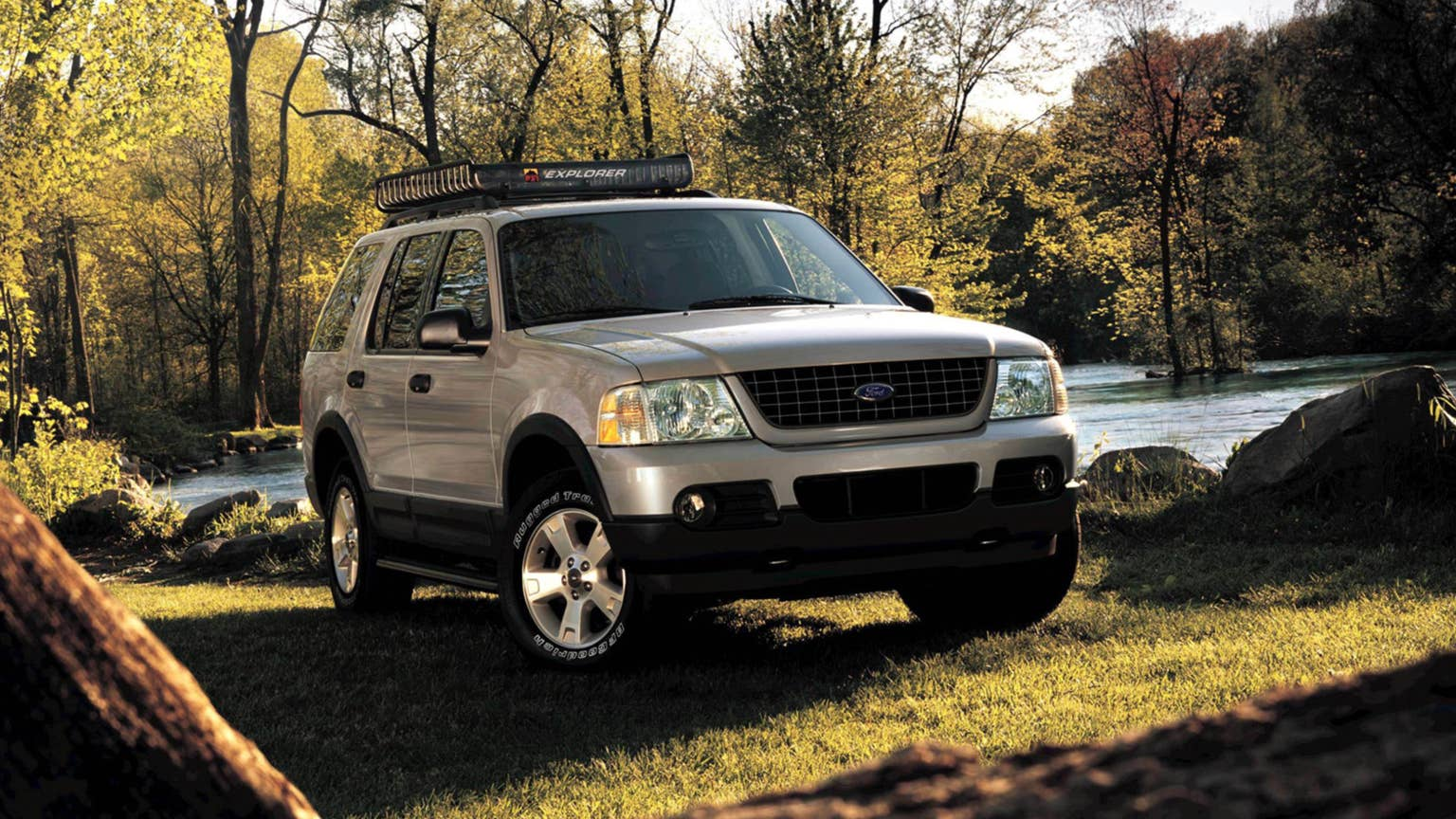
The 2002 Ford Explorer has one of the worst reliability records among vehicles, according to complaint and recall data. While today’s Ford Explorer regularly tops the sales charts as America’s best-selling three-row SUV, the third-generation model had serious problems, with the 2002 model year standing out for its extensive transmission failures and other defects.
2002 Ford Explorer’s Catastrophic Reliability Record
On Car Complaints, which collects complaint data directly from consumers, the 2002 Ford Explorer has the worst record of any model across all brands. Based on the number of failures, average mileage at failure and repair costs, the publication calls it “hands-down our worst vehicle on record” and advises consumers to “avoid it like the plague.”
The 2002 Ford Explorer was the first model year of the relatively short-lived third generation. It represented a complete redesign of the nameplate and ended the chassis commonality with the Ford Ranger.
The new model introduced independent rear suspension and other fresh technologies intended to improve the SUV. However, the unproven technology was associated with several major defects that ultimately created serious problems for Ford.
National Highway Traffic Safety Administration (NHTSA) data also shows the extent of the problems. The 2002 Explorer has 14 recalls and 3,622 complaints on file.
The Main 2002 Ford Explorer Problems
According to Car Complaints, transmission-related issues accounted for most of the complaints involving the 2002 Explorer.
- Transmission failure: 441 complaints
- O/D light blinking: 386 complaints
- Transmission slips when shifting and clunks: 151 complaints
- Enclosed transmission had to be overhauled: 136 complaints
- Difficulty shifting: 101 complaints
- Hard/soft shifting, rattling noise, gear ratio out, O/D light on: 56 complaints
- Won’t shift into third gear: 52 complaints
- Transmission hesitates: 28 complaints
Car Complaints data shows that the Explorer’s transmission would fail at an average mileage of 94,800 miles and typically cost $2,840 to repair. The problems specifically affected the five-speed automatic transmissions, including the 5R55W and 5R55S variants.
The transmissions had no dipstick or easy way to check the condition of the transmission fluid. Degraded fluid accelerated wear on internal components, while the transmissions were also referred to as having “lifetime” fluid.
Failing solenoid packs, valve body failure and servo bore wear were among the flaws affecting the transmissions, contributing to one or more of the problems reported by owners.
Other 2002 Ford Explorer Recalls and Defects
Several recalls involved build-quality issues, including broken liftgate glass brackets and fractured seat bolts. Lighting problems and a fire risk associated with running boards were also mentioned.
The transmission remained the most prevalent and costly flaw in the 2002 Explorer, contributing to its reputation as one of the least dependable Fords.
Ironically, the third-generation Explorer was intended to resolve Ford’s public relations disaster following the Firestone tire controversy. Certain tires equipped on SUVs such as the second-generation Explorer had been involved in many fatal crashes.
The third-generation Explorer was less of a rollover risk than its predecessor, but its serious transmission problems damaged the vehicle’s reputation.
What Happened With Later Ford Explorer Models?
The 2002 Explorer has the most complaints, while the third-generation Explorer as a whole is presented as a model to avoid for buyers seeking an older but reliable SUV. A model equipped with the five-speed manual gearbox is another option because it eliminates at least one major area of concern.
Explorer complaints dropped significantly with the launch of the fourth-generation model for the 2006 model year. That generation was also the last Explorer to use traditional body-on-frame construction, while later versions transitioned to a more comfortable unibody structure.
The 2002 Explorer represents the low point of the nameplate, with its well-documented flaws inconveniencing thousands of owners. Subsequent Explorers became considerably more dependable and developed into one of America’s favorite three-row SUVs.