
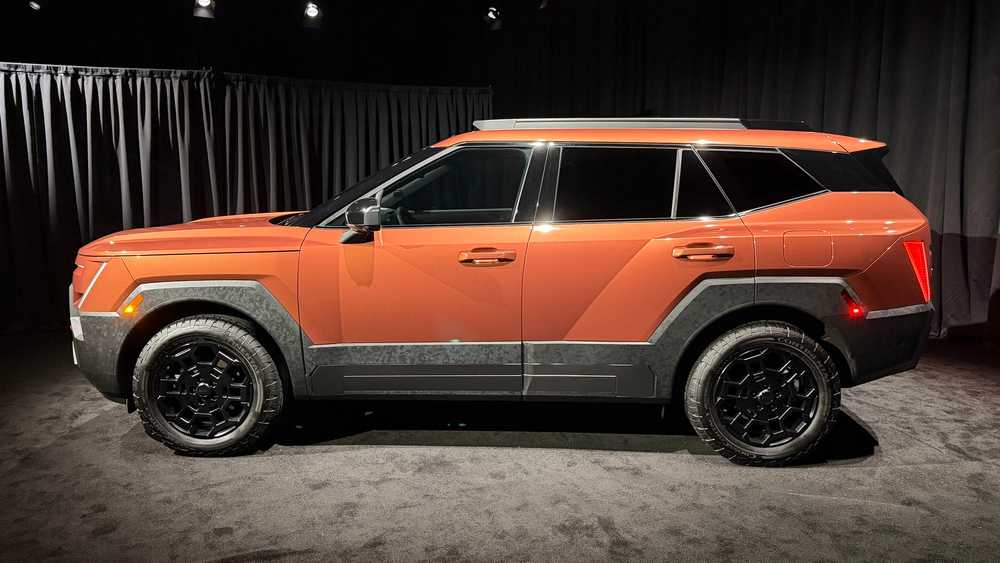
The 2027 Hyundai Tucson has been revealed with details on its dimensions, engines and trims, but its most notable change is its dramatically redesigned exterior. The new look represents a major styling departure for Hyundai’s biggest-selling vehicle in America, continuing the automaker’s willingness to make bold design moves.
Hyundai Chose a Radical Design Direction
Simon Loasby, senior vice president and head of Hyundai’s Design Center, said the company debated whether the new Tucson should follow a more evolutionary approach or take a more dramatic step. Ultimately, the team looked to the previous generation for inspiration.
“We actually questioned ourselves, ‘Can we make such a big jump, or should we make such a big jump from something which was arguably very successful?’ So we looked back at the step between the third generation and fourth generation where we completely tore up the rule book and made such a big step. It works,” Loasby said.
The third-generation Tucson, launched for 2016, featured the familiar proportions and styling of a small SUV, with softer lines, plastic cladding and a relatively conventional appearance. The fourth-generation model, which launched for 2022, took a dramatically different approach.
Its running lights blended into a jewel-like grille, while pronounced curves and creases gave the body a sleeker and sportier appearance. The contrast between the two generations demonstrated how significantly Hyundai was willing to change the Tucson’s design.
Hyundai Chairman Pushed the Team to Go Further
Loasby also pointed to the influence of Hyundai chairperson Euisun Chung on the company’s approach to the clean-sheet design.
Loasby said Chung tells the design team, “Move on. Move on. Raise the bar. Move on. Don’t look back so much. Look forwards.” He also said Chung would ask the team, “Is it sensational?” as a way of encouraging them to push the design even further.
The Tucson is part of a broader effort by Hyundai’s design team to create distinctive vehicles. The company’s Ioniq range follows a similarly unconventional approach, with the Ioniq 5 using sharp edges and retro cues while the Ioniq 6 emphasizes curved surfaces and aerodynamic efficiency.
The 2027 Hyundai Tucson’s Detailed Design
Beyond its blocky, faceted exterior, the 2027 Hyundai Tucson features several intricate design elements, particularly around its rear lighting.
The Taillights Combine Design and Function
The primary taillights are the vertical, crystal-like elements positioned on either side of the tailgate. The shape is made from transparent plastic and illuminated by a flush panel inside. When the lights are off, the panel appears clear white, while its design allows it to appear transparent from some angles.
Small strakes add visual detail, while the rearmost plane is slightly frosted to capture light from the lamps. The center lamp in the hatch is also designed in an unusual way, with the visible light created through a reflection off the body panel.
According to Loasby, those distinctive taillights were not part of the Tucson’s original design. The SUV initially featured more conventional flush-fitting lights.
At the same time, Hyundai’s design team was developing the new Avante, which will eventually arrive as the new Elantra. That project introduced the new lighting design, which appealed to the team, including SangYup Lee, Hyundai and Genesis’ head of global design.
There was one major challenge: the Tucson’s design had already been finalized. Changing the taillights would have added cost, so the design team found a way to make some of the cladding a single piece, helping offset the expense.
The team also discovered that the new lights provided an aerodynamic benefit, further supporting the decision to use the design on the Tucson.
Korean Design Inspiration Inside and Out
The Tucson’s exterior also incorporates elements inspired by traditional Korean design. Along the side of the vehicle, a prominent diagonal crease runs across each rear door and emphasizes the rear fenders.
Loasby said the line was inspired by the traditional Korean clothing known as “hanbok.” When worn, the robe-like garment can create a strong diagonal line where one section overlaps another.
A similar design theme appears inside the cabin. With the front doors open, a long diagonal line runs from the top of the interior panel to the bottom. The door handle and armrest sit directly against the line on one side, while the door speakers, window switches and contrasting wood-grain trim occupy the other.
Additional diagonal lines appear on the lower section of the door panel, reinforcing the main design element and carrying the exterior styling theme into the cabin.
The 2027 Hyundai Tucson therefore represents another major styling step for the model, with Hyundai drawing on its previous design changes, internal design philosophy and Korean-inspired elements to create a distinctly different SUV.