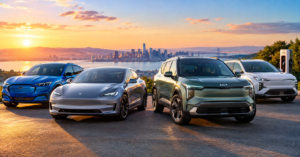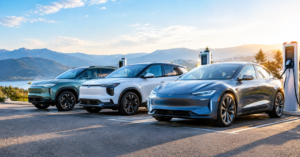

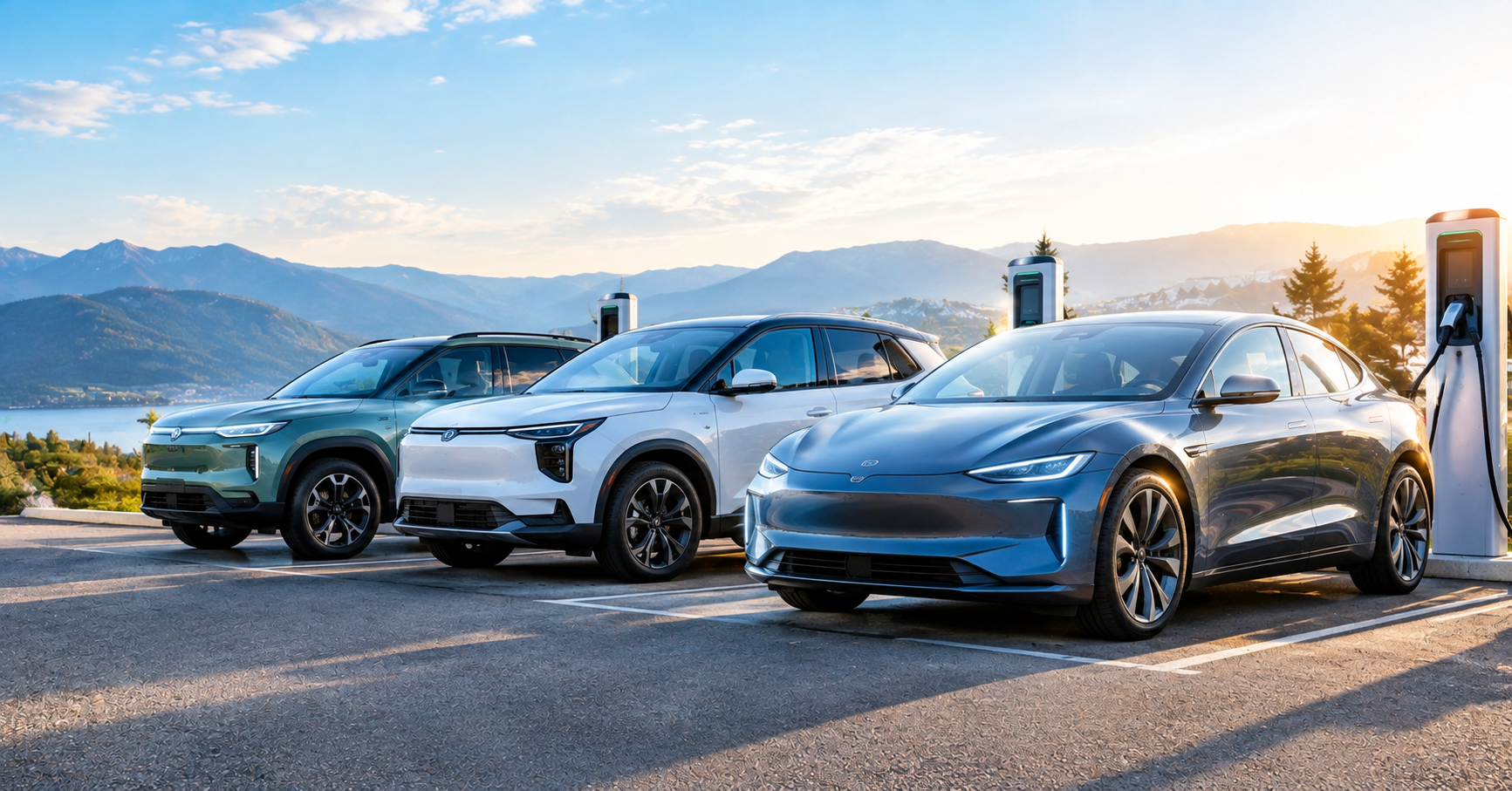
The market for new electric cars 2026 shoppers can choose from is bigger, more varied and more competitive than ever. Buyers can now find affordable EVs near $30,000, family SUVs with three rows, luxury models capable of more than 400 miles of range, and performance cars that bring electric power to traditionally gasoline-focused segments.
That changes the question buyers should ask. Instead of simply looking for the newest technology, shoppers need to consider the entire ownership proposition: price, range, charging, comfort, practicality, reliability signals and the type of driving they actually do.
Our list of new electric cars 2026 focuses on 10 vehicles that stand out for different reasons. Some are strong all-around choices, while others make the list because they offer unusually long range, low pricing, family practicality, luxury or performance.
There is no single EV that is perfect for every driver. The best choice for a commuter may be very different from the best choice for a family or a luxury buyer. The goal here is to show where each model fits and what trade-offs shoppers should understand before buying.
How We Chose the Best New Electric Cars 2026
The 10 vehicles below were selected from the research provided using several practical factors rather than relying on one ranking alone.
- Expert evaluations: Rankings and recommendations from Edmunds and Kelley Blue Book.
- Range: EPA estimates where available, along with clearly identified manufacturer estimates or independent testing.
- Value: Starting price relative to range, capability and equipment.
- Practicality: Passenger space, cargo utility and everyday usability.
- Charging: DC fast-charging capability and charging-network considerations.
- Reliability signals: Available information from Consumer Reports and other expert evaluations.
- Market diversity: The list includes affordable EVs, sedans, crossovers, family SUVs, luxury models and performance cars.
It is also important to distinguish model-year terminology from calendar-year availability. Several 2027 models, including the Chevrolet Bolt and Kia EV3, are expected to go on sale during calendar year 2026. They are therefore relevant to shoppers researching what they can actually buy during 2026.
10 Best New Electric Cars 2026 Buyers Should Consider
1. 2026 Tesla Model 3
Best for: Buyers seeking a well-rounded electric sedan.
The 2026 Tesla Model 3 has one of the strongest cases in the entire new electric cars 2026 market because it combines range, efficiency, performance, technology and charging access in a familiar sedan package.
Edmunds selected the Model 3 as its Top Rated Electric Car for 2026. The publication gives it an 8.1/10 Edmunds Rating and lists a starting price of about $43,880. Edmunds also recorded 338 miles during its range testing.
That combination is important because an EV’s value is not determined by its sticker price alone. A vehicle that can travel farther between charging stops can be more convenient for drivers who frequently travel long distances.
The Model 3 also benefits from Tesla’s established Supercharger ecosystem and mature software platform. Edmunds testing praised its combination of efficiency, performance, comfort, space, technology and convenience.
There are compromises. The minimalist cabin and heavy reliance on touchscreen controls will not appeal to every driver. Build-quality perceptions have also varied among owners and production periods.
Bottom line: For shoppers who want one EV that performs well across multiple categories, the 2026 Model 3 is one of the strongest all-around candidates.
2. 2026 Hyundai Ioniq 5
Best for: Buyers who prioritize design, space and fast charging.
The Hyundai Ioniq 5 continues to be one of the most compelling electric crossovers available to American buyers. Kelley Blue Book named the 2026 Ioniq 5 its Best Electric Vehicle for the year, following two consecutive years in which the model received the same award.
The Ioniq 5 combines distinctive styling with a practical crossover layout and an 800-volt electrical architecture designed to support rapid DC charging when connected to an appropriately capable charger.
Depending on configuration, range is generally in the mid-200-mile to low-300-mile territory. Pricing starts in the high-$40,000s to low-$50,000s depending on trim and drivetrain.
For shoppers considering new electric cars 2026 for everyday use, the Ioniq 5 offers a useful balance between technology and practicality. It is especially interesting for drivers who value charging speed as much as maximum range.
Its main disadvantage is that some newer competitors offer longer driving ranges. Buyers should also evaluate visibility, technology interfaces and their preferred trim before making a decision.
Bottom line: The Ioniq 5 remains a benchmark electric crossover for buyers who want a distinctive design without giving up everyday practicality.
3. 2026 Hyundai Ioniq 9
Best for: Families needing three rows and long-distance capability.
The Hyundai Ioniq 9 brings something increasingly important to the EV market: a large, three-row electric SUV designed for families.
It starts at roughly $58,955 to $60,555 depending on the source and configuration, while EPA-estimated range reaches as high as 335 miles. Edmunds’ 70-mph highway testing produced results ranging from 315 to 366 miles depending on trim and driving mode.
Charging is another major strength. On a 350-kW charger, the Ioniq 9 can reportedly charge from 10% to 80% in as little as 24 minutes.
The trade-off is reliability. Consumer Reports gives the vehicle a strong road-test assessment and describes it as quick, quiet and comfortable, but it does not recommend the 2026 Ioniq 9 because of below-average predicted reliability.
That distinction is valuable for buyers. A vehicle can deliver excellent performance, comfort and range while still presenting a different ownership risk than a more mature model.
Bottom line: The Ioniq 9 is a compelling choice for families who need three rows, but shoppers should weigh its reliability assessment alongside its impressive road-test results.
4. 2026 Nissan Leaf
Best for: Budget-conscious EV shoppers.
The Nissan Leaf enters 2026 with a major redesign that transforms the familiar EV into a larger, SUV-like hatchback.
Pricing starts at approximately $31,535 to $31,565, depending on the source. Higher trims can reach up to 303 miles of EPA-estimated range, giving the Leaf a much stronger position for buyers who want an affordable EV capable of more than basic urban commuting.
The redesigned interior and updated technology also make the Leaf more competitive in a market where buyers have far more alternatives than they did when the original Leaf debuted.
However, buyers should pay attention to trim selection. Entry-level versions have less range, while charging performance is not positioned as a class leader.
For shoppers comparing new electric cars 2026 on purchase price, the Leaf deserves attention because it brings a recognized EV nameplate into a lower price bracket.
Bottom line: The 2026 Leaf is particularly attractive to buyers who want a practical electric vehicle without moving into $40,000-plus territory.
5. 2027 Chevrolet Bolt
Best for: Buyers focused on the lowest possible new-EV price.
The returning Chevrolet Bolt is one of the most important affordable EVs arriving during the 2026 calendar year, even though it carries a 2027 model-year designation.
Cars.com lists a starting MSRP of $28,995, making it the only EV identified in the research with a base price below $30,000 at the time of reporting.
The Bolt is expected to deliver an EPA-estimated 262 miles of range and 120 MPGe combined. That gives it an interesting value proposition for urban drivers, commuters and first-time EV buyers.
The compromise is packaging. Its smaller interior and cargo area cannot match larger electric crossovers, while DC fast charging is adequate rather than class-leading.
Still, the importance of the Bolt is difficult to overlook. With the federal EV credit gone, an EV starting below $30,000 can materially change the affordability equation.
Bottom line: If minimizing the purchase price is your primary objective, the Bolt is one of the most significant electric vehicles to watch during 2026.
6. 2026 Lucid Gravity
Best for: Luxury buyers who prioritize range and performance.
The Lucid Gravity represents the opposite end of the EV market from the Chevrolet Bolt. It is a premium electric SUV aimed at buyers willing to spend significantly more for range, performance and technology.
The Gravity starts around $81,550 in Touring form. The Grand Touring version can produce up to 828 horsepower and offers up to 450 miles of EPA-estimated range.
That 450-mile figure makes the Gravity one of the standout long-range EVs in the market. However, independent testing illustrates why shoppers should distinguish between official ratings and real-world results.
Edmunds recorded 388 miles with summer tires and 400 miles with all-season tires in its range testing.
The Gravity also offers rapid performance, with high-output versions capable of reaching 60 mph in the mid-three-second range.
The drawbacks are straightforward: price and ownership considerations. The higher trims become extremely expensive, while Lucid’s service network remains smaller than those of established luxury automakers. Some reviews have also noted early software issues.
Bottom line: The Gravity is not a value EV, but it demonstrates how far electric SUVs have advanced in range, performance and technology.
7. 2026 Dodge Charger Daytona
Best for: Drivers who want an electric performance car with muscle-car character.
The Dodge Charger Daytona takes a very different approach to electrification. Instead of presenting itself primarily as an efficiency-focused commuter, it brings electric power into the muscle-car conversation.
Kelley Blue Book gives the 2026 Charger Daytona a 4.5/5 rating on its best electric cars list. The model starts around $61,990 and has an estimated range of approximately 267 miles.
Its dual-motor all-wheel-drive configurations emphasize performance, while the availability of a four-door body style makes the concept more practical for everyday use than a traditional two-seat performance car.
The biggest compromise is range. At roughly 267 miles, the Charger Daytona cannot compete with the longest-range electric sedans and SUVs in this group.
But range is not the only reason people buy performance cars. For enthusiasts, character, acceleration and design can matter just as much.
Bottom line: The Charger Daytona makes sense for buyers who want an EV without giving up the emotional appeal associated with American performance cars.
8. 2026 Lexus ES 350e
Best for: Luxury sedan shoppers focused on comfort and dependability.
The Lexus ES 350e gives traditional luxury-sedan buyers another path into the electric market. Its starting MSRP is about $48,895, while EPA-estimated range reaches 307 miles.
That combination puts the ES 350e in an interesting position. It offers more than 300 miles of estimated range without entering the six-figure territory occupied by some premium electric SUVs.
The Lexus name also gives buyers a familiar luxury dealer network and a brand reputation centered on build quality and dependability.
However, the ES 350e is not aimed at drivers searching for the most aggressive performance or most futuristic cabin. Its appeal is more focused on comfort, quietness and conventional luxury-sedan usability.
Bottom line: The ES 350e is worth considering for buyers who want an electric luxury sedan without making performance the central priority.
9. 2026 Tesla Model Y
Best for: Buyers seeking a mainstream electric crossover.
The redesigned 2026 Tesla Model Y remains one of the most recognizable names in the electric crossover market.
Cars.com lists a starting MSRP of approximately $41,380 and an EPA-estimated range of up to 321 miles. The crossover body provides the cargo flexibility many American buyers want while retaining Tesla’s extensive Supercharger infrastructure.
The Model Y is particularly relevant for buyers who regularly combine commuting, errands and road trips. Its combination of crossover packaging, efficiency and charging access addresses several practical concerns at once.
There are still compromises. Ride firmness, minimalist interior design and discussions around build-quality consistency may influence some buyers more than others.
The redesigned 2026 model also illustrates a broader consideration when shopping for new electric cars 2026: a new generation can bring meaningful improvements, but buyers should pay close attention to early production experiences and long-term reliability information as it becomes available.
Bottom line: The Model Y remains a logical choice for shoppers who want an electric SUV backed by a large charging ecosystem.
10. 2027 Kia EV3
Best for: Budget-minded crossover shoppers who want long range.
The Kia EV3 is another 2027 model expected to be sold during calendar 2026, and its pricing makes it especially relevant to value-focused buyers.
The base version starts at about $31,385 and uses a 58.3-kWh battery with 201 horsepower and 221 miles of range. A Wind version with an 81.4-kWh battery can reach up to 321 miles of range.
That creates an unusual choice: buyers can prioritize a lower purchase price or spend more for a much larger battery and significantly greater range.
The EV3 is smaller than a three-row family SUV, but its compact crossover format makes it better suited to shoppers who primarily need an efficient daily vehicle.
Charging speed and outright performance are not its primary strengths, but its combination of price and long-range capability makes it one of the most interesting affordable EVs entering the U.S. market.
Bottom line: The EV3 could appeal strongly to buyers who want crossover styling and long-range capability without paying luxury-EV prices.
Honorable Mentions
The 10 models above are not the only noteworthy EVs entering the 2026 market. Several alternatives deserve consideration depending on a buyer’s priorities.
2026 BMW i5
Edmunds highly recommends the BMW i5, highlighting its refined driving experience and strong real-world range. Edmunds recorded 321 miles during its range testing.
Audi A6 Sportback E-Tron
The Audi A6 Sportback E-Tron is another Edmunds highly recommended EV. Edmunds recorded up to 392 miles in its range testing, making it particularly interesting for buyers who frequently travel long distances.
2026 Rivian R2
The Rivian R2 is a midsize electric SUV with a starting price of approximately $59,485 and about 330 miles of EPA-estimated range. Its off-road credentials add another dimension for buyers who want an EV that can leave paved roads.
How Long Is the Range of New Electric Cars 2026 Buyers Can Get?
Range has become one of the biggest differentiators in the 2026 EV market. Several vehicles now approach or exceed 400 miles, although shoppers must distinguish between EPA estimates, manufacturer claims and independent testing.
- Lucid Gravity: up to 450 miles EPA-estimated.
- Mercedes-Benz GLC400 4Matic Electric: up to 443 miles claimed.
- BMW iX5: up to 435 miles manufacturer-estimated.
- Cadillac Escalade IQL: 460 miles manufacturer-estimated.
- Kia EV3: up to 321 miles.
- Nissan Leaf: up to 303 miles.
These figures should not be treated as directly interchangeable. EPA testing is a standardized benchmark, while manufacturer estimates may be based on different testing conditions. Independent road tests can also produce different results.
For most buyers, the smarter question is not simply, “Which EV has the longest range?” Instead, ask how much range is actually necessary for your normal driving.
A commuter who drives 40 miles per day may gain little practical benefit from paying a large premium for a 450-mile EV. A driver who regularly crosses multiple states may place much greater value on long-range capability and fast charging.
The Federal EV Tax Credit Is No Longer Available for 2026 Purchases
One of the biggest financial changes for new electric cars 2026 shoppers is the expiration of the federal clean-vehicle credit.
The credit of up to $7,500 applied to qualifying vehicles placed in service on or before September 30, 2025. Vehicles purchased and placed in service on or after October 1, 2025 do not qualify for that federal new-vehicle credit under the rules described in the research.
That means buyers shopping for a new EV during calendar 2026 should not build their budget around receiving a $7,500 federal incentive.
Instead, compare the actual transaction price and investigate any manufacturer or dealer incentives that may be available at the time of purchase.
What Should You Check Before Buying a 2026 EV?
The expanding EV market makes comparison shopping more important, not less. A vehicle can look excellent on paper but still be the wrong choice for a particular household.
- Calculate your real driving needs.Look at your typical daily mileage and your longest regular trips before paying extra for additional range.
- Check charging at home.Home charging can dramatically affect the convenience of EV ownership. Make sure your parking situation can accommodate the charging setup you need.
- Study public charging where you drive.Long-distance EV ownership depends heavily on charger availability, reliability and location.
- Compare DC fast-charging capability.Two EVs with similar range can provide very different road-trip experiences if one charges substantially faster.
- Compare total ownership costs.Purchase price is only one part of the equation. Consider insurance, maintenance, charging and expected ownership costs.
- Check reliability information.Especially for newly redesigned EVs, look beyond performance scores. Consumer Reports and other independent sources can provide useful reliability signals as more ownership data becomes available.
- Evaluate the warranty.Battery and vehicle warranties are important considerations when comparing electric models.
- Test the technology yourself.Try the infotainment system, phone connectivity, navigation, charging controls and driver displays before committing to a purchase.
Are New Electric Cars 2026 Better Than Earlier EVs?
In several respects, the 2026 market shows how quickly EV technology is developing.
Buyers have more body styles, wider price ranges, longer driving ranges and increasingly sophisticated charging systems than earlier EV shoppers had.
There are also more choices for buyers who do not want a traditional sedan. The market now includes compact crossovers, three-row SUVs, luxury SUVs and performance-oriented vehicles.
But newer does not automatically mean better for every buyer.
Rapid product development can introduce another risk: many of the vehicles arriving for 2026 and 2027 are new or substantially redesigned. A mature vehicle may have a longer track record, while an all-new model has less long-term ownership data.
The Hyundai Ioniq 9 illustrates this perfectly. Its road-test performance is impressive, but Consumer Reports’ below-average predicted reliability assessment demonstrates why buyers should examine more than one category before making a decision.
Gas, Hybrid or EV: When Does an Electric Car Make Sense?
An EV makes the most sense when its advantages align with how you drive.
For drivers with convenient home charging, daily commuting can be particularly straightforward. Drivers who frequently travel long distances should pay more attention to highway range, fast-charging speed and charger availability.
Buyers without reliable access to home charging may need to depend heavily on public charging. In that situation, the local charging network becomes just as important as the vehicle itself.
Price is another major factor in 2026 because the federal incentive is gone. Affordable models such as the Chevrolet Bolt and Nissan Leaf therefore take on greater importance for budget-conscious shoppers.
Luxury buyers have a different equation. Vehicles such as the Lucid Gravity offer levels of range and performance that may justify their higher prices for shoppers who prioritize those attributes.
Which New Electric Car Is Right for You?
The best EV depends heavily on the buyer.
- Best overall sedan: 2026 Tesla Model 3.
- Best electric crossover: 2026 Hyundai Ioniq 5.
- Best family three-row EV: 2026 Hyundai Ioniq 9.
- Best affordable established EV: 2026 Nissan Leaf.
- Lowest-price new EV: 2027 Chevrolet Bolt.
- Best long-range luxury SUV: 2026 Lucid Gravity.
- Best electric muscle car: 2026 Dodge Charger Daytona.
- Best luxury electric sedan for comfort-focused buyers: 2026 Lexus ES 350e.
- Best mainstream electric crossover with established charging access: 2026 Tesla Model Y.
- Best affordable long-range crossover candidate: 2027 Kia EV3.
That variety is ultimately what makes the current generation of EVs so interesting. The market is no longer built around a handful of expensive electric models. Buyers can now choose among vehicles designed for very different budgets and lifestyles.
Frequently Asked Questions
Is there still a federal EV tax credit in 2026?
No. The federal clean-vehicle credit of up to $7,500 applied to qualifying vehicles placed in service on or before September 30, 2025. New EVs purchased and placed in service on or after October 1, 2025 do not qualify for that federal new-vehicle credit under the rules covered by this research.
What is the best electric car to buy in 2026?
There is no single best EV for every buyer. Edmunds named the 2026 Tesla Model 3 its Top Rated Electric Car for 2026, while Kelley Blue Book named the 2026 Hyundai Ioniq 5 its Best Electric Vehicle. The right choice depends on price, range, charging, vehicle type and personal priorities.
What is the cheapest new EV in 2026?
The 2027 Chevrolet Bolt, which goes on sale during calendar 2026, is listed at a starting MSRP of $28,995 in the research. The 2027 Kia EV3 and 2026 Nissan Leaf are positioned slightly above it in the low-$31,000 range.
Which electric car has the longest range in 2026?
The 2026 Lucid Gravity offers up to 450 miles of EPA-estimated range on the Grand Touring trim. Other long-range models include the 2027 BMW iX5 and 2026 Mercedes-Benz GLC400 4Matic Electric, although their cited figures are manufacturer claims rather than directly comparable EPA figures.
Is the 2026 Hyundai Ioniq 9 reliable?
Reliability data should be treated separately from driving performance. Consumer Reports gives the Ioniq 9 a strong road-test assessment but does not recommend it because of below-average predicted reliability. That makes it important for shoppers to consider both categories rather than relying on its performance score alone.
Are EVs cheaper to own than gasoline cars?
Operating and maintenance costs can be lower for EVs, particularly for drivers with high annual mileage, but the total financial picture varies by vehicle, electricity costs, insurance, maintenance, purchase price and charging setup. Buyers should compare total ownership costs rather than assuming every EV will automatically cost less.
Should I buy a 2026 EV or wait for a 2027 model?
Several 2027 EVs are already scheduled to go on sale during calendar 2026, including the Chevrolet Bolt and Kia EV3. Waiting can make sense for buyers who want a newer design, while buying an available 2026 model may make more sense for someone who finds the right price and configuration now.
What should I prioritize when choosing a new EV?
Start with your actual driving pattern. Range, charging speed, home-charging access, purchase price, passenger and cargo requirements, reliability information and total ownership costs should all be considered together.
The Bottom Line
The new electric cars 2026 market is no longer defined by a small group of expensive early-adopter vehicles. Buyers can choose from affordable EVs, mainstream sedans and crossovers, three-row family SUVs, luxury models and electric performance cars.
The end of the federal $7,500 clean-vehicle credit changes the economics, but it does not eliminate the appeal of electric vehicles. Instead, it makes careful comparison more important.
The Tesla Model 3 stands out as an expert-rated all-around sedan, while the Hyundai Ioniq 5 continues to earn strong recognition as a versatile electric crossover. The Nissan Leaf, Chevrolet Bolt and Kia EV3 expand the affordable end of the market, while the Lucid Gravity demonstrates what is possible at the luxury end.
For families, the Hyundai Ioniq 9 brings three-row practicality to the EV market. For enthusiasts, the Dodge Charger Daytona offers a distinctly performance-focused interpretation of electrification. And for traditional luxury-sedan buyers, the Lexus ES 350e provides another path into EV ownership.
The smartest way to shop is not to chase the biggest range number or the newest technology. Match the vehicle to your driving needs, verify charging options, compare the real purchase price, examine reliability information and calculate the cost of ownership.
With that approach, the growing selection of new electric cars 2026 offers more meaningful choices than ever for American buyers.
Sources and Methodology
This article is based on research from Edmunds, Kelley Blue Book, Consumer Reports, Cars.com, Congress.gov and manufacturer-reported specifications. Pricing and range figures can vary by trim, configuration, destination charges and final market conditions. EPA-estimated figures are identified separately from manufacturer estimates and independent testing where applicable.
Because several vehicles are newly redesigned or entering the market for the first time, long-term reliability information may be limited. Expert road-test performance should therefore not be treated as a substitute for long-term dependability data.