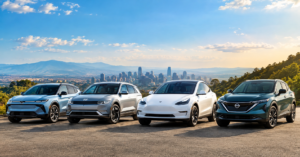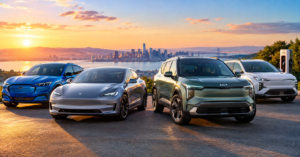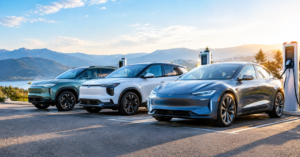

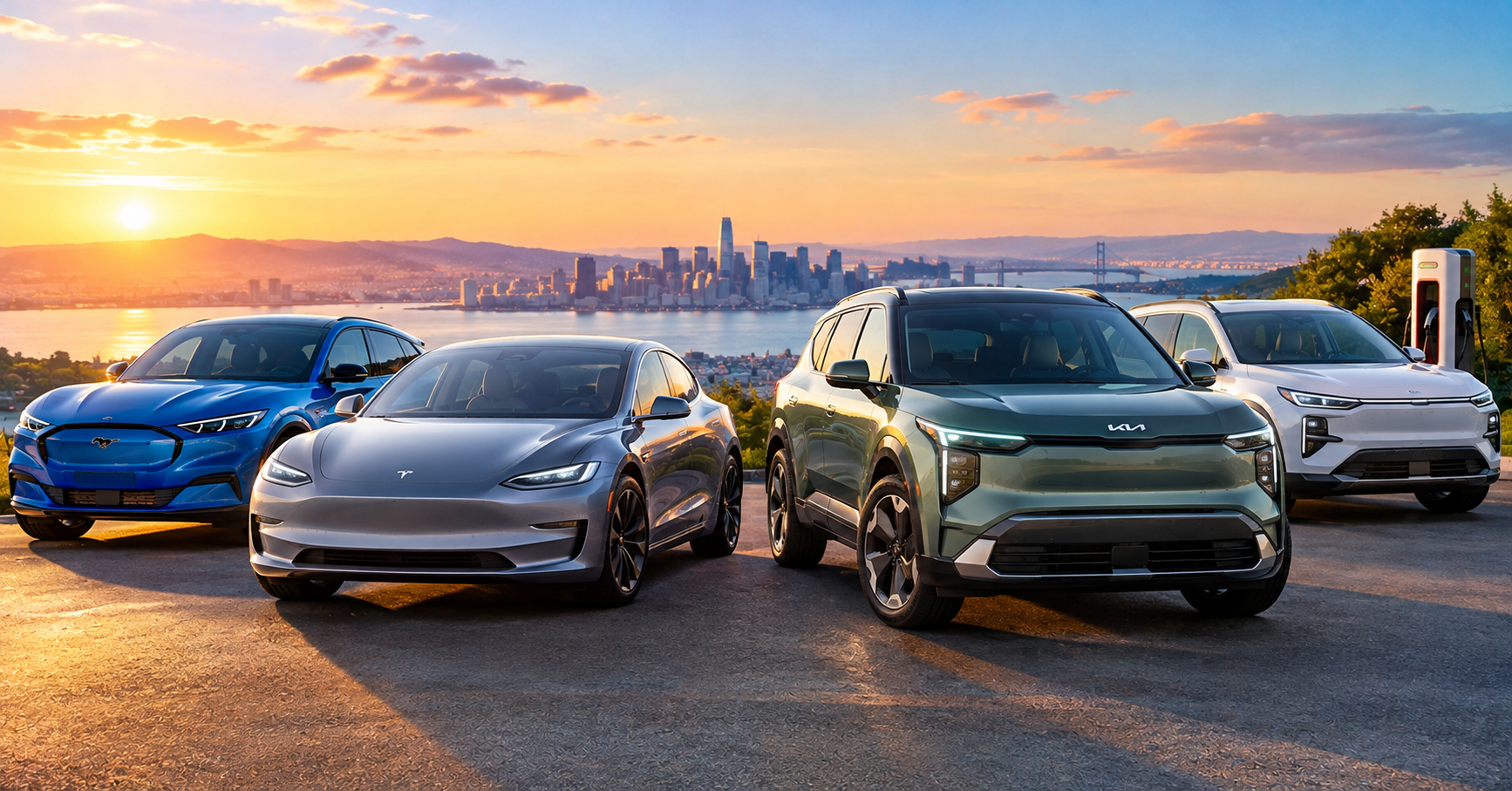
The best electric cars 2026 buyers can choose from look very different from the EVs that defined the market just a few years ago. There are affordable models priced in the low $30,000s, family SUVs with three rows, luxury sedans capable of traveling hundreds of miles between charges, and performance-oriented EVs designed to make electrification feel anything but ordinary.
That makes choosing the right EV more complicated—and more important.
To identify the strongest options, this guide brings together expert awards and testing from Edmunds, Kelley Blue Book, Consumer Reports and Cars.com, along with pricing, range and charging information from the research available for the 2026 U.S. market.
Best Electric Cars 2026: Our Top 10 Picks
There is no single electric vehicle that works for every driver. A commuter looking for an efficient sedan has different priorities from a family that needs three rows, while a luxury buyer may care more about refinement and highway range than purchase price.
With that in mind, the following list focuses on different buyer needs rather than treating every EV as interchangeable.
- 2026 Tesla Model 3 — Best Overall Value
- 2026 Hyundai Ioniq 5 — Best All-Around EV
- 2026 Kia EV9 — Best Three-Row EV
- 2026 Nissan Leaf — Best Affordable EV
- 2026 Tesla Model Y — Best Mainstream Electric SUV
- 2026 Audi A6 Sportback E-Tron — Best Luxury Range
- 2026 BMW i5 — Best Luxury Electric Sedan
- Chevrolet Bolt — Best Budget Choice When Available
- 2026 Ford Mustang Mach-E — Best Sporty Electric SUV
- 2026 Lucid Gravity — Best Long-Range Luxury SUV
1. 2026 Tesla Model 3: Best Overall Value
The 2026 Tesla Model 3 remains one of the strongest all-around choices for shoppers who want an electric sedan without moving into luxury-car pricing.
Edmunds named the 2026 Model 3 its Top Rated Electric Car for 2026, giving it an 8.1 out of 10 rating. The publication cited its combination of price, range, efficiency, comfort and technology.
The Model 3 starts at about $43,880, while Edmunds recorded 338 miles in its independent EV range testing. Those numbers put the sedan in a compelling position for buyers who want substantial highway capability without paying luxury-SUV money.
Edmunds testing director Jonathan Elfalan described the Model 3 as offering a combination of speed, range, comfort, space, technology, accessibility and convenience.
Why buy the Model 3?
- Strong combination of price and range.
- 338 miles in Edmunds’ range test.
- Efficient electric powertrain.
- Extensive access to Tesla’s Supercharger network.
- Strong technology integration.
The biggest compromises are its minimalist cabin and heavy dependence on touchscreen controls. Buyers who prefer traditional physical controls may find the interface less intuitive.
For shoppers searching for the best electric cars 2026 offers at a mainstream price, however, the Model 3 is difficult to overlook.
2. 2026 Hyundai Ioniq 5: Best All-Around EV
The Hyundai Ioniq 5 has established itself as one of the most consistently praised EVs in the U.S. market, and the 2026 model continues that momentum.
Kelley Blue Book selected the 2026 Hyundai Ioniq 5 as its Best Electric Vehicle for 2026. It also marked the fourth consecutive year that the Ioniq 5 received KBB’s EV Best Buy award.
Pricing starts around $36,600 following significant price reductions of up to $9,800, according to the research. Depending on configuration, range reaches approximately 245 to 318 miles.
The Ioniq 5 is particularly attractive because it combines crossover practicality with fast charging. Its 800-volt electrical architecture allows a 10-to-80% DC fast-charge session in about 20 minutes under suitable conditions.
The model also supports NACS charging, while Hyundai provides a 10-year or 100,000-mile powertrain warranty.
Who should buy it?
The Ioniq 5 makes sense for drivers who want an EV that feels different from a conventional sedan but do not need a massive SUV. Its spacious interior, distinctive styling and fast charging make it particularly attractive for daily driving and road trips.
The primary trade-off is that some competitors now offer greater maximum range. Rear visibility and certain technology details may also require an adjustment period.
3. 2026 Kia EV9: Best Three-Row EV
For families, the Kia EV9 solves a problem that many electric vehicles still struggle with: providing genuinely useful three-row space without sacrificing long-distance capability.
Cars.com selected the 2026 Kia EV9 as its Best Electric Vehicle of 2026, while Kelley Blue Book named it the Best 3-Row EV.
The EV9 can deliver up to 305 miles of range, according to the research, and it has access to Tesla Superchargers. Its three-row configuration makes it significantly more practical for larger families than most two-row electric crossovers.
Why the EV9 stands out
- Three-row seating.
- Up to 305 miles of range.
- Fast-charging capability.
- Tesla Supercharger access.
- Family-focused interior packaging.
The EV9 is not the obvious choice for someone who mostly drives alone in a city. Its larger dimensions can make parking and maneuvering more difficult than with a compact EV.
For households that genuinely need three rows, however, the EV9 is one of the most convincing electric family vehicles available.
4. 2026 Nissan Leaf: Best Affordable EV
The Nissan Leaf enters 2026 with a major redesign and a much more modern market position.
Kelley Blue Book selected the 2026 Nissan Leaf as its Best Electric Vehicle Under $35,000. The redesigned Leaf adopts a larger, more SUV-like hatchback shape and offers more than 300 miles of available range in higher trims.
Pricing starts in the low $31,000 range, while the top versions can reach approximately 303 miles of EPA-estimated range.
That combination is important because affordability and range have historically been two of the biggest challenges for mainstream EV shoppers.
Best for budget-conscious drivers
The Leaf is particularly well suited to commuters and buyers who want a practical daily EV without moving into Tesla pricing or premium-brand territory.
The compromises are equally clear. Lower trims offer less range, while charging speed and outright performance are more modest than some newer competitors.
Still, for shoppers focused on purchase price and everyday practicality, the Leaf deserves a place among the best electric cars 2026 has to offer.
5. 2026 Tesla Model Y: Best Mainstream Electric SUV
The Model Y remains one of the most recognizable electric crossovers in America, and the redesigned 2026 version continues to target buyers who want SUV practicality without the size of a three-row vehicle.
Consumer Reports named the Tesla Model Y its best electric vehicle in its 2026 top-vehicle coverage. Its overall evaluation considers road-test performance, predicted reliability, owner satisfaction and safety.
The Model Y starts at approximately $41,380 and offers up to 321 miles of EPA-estimated range.
The crossover’s appeal comes from its combination of efficiency, cargo space, charging infrastructure and familiar Tesla software.
What to consider
Potential buyers should also consider the Model Y’s firmer ride, minimalist interior and reports of variable build quality. Those characteristics may matter more to shoppers comparing it with conventional luxury crossovers.
Nevertheless, its combination of price, range and crossover practicality makes the Model Y a significant contender for buyers who want an electric SUV for daily use.
6. 2026 Audi A6 Sportback E-Tron: Best Luxury Range
The Audi A6 Sportback E-Tron demonstrates how quickly premium EVs have improved in range and refinement.
Edmunds highly recommended the A6 Sportback E-Tron and recorded 392 miles in its EV Range Test with an all-wheel-drive model.
The starting price is around $67,195, placing the Audi well above mainstream EVs such as the Leaf and Model 3.
In return, buyers get a premium interior, a smooth and quiet driving experience and impressive long-distance capability.
Who is it for?
The A6 Sportback E-Tron is aimed at buyers who want an electric vehicle with luxury-car refinement rather than simply the lowest possible purchase price.
Its biggest disadvantage is cost. Buyers who do not value premium materials, ride quality and luxury-brand presentation may get more practical value from less expensive EVs.
7. 2026 BMW i5: Best Luxury Electric Sedan
The BMW i5 is another strong choice for buyers who want the driving character and cabin environment associated with a traditional luxury sedan while switching to electric power.
Edmunds highly recommended the i5 and recorded 321 miles in its range testing.
The 2026 BMW i5 starts at approximately $68,275. That places it firmly in premium territory, but the vehicle is designed for shoppers who prioritize interior quality, ride comfort and driving dynamics.
Unlike some technology-first EVs, the i5 maintains a more familiar luxury-car approach to controls and driving experience.
BMW i5 strengths
- High-quality interior.
- Comfortable ride.
- 321 miles in Edmunds testing.
- Traditional BMW driving character.
- Premium sedan experience.
The main issue is price. At more than $68,000 to start, the i5 is a very different proposition from an Ioniq 5 or Model 3.
8. Chevrolet Bolt: Best Budget Choice When Available
The Chevrolet Bolt remains an important reference point for affordable EV shopping, particularly where remaining dealer inventory is available.
The research lists a $28,995 starting price, 262 miles of EPA-estimated range and 120 MPGe combined. Those figures make the Bolt an unusually accessible option for buyers who primarily want an inexpensive electric commuter.
Its compact hatchback dimensions can be an advantage in urban environments, but they also mean less interior and cargo space than many modern electric crossovers.
DC fast charging is adequate but not class-leading, which matters for drivers who frequently make long-distance trips.
There is also an important model-year consideration: Chevrolet’s newer Bolt timing and availability can vary, and the research identifies the 2027 Bolt as a model going on sale during 2026. Buyers should therefore verify the exact model year and inventory available at a local dealer.
9. 2026 Ford Mustang Mach-E: Best Sporty Electric SUV
The Ford Mustang Mach-E remains one of the more appealing choices for drivers who want an electric crossover with a stronger performance personality.
Consumer Reports and other testers have frequently included the Mach-E among notable electric SUVs because of its combination of range, driving dynamics and everyday usability.
Pricing begins in the mid-$40,000s, while EPA-estimated range generally falls from the mid-200s into the low-300-mile territory depending on battery and drivetrain configuration.
All-wheel drive and performance variants expand the lineup for shoppers who value acceleration and handling as much as efficiency.
Where the Mach-E fits
The Mach-E is a good match for buyers who want an EV that feels more expressive than a conventional commuter crossover.
It is not the roomiest option in the segment. Rear-seat and cargo space can trail larger electric SUVs, and equipment varies substantially between trims.
For drivers who want an electric vehicle with sporty styling and an engaging driving experience, however, the Mach-E remains a compelling choice.
10. 2026 Lucid Gravity: Best Long-Range Luxury SUV
At the opposite end of the affordability spectrum is the Lucid Gravity, an electric SUV designed to combine luxury, performance and unusually long range.
The 2026 Gravity starts around $81,550 for the Touring version. The Grand Touring model can produce up to 828 horsepower and has an EPA-estimated range of up to 450 miles.
Independent Edmunds testing recorded between 388 and 400 miles depending on tire configuration, illustrating why buyers should distinguish between EPA figures and independent real-world testing.
The Gravity is particularly interesting for drivers who want a large luxury SUV without accepting the range limitations that have affected some high-performance EVs.
Why it stands out
- Up to 450 miles of EPA-estimated range.
- Up to 828 horsepower in Grand Touring specification.
- Luxury SUV packaging.
- Strong long-distance capability.
- High-performance electric powertrain.
The obvious drawback is price. Service-network coverage is also less extensive than that of established luxury manufacturers, while early software issues have been noted in reviews.
How We Chose the Best Electric Cars for 2026
This list does not simply rank vehicles by EPA range or horsepower. Those numbers matter, but they do not tell the entire story of owning an EV.
The evaluation combines several factors that are especially relevant to American buyers in 2026.
1. Expert testing and awards
Recognition from Edmunds, Kelley Blue Book, Consumer Reports and Cars.com provides an important independent reference point. Their testing and awards help distinguish vehicles that perform well on paper from those that work well in everyday driving.
2. Range and efficiency
Range is still one of the most important EV shopping factors. But advertised figures should not be treated as guarantees of highway performance.
Consumer Reports notes that real-world EV range can vary significantly from EPA estimates. Weather, speed, temperature, tires and driving conditions can all influence energy consumption.
3. Charging capability
Charging speed can be just as important as battery size. An EV that can rapidly add substantial range during a road trip may be more convenient than a vehicle with a larger battery but slower charging.
4. Price and total value
Because the federal EV purchase credit is no longer available for 2026 purchases, upfront pricing has become more important. Buyers should also consider electricity costs, maintenance, insurance, financing and expected depreciation.
5. Reliability
Reliability deserves special attention when shopping among newly redesigned EVs. Consumer Reports emphasizes that many EVs can experience reliability challenges, particularly during their first model year.
A high road-test score does not automatically mean a vehicle will have excellent long-term reliability.
What Happened to the Federal EV Tax Credit?
One of the biggest changes affecting best electric cars 2026 shoppers is the disappearance of the federal clean-vehicle purchase credit.
The federal credit of up to $7,500 for qualifying new EVs applied to vehicles acquired on or before September 30, 2025. The research indicates that vehicles acquired after that date do not qualify, with only a narrow binding-contract exception.
That means buyers shopping for a new EV in calendar year 2026 should not build their purchase budget around receiving a federal $7,500 incentive.
The federal home-charger credit also ended June 30, 2026, according to the supplied research.
This makes manufacturer discounts, dealer incentives, state programs where available and total ownership costs more important when comparing vehicles.
Are EVs Still Worth Buying in 2026?
For the right driver, yes—but the answer depends heavily on charging access and driving habits.
EV technology has improved considerably. Many current models offer 250 to 350 miles of range, while several premium vehicles can approach or exceed 400 miles under EPA testing or independent evaluation.
Operating costs can also be attractive because electric vehicles do not require gasoline and generally have fewer conventional powertrain maintenance requirements.
But the economics are not identical for every household. Insurance, tire costs, repairs and electricity rates can change the ownership equation.
An EV may make more sense if you:
- Can charge at home overnight.
- Drive predictable daily distances.
- Have reliable public charging available for longer trips.
- Want to reduce gasoline spending.
- Plan to keep the vehicle long enough to benefit from lower operating costs.
A hybrid may make more sense if you:
- Frequently drive long distances without predictable charging.
- Live in an area with limited public charging.
- Want fuel savings without changing your refueling habits.
- Are uncomfortable with the upfront cost of some EVs.
The research indicates that conventional hybrid sales have increased significantly in 2026 as some shoppers seek fuel savings without charging dependence.
How to Choose Among the Best Electric Cars 2026
Instead of starting with a brand name, start with how you actually use your vehicle.
- Calculate your daily mileage. If your commute is short, maximum range may not be worth paying for.
- Check home charging. Overnight charging can dramatically simplify EV ownership.
- Map your regular road trips. Look at charging locations along routes you actually drive.
- Compare DC fast-charging performance. Battery capacity alone does not tell you how quickly an EV can recover range.
- Research reliability. Pay particular attention to new platforms and first-year redesigns.
- Compare warranties. Battery and powertrain coverage can vary considerably.
- Calculate ownership costs. Include insurance, electricity, maintenance, tires and financing—not just MSRP.
- Test the technology. Make sure the infotainment, driver-assistance features and controls work for you.
Range Isn’t the Whole Story
One of the most important lessons for EV shoppers is that range figures should not be compared without knowing how they were produced.
An EPA-estimated figure is not the same as an Edmunds highway test, and neither is necessarily the same as a manufacturer’s preliminary estimate.
For example, the Lucid Gravity is rated for up to 450 miles under EPA testing, while Edmunds recorded 388 to 400 miles in its independent testing depending on tires.
The Audi A6 Sportback E-Tron, meanwhile, recorded 392 miles in Edmunds testing.
Those results demonstrate why independent testing can provide valuable context beyond a specification sheet.
Best Electric Cars 2026 by Buyer Type
Best for most buyers: Tesla Model 3
The Model 3 combines a competitive starting price, strong tested range, efficiency and charging access.
Best crossover value: Hyundai Ioniq 5
The Ioniq 5 stands out for fast charging, flexible packaging and repeated recognition from Kelley Blue Book.
Best family EV: Kia EV9
Three rows and up to 305 miles of range make the EV9 a natural fit for larger households.
Best affordable EV: Nissan Leaf
The redesigned Leaf brings more than 300 miles of available range into a lower-priced segment.
Best luxury sedan: Audi A6 Sportback E-Tron
Its 392-mile Edmunds test result makes the Audi especially interesting for luxury buyers who prioritize highway range.
Best luxury SUV: Lucid Gravity
The Gravity combines a 450-mile EPA-estimated maximum range with high performance, although its price is substantially higher than mainstream alternatives.
FAQ: Best Electric Cars 2026
What is the best electric car to buy in 2026?
There is no single best EV for every buyer. Edmunds selected the 2026 Tesla Model 3 as its Top Rated Electric Car, while Kelley Blue Book named the Hyundai Ioniq 5 its Best Electric Vehicle and Cars.com selected the Kia EV9 as its Best Electric Vehicle of 2026. The right choice depends on budget, body style, range and charging needs.
What is the cheapest new EV in 2026?
The Chevrolet Bolt is listed in the research at $28,995 when available, making it the lowest-priced option discussed. The 2026 Nissan Leaf starts in the low $31,000s and is Kelley Blue Book’s Best Electric Vehicle Under $35,000.
Is there a federal EV tax credit in 2026?
No. The federal new-EV credit of up to $7,500 ended for vehicles acquired after September 30, 2025, subject to a narrow binding-contract exception. Buyers purchasing new EVs in calendar year 2026 should not assume they qualify for the former federal purchase credit.
Which EV has the longest range in 2026?
The 2026 Lucid Gravity Grand Touring is listed with up to 450 miles of EPA-estimated range. Other long-range EVs, including the Audi A6 Sportback E-Tron, can also deliver exceptional results, although independent testing and EPA ratings should be compared separately.
Are electric cars reliable in 2026?
Reliability varies by model and model year. Consumer Reports warns that many EVs can have reliability issues, particularly in their first model year. Buyers should examine predicted reliability separately from road-test performance.
Is the Hyundai Ioniq 5 still a good EV in 2026?
Yes. Kelley Blue Book named the 2026 Ioniq 5 its Best Electric Vehicle for 2026, marking its fourth consecutive year receiving the EV Best Buy award. Its combination of price, range, interior space and fast charging remains a major strength.
Is the Kia EV9 a good family EV?
The EV9 is specifically suited to families that need three rows. It offers up to 305 miles of range and access to Tesla Superchargers, while Kelley Blue Book named it the Best 3-Row EV for 2026.
Should I buy an EV or a hybrid in 2026?
The answer depends on your driving and charging situation. An EV can be particularly convenient for drivers with home charging and predictable daily mileage. A hybrid may be more practical for drivers who frequently travel long distances or have limited access to charging.
The Bottom Line
The 2026 EV market is broader and more capable than ever, but it also demands a more careful buying decision.
The strongest choices cover very different needs. The Tesla Model 3 delivers a compelling balance of range, efficiency and price. The Hyundai Ioniq 5 remains a standout crossover. The Kia EV9 brings genuine three-row practicality to the EV segment, while the Nissan Leaf makes long-range electric driving more accessible.
At the luxury end, the Audi A6 Sportback E-Tron, BMW i5 and Lucid Gravity demonstrate how far electric vehicles have progressed in range, comfort and refinement.
The most important change for shoppers is financial. With the federal EV tax credit no longer available for 2026 purchases, the strongest value now comes from evaluating the entire ownership equation rather than relying on incentives.
Ultimately, the best electric cars 2026 shoppers should consider are the ones that match their actual driving patterns. For some buyers, that will mean a Model 3 or Ioniq 5. For others, it could mean a three-row EV9, affordable Leaf or long-range luxury Gravity.
The technology is no longer the only question. In 2026, the better question is which EV fits your life, your charging access and your budget most convincingly.
{
“@context”: “https://schema.org”,
“@type”: “FAQPage”,
“mainEntity”: [
{
“@type”: “Question”,
“name”: “What is the best electric car to buy in 2026?”,
“acceptedAnswer”: {
“@type”: “Answer”,
“text”: “There is no single best EV for every buyer. Edmunds selected the 2026 Tesla Model 3 as its Top Rated Electric Car, Kelley Blue Book named the Hyundai Ioniq 5 its Best Electric Vehicle, and Cars.com selected the Kia EV9 as its Best Electric Vehicle of 2026.”
}
},
{
“@type”: “Question”,
“name”: “What is the cheapest new EV in 2026?”,
“acceptedAnswer”: {
“@type”: “Answer”,
“text”: “The Chevrolet Bolt is listed in the research at $28,995 when available. The 2026 Nissan Leaf starts in the low $31,000s and is Kelley Blue Book’s Best Electric Vehicle Under $35,000.”
}
},
{
“@type”: “Question”,
“name”: “Is there a federal EV tax credit in 2026?”,
“acceptedAnswer”: {
“@type”: “Answer”,
“text”: “No. The federal new-EV credit of up to $7,500 ended for vehicles acquired after September 30, 2025, subject to a narrow binding-contract exception.”
}
},
{
“@type”: “Question”,
“name”: “Which EV has the longest range in 2026?”,
“acceptedAnswer”: {
“@type”: “Answer”,
“text”: “The 2026 Lucid Gravity Grand Touring is listed with up to 450 miles of EPA-estimated range. Other long-range EVs, including the Audi A6 Sportback E-Tron, also offer exceptional range.”
}
},
{
“@type”: “Question”,
“name”: “Are electric cars reliable in 2026?”,
“acceptedAnswer”: {
“@type”: “Answer”,
“text”: “Reliability varies by model and model year. Consumer Reports notes that many EVs can have reliability issues, particularly in their first model year, so predicted reliability should be considered separately from road-test performance.”
}
},
{
“@type”: “Question”,
“name”: “Is the Hyundai Ioniq 5 still a good EV in 2026?”,
“acceptedAnswer”: {
“@type”: “Answer”,
“text”: “Yes. Kelley Blue Book named the 2026 Hyundai Ioniq 5 its Best Electric Vehicle for 2026, marking its fourth consecutive year receiving the EV Best Buy award.”
}
},
{
“@type”: “Question”,
“name”: “Is the Kia EV9 a good family EV?”,
“acceptedAnswer”: {
“@type”: “Answer”,
“text”: “The Kia EV9 is well suited to families that need three rows. It offers up to 305 miles of range and access to Tesla Superchargers, while Kelley Blue Book named it the Best 3-Row EV for 2026.”
}
},
{
“@type”: “Question”,
“name”: “Should I buy an EV or a hybrid in 2026?”,
“acceptedAnswer”: {
“@type”: “Answer”,
“text”: “The answer depends on driving and charging needs. EVs can be particularly convenient for drivers with home charging and predictable daily mileage, while hybrids may be more practical for drivers who frequently travel long distances or have limited charging access.”
}
}
]
}
Best Electric Cars 2026: 10 Top Picks Worth Buying
The best electric cars 2026 buyers can choose from look very different from the EVs that defined the market just a few years ago. There are affordable models priced in the low $30,000s, family SUVs with three rows, luxury sedans capable of traveling hundreds of miles between charges, and performance-oriented EVs designed to make electrification feel anything but ordinary.
But 2026 also brings a major change for shoppers: the federal $7,500 new-EV tax credit is no longer available for vehicles purchased after September 30, 2025. That means buyers have to judge today’s electric vehicles more heavily on their actual value, including purchase price, range, charging capability, reliability, practicality and long-term ownership costs.
That makes choosing the right EV more complicated—and more important.
To identify the strongest options, this guide brings together expert awards and testing from Edmunds, Kelley Blue Book, Consumer Reports and Cars.com, along with pricing, range and charging information from the research available for the 2026 U.S. market.
Best Electric Cars 2026: Our Top 10 Picks
There is no single electric vehicle that works for every driver. A commuter looking for an efficient sedan has different priorities from a family that needs three rows, while a luxury buyer may care more about refinement and highway range than purchase price.
With that in mind, the following list focuses on different buyer needs rather than treating every EV as interchangeable.
- 2026 Tesla Model 3 — Best Overall Value
- 2026 Hyundai Ioniq 5 — Best All-Around EV
- 2026 Kia EV9 — Best Three-Row EV
- 2026 Nissan Leaf — Best Affordable EV
- 2026 Tesla Model Y — Best Mainstream Electric SUV
- 2026 Audi A6 Sportback E-Tron — Best Luxury Range
- 2026 BMW i5 — Best Luxury Electric Sedan
- Chevrolet Bolt — Best Budget Choice When Available
- 2026 Ford Mustang Mach-E — Best Sporty Electric SUV
- 2026 Lucid Gravity — Best Long-Range Luxury SUV
1. 2026 Tesla Model 3: Best Overall Value
The 2026 Tesla Model 3 remains one of the strongest all-around choices for shoppers who want an electric sedan without moving into luxury-car pricing.
Edmunds named the 2026 Model 3 its Top Rated Electric Car for 2026, giving it an 8.1 out of 10 rating. The publication cited its combination of price, range, efficiency, comfort and technology.
The Model 3 starts at about $43,880, while Edmunds recorded 338 miles in its independent EV range testing. Those numbers put the sedan in a compelling position for buyers who want substantial highway capability without paying luxury-SUV money.
Edmunds testing director Jonathan Elfalan described the Model 3 as offering a combination of speed, range, comfort, space, technology, accessibility and convenience.
Why buy the Model 3?
- Strong combination of price and range.
- 338 miles in Edmunds’ range test.
- Efficient electric powertrain.
- Extensive access to Tesla’s Supercharger network.
- Strong technology integration.
The biggest compromises are its minimalist cabin and heavy dependence on touchscreen controls. Buyers who prefer traditional physical controls may find the interface less intuitive.
For shoppers searching for the best electric cars 2026 offers at a mainstream price, however, the Model 3 is difficult to overlook.
2. 2026 Hyundai Ioniq 5: Best All-Around EV
The Hyundai Ioniq 5 has established itself as one of the most consistently praised EVs in the U.S. market, and the 2026 model continues that momentum.
Kelley Blue Book selected the 2026 Hyundai Ioniq 5 as its Best Electric Vehicle for 2026. It also marked the fourth consecutive year that the Ioniq 5 received KBB’s EV Best Buy award.
Pricing starts around $36,600 following significant price reductions of up to $9,800, according to the research. Depending on configuration, range reaches approximately 245 to 318 miles.
The Ioniq 5 is particularly attractive because it combines crossover practicality with fast charging. Its 800-volt electrical architecture allows a 10-to-80% DC fast-charge session in about 20 minutes under suitable conditions.
The model also supports NACS charging, while Hyundai provides a 10-year or 100,000-mile powertrain warranty.
Who should buy it?
The Ioniq 5 makes sense for drivers who want an EV that feels different from a conventional sedan but do not need a massive SUV. Its spacious interior, distinctive styling and fast charging make it particularly attractive for daily driving and road trips.
The primary trade-off is that some competitors now offer greater maximum range. Rear visibility and certain technology details may also require an adjustment period.
3. 2026 Kia EV9: Best Three-Row EV
For families, the Kia EV9 solves a problem that many electric vehicles still struggle with: providing genuinely useful three-row space without sacrificing long-distance capability.
Cars.com selected the 2026 Kia EV9 as its Best Electric Vehicle of 2026, while Kelley Blue Book named it the Best 3-Row EV.
The EV9 can deliver up to 305 miles of range, according to the research, and it has access to Tesla Superchargers. Its three-row configuration makes it significantly more practical for larger families than most two-row electric crossovers.
Why the EV9 stands out
- Three-row seating.
- Up to 305 miles of range.
- Fast-charging capability.
- Tesla Supercharger access.
- Family-focused interior packaging.
The EV9 is not the obvious choice for someone who mostly drives alone in a city. Its larger dimensions can make parking and maneuvering more difficult than with a compact EV.
For households that genuinely need three rows, however, the EV9 is one of the most convincing electric family vehicles available.
4. 2026 Nissan Leaf: Best Affordable EV
The Nissan Leaf enters 2026 with a major redesign and a much more modern market position.
Kelley Blue Book selected the 2026 Nissan Leaf as its Best Electric Vehicle Under $35,000. The redesigned Leaf adopts a larger, more SUV-like hatchback shape and offers more than 300 miles of available range in higher trims.
Pricing starts in the low $31,000 range, while the top versions can reach approximately 303 miles of EPA-estimated range.
That combination is important because affordability and range have historically been two of the biggest challenges for mainstream EV shoppers.
Best for budget-conscious drivers
The Leaf is particularly well suited to commuters and buyers who want a practical daily EV without moving into Tesla pricing or premium-brand territory.
The compromises are equally clear. Lower trims offer less range, while charging speed and outright performance are more modest than some newer competitors.
Still, for shoppers focused on purchase price and everyday practicality, the Leaf deserves a place among the best electric cars 2026 has to offer.
5. 2026 Tesla Model Y: Best Mainstream Electric SUV
The Model Y remains one of the most recognizable electric crossovers in America, and the redesigned 2026 version continues to target buyers who want SUV practicality without the size of a three-row vehicle.
Consumer Reports named the Tesla Model Y its best electric vehicle in its 2026 top-vehicle coverage. Its overall evaluation considers road-test performance, predicted reliability, owner satisfaction and safety.
The Model Y starts at approximately $41,380 and offers up to 321 miles of EPA-estimated range.
The crossover’s appeal comes from its combination of efficiency, cargo space, charging infrastructure and familiar Tesla software.
What to consider
Potential buyers should also consider the Model Y’s firmer ride, minimalist interior and reports of variable build quality. Those characteristics may matter more to shoppers comparing it with conventional luxury crossovers.
Nevertheless, its combination of price, range and crossover practicality makes the Model Y a significant contender for buyers who want an electric SUV for daily use.
6. 2026 Audi A6 Sportback E-Tron: Best Luxury Range
The Audi A6 Sportback E-Tron demonstrates how quickly premium EVs have improved in range and refinement.
Edmunds highly recommended the A6 Sportback E-Tron and recorded 392 miles in its EV Range Test with an all-wheel-drive model.
The starting price is around $67,195, placing the Audi well above mainstream EVs such as the Leaf and Model 3.
In return, buyers get a premium interior, a smooth and quiet driving experience and impressive long-distance capability.
Who is it for?
The A6 Sportback E-Tron is aimed at buyers who want an electric vehicle with luxury-car refinement rather than simply the lowest possible purchase price.
Its biggest disadvantage is cost. Buyers who do not value premium materials, ride quality and luxury-brand presentation may get more practical value from less expensive EVs.
7. 2026 BMW i5: Best Luxury Electric Sedan
The BMW i5 is another strong choice for buyers who want the driving character and cabin environment associated with a traditional luxury sedan while switching to electric power.
Edmunds highly recommended the i5 and recorded 321 miles in its range testing.
The 2026 BMW i5 starts at approximately $68,275. That places it firmly in premium territory, but the vehicle is designed for shoppers who prioritize interior quality, ride comfort and driving dynamics.
Unlike some technology-first EVs, the i5 maintains a more familiar luxury-car approach to controls and driving experience.
BMW i5 strengths
- High-quality interior.
- Comfortable ride.
- 321 miles in Edmunds testing.
- Traditional BMW driving character.
- Premium sedan experience.
The main issue is price. At more than $68,000 to start, the i5 is a very different proposition from an Ioniq 5 or Model 3.
8. Chevrolet Bolt: Best Budget Choice When Available
The Chevrolet Bolt remains an important reference point for affordable EV shopping, particularly where remaining dealer inventory is available.
The research lists a $28,995 starting price, 262 miles of EPA-estimated range and 120 MPGe combined. Those figures make the Bolt an unusually accessible option for buyers who primarily want an inexpensive electric commuter.
Its compact hatchback dimensions can be an advantage in urban environments, but they also mean less interior and cargo space than many modern electric crossovers.
DC fast charging is adequate but not class-leading, which matters for drivers who frequently make long-distance trips.
There is also an important model-year consideration: Chevrolet’s newer Bolt timing and availability can vary, and the research identifies the 2027 Bolt as a model going on sale during 2026. Buyers should therefore verify the exact model year and inventory available at a local dealer.
9. 2026 Ford Mustang Mach-E: Best Sporty Electric SUV
The Ford Mustang Mach-E remains one of the more appealing choices for drivers who want an electric crossover with a stronger performance personality.
Consumer Reports and other testers have frequently included the Mach-E among notable electric SUVs because of its combination of range, driving dynamics and everyday usability.
Pricing begins in the mid-$40,000s, while EPA-estimated range generally falls from the mid-200s into the low-300-mile territory depending on battery and drivetrain configuration.
All-wheel drive and performance variants expand the lineup for shoppers who value acceleration and handling as much as efficiency.
Where the Mach-E fits
The Mach-E is a good match for buyers who want an EV that feels more expressive than a conventional commuter crossover.
It is not the roomiest option in the segment. Rear-seat and cargo space can trail larger electric SUVs, and equipment varies substantially between trims.
For drivers who want an electric vehicle with sporty styling and an engaging driving experience, however, the Mach-E remains a compelling choice.
10. 2026 Lucid Gravity: Best Long-Range Luxury SUV
At the opposite end of the affordability spectrum is the Lucid Gravity, an electric SUV designed to combine luxury, performance and unusually long range.
The 2026 Gravity starts around $81,550 for the Touring version. The Grand Touring model can produce up to 828 horsepower and has an EPA-estimated range of up to 450 miles.
Independent Edmunds testing recorded between 388 and 400 miles depending on tire configuration, illustrating why buyers should distinguish between EPA figures and independent real-world testing.
The Gravity is particularly interesting for drivers who want a large luxury SUV without accepting the range limitations that have affected some high-performance EVs.
Why it stands out
- Up to 450 miles of EPA-estimated range.
- Up to 828 horsepower in Grand Touring specification.
- Luxury SUV packaging.
- Strong long-distance capability.
- High-performance electric powertrain.
The obvious drawback is price. Service-network coverage is also less extensive than that of established luxury manufacturers, while early software issues have been noted in reviews.
How We Chose the Best Electric Cars for 2026
This list does not simply rank vehicles by EPA range or horsepower. Those numbers matter, but they do not tell the entire story of owning an EV.
The evaluation combines several factors that are especially relevant to American buyers in 2026.
1. Expert testing and awards
Recognition from Edmunds, Kelley Blue Book, Consumer Reports and Cars.com provides an important independent reference point. Their testing and awards help distinguish vehicles that perform well on paper from those that work well in everyday driving.
2. Range and efficiency
Range is still one of the most important EV shopping factors. But advertised figures should not be treated as guarantees of highway performance.
Consumer Reports notes that real-world EV range can vary significantly from EPA estimates. Weather, speed, temperature, tires and driving conditions can all influence energy consumption.
3. Charging capability
Charging speed can be just as important as battery size. An EV that can rapidly add substantial range during a road trip may be more convenient than a vehicle with a larger battery but slower charging.
4. Price and total value
Because the federal EV purchase credit is no longer available for 2026 purchases, upfront pricing has become more important. Buyers should also consider electricity costs, maintenance, insurance, financing and expected depreciation.
5. Reliability
Reliability deserves special attention when shopping among newly redesigned EVs. Consumer Reports emphasizes that many EVs can experience reliability challenges, particularly during their first model year.
A high road-test score does not automatically mean a vehicle will have excellent long-term reliability.
What Happened to the Federal EV Tax Credit?
One of the biggest changes affecting best electric cars 2026 shoppers is the disappearance of the federal clean-vehicle purchase credit.
The federal credit of up to $7,500 for qualifying new EVs applied to vehicles acquired on or before September 30, 2025. The research indicates that vehicles acquired after that date do not qualify, with only a narrow binding-contract exception.
That means buyers shopping for a new EV in calendar year 2026 should not build their purchase budget around receiving a federal $7,500 incentive.
The federal home-charger credit also ended June 30, 2026, according to the supplied research.
This makes manufacturer discounts, dealer incentives, state programs where available and total ownership costs more important when comparing vehicles.
Are EVs Still Worth Buying in 2026?
For the right driver, yes—but the answer depends heavily on charging access and driving habits.
EV technology has improved considerably. Many current models offer 250 to 350 miles of range, while several premium vehicles can approach or exceed 400 miles under EPA testing or independent evaluation.
Operating costs can also be attractive because electric vehicles do not require gasoline and generally have fewer conventional powertrain maintenance requirements.
But the economics are not identical for every household. Insurance, tire costs, repairs and electricity rates can change the ownership equation.
An EV may make more sense if you:
- Can charge at home overnight.
- Drive predictable daily distances.
- Have reliable public charging available for longer trips.
- Want to reduce gasoline spending.
- Plan to keep the vehicle long enough to benefit from lower operating costs.
A hybrid may make more sense if you:
- Frequently drive long distances without predictable charging.
- Live in an area with limited public charging.
- Want fuel savings without changing your refueling habits.
- Are uncomfortable with the upfront cost of some EVs.
The research indicates that conventional hybrid sales have increased significantly in 2026 as some shoppers seek fuel savings without charging dependence.
How to Choose Among the Best Electric Cars 2026
Instead of starting with a brand name, start with how you actually use your vehicle.
- Calculate your daily mileage. If your commute is short, maximum range may not be worth paying for.
- Check home charging. Overnight charging can dramatically simplify EV ownership.
- Map your regular road trips. Look at charging locations along routes you actually drive.
- Compare DC fast-charging performance. Battery capacity alone does not tell you how quickly an EV can recover range.
- Research reliability. Pay particular attention to new platforms and first-year redesigns.
- Compare warranties. Battery and powertrain coverage can vary considerably.
- Calculate ownership costs. Include insurance, electricity, maintenance, tires and financing—not just MSRP.
- Test the technology. Make sure the infotainment, driver-assistance features and controls work for you.
Range Isn’t the Whole Story
One of the most important lessons for EV shoppers is that range figures should not be compared without knowing how they were produced.
An EPA-estimated figure is not the same as an Edmunds highway test, and neither is necessarily the same as a manufacturer’s preliminary estimate.
For example, the Lucid Gravity is rated for up to 450 miles under EPA testing, while Edmunds recorded 388 to 400 miles in its independent testing depending on tires.
The Audi A6 Sportback E-Tron, meanwhile, recorded 392 miles in Edmunds testing.
Those results demonstrate why independent testing can provide valuable context beyond a specification sheet.
Best Electric Cars 2026 by Buyer Type
Best for most buyers: Tesla Model 3
The Model 3 combines a competitive starting price, strong tested range, efficiency and charging access.
Best crossover value: Hyundai Ioniq 5
The Ioniq 5 stands out for fast charging, flexible packaging and repeated recognition from Kelley Blue Book.
Best family EV: Kia EV9
Three rows and up to 305 miles of range make the EV9 a natural fit for larger households.
Best affordable EV: Nissan Leaf
The redesigned Leaf brings more than 300 miles of available range into a lower-priced segment.
Best luxury sedan: Audi A6 Sportback E-Tron
Its 392-mile Edmunds test result makes the Audi especially interesting for luxury buyers who prioritize highway range.
Best luxury SUV: Lucid Gravity
The Gravity combines a 450-mile EPA-estimated maximum range with high performance, although its price is substantially higher than mainstream alternatives.
FAQ: Best Electric Cars 2026
What is the best electric car to buy in 2026?
There is no single best EV for every buyer. Edmunds selected the 2026 Tesla Model 3 as its Top Rated Electric Car, while Kelley Blue Book named the Hyundai Ioniq 5 its Best Electric Vehicle and Cars.com selected the Kia EV9 as its Best Electric Vehicle of 2026. The right choice depends on budget, body style, range and charging needs.
What is the cheapest new EV in 2026?
The Chevrolet Bolt is listed in the research at $28,995 when available, making it the lowest-priced option discussed. The 2026 Nissan Leaf starts in the low $31,000s and is Kelley Blue Book’s Best Electric Vehicle Under $35,000.
Is there a federal EV tax credit in 2026?
No. The federal new-EV credit of up to $7,500 ended for vehicles acquired after September 30, 2025, subject to a narrow binding-contract exception. Buyers purchasing new EVs in calendar year 2026 should not assume they qualify for the former federal purchase credit.
Which EV has the longest range in 2026?
The 2026 Lucid Gravity Grand Touring is listed with up to 450 miles of EPA-estimated range. Other long-range EVs, including the Audi A6 Sportback E-Tron, can also deliver exceptional results, although independent testing and EPA ratings should be compared separately.
Are electric cars reliable in 2026?
Reliability varies by model and model year. Consumer Reports warns that many EVs can have reliability issues, particularly in their first model year. Buyers should examine predicted reliability separately from road-test performance.
Is the Hyundai Ioniq 5 still a good EV in 2026?
Yes. Kelley Blue Book named the 2026 Ioniq 5 its Best Electric Vehicle for 2026, marking its fourth consecutive year receiving the EV Best Buy award. Its combination of price, range, interior space and fast charging remains a major strength.
Is the Kia EV9 a good family EV?
The EV9 is specifically suited to families that need three rows. It offers up to 305 miles of range and access to Tesla Superchargers, while Kelley Blue Book named it the Best 3-Row EV for 2026.
Should I buy an EV or a hybrid in 2026?
The answer depends on your driving and charging situation. An EV can be particularly convenient for drivers with home charging and predictable daily mileage. A hybrid may be more practical for drivers who frequently travel long distances or have limited access to charging.
The Bottom Line
The 2026 EV market is broader and more capable than ever, but it also demands a more careful buying decision.
The strongest choices cover very different needs. The Tesla Model 3 delivers a compelling balance of range, efficiency and price. The Hyundai Ioniq 5 remains a standout crossover. The Kia EV9 brings genuine three-row practicality to the EV segment, while the Nissan Leaf makes long-range electric driving more accessible.
At the luxury end, the Audi A6 Sportback E-Tron, BMW i5 and Lucid Gravity demonstrate how far electric vehicles have progressed in range, comfort and refinement.
The most important change for shoppers is financial. With the federal EV tax credit no longer available for 2026 purchases, the strongest value now comes from evaluating the entire ownership equation rather than relying on incentives.
Ultimately, the best electric cars 2026 shoppers should consider are the ones that match their actual driving patterns. For some buyers, that will mean a Model 3 or Ioniq 5. For others, it could mean a three-row EV9, affordable Leaf or long-range luxury Gravity.
The technology is no longer the only question. In 2026, the better question is which EV fits your life, your charging access and your budget most convincingly.