
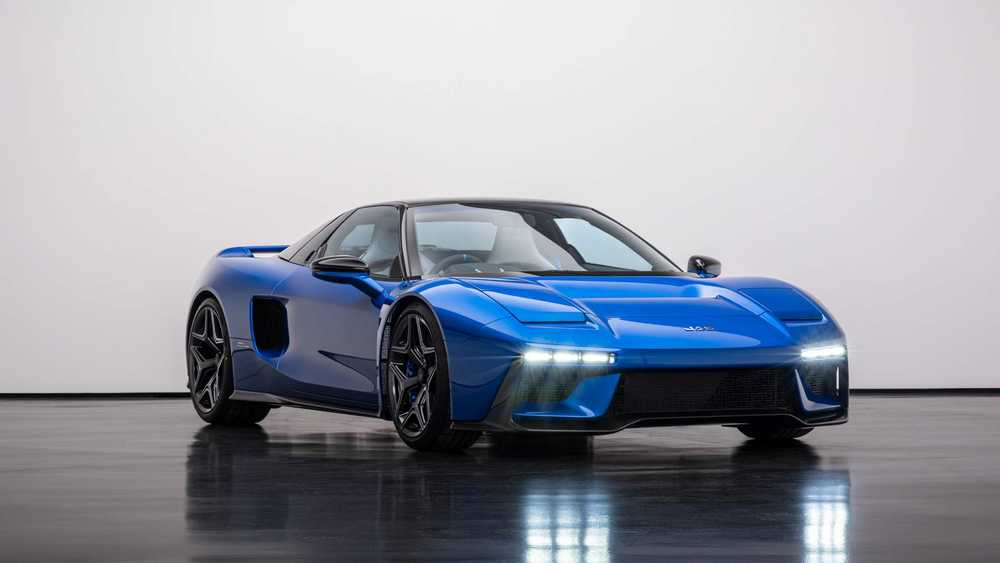
The modernized Acura NSX that Honda never built has arrived in the form of the Tensai, a reimagined version of the original NSX created by JAS Motorsport and Pininfarina. With a carbon body, redesigned styling and a heavily upgraded Honda V6, the Tensai combines the character of the original car with modern performance hardware.
A Reborn Acura NSX With a Carbon Body
Tensai means “rebirth” in Japanese, making the name a fitting description for the project. JAS Motorsport, the Italian racing team that has been running Honda efforts for nearly 30 years, worked with Pininfarina to create a modern interpretation of the original Acura NSX.
The project begins with an original 1990 NSX. Its chassis was laser-scanned before being reinforced with additional carbon-Kevlar elements around the pillars and center tunnel, providing the stiffness needed for modern tires and performance expectations.
Pininfarina redesigned the body while retaining the recognizable lines of the original NSX. The sharp character of the late 1980s design has been replaced by more rounded and sensual forms, highlighted by a deep blue finish.
The exterior also features a new interpretation of the NSX’s classic rear wing. The original side ducting remains, but it has been made deeper and more purposeful. Pininfarina also retained the pop-up front lamps, which now use LED lighting and a titanium mechanism rather than the larger lights fitted to the original car.
How Much Power Does the Tensai Have?
The Tensai’s engine was built by Judd Power, a British company with decades of experience building racing engines for IndyCar, F1 and other major racing series.
The project started with the original 3.0-liter Honda V6, but Judd increased the engine’s displacement to 3.5 liters. The factory C30A V6 produced 270 horsepower and had an 8,000-rpm redline.
Judd’s naturally aspirated version now produces 425 horsepower and can rev to 8,500 rpm. The engine uses a new crankshaft, new cams and titanium valves, although the original VTEC system was not carried over.
The upgraded engine is paired with a new Inconel exhaust and a six-speed manual transmission with a Torsen limited-slip differential.
Wider Stance and Modern Suspension
JAS Motorsport widened the original NSX by 6.7 inches at the front and 7.5 inches at the rear, giving the Tensai a more aggressive stance. The wheelbase has also been extended by 2.1 inches, allowing for shorter overhangs.
The suspension is completely new, featuring billet-machined aluminum suspension wishbones and a multi-link rear setup. Four-way adjustable KW shocks are fitted, while the suspension itself is fully adjustable.
The Tensai also receives a front lift system, bringing another feature associated with modern supercars to the reimagined NSX.
Carbon Ceramic Brakes and New Wheels
Braking performance has also been upgraded significantly. Brembo CCM-R carbon ceramic discs replace the factory units, while new center-lock wheels measure 19 inches at the front and 20 inches at the rear.
The larger wheels clear the upgraded brakes and are fitted with modern Pirelli tires.
A Completely Updated NSX Interior
Inside, JAS Motorsport says the cockpit design was inspired by an F-16. The interior brings a substantial visual update over the early 1990s Honda, using exposed carbon, full-grain leather and Alcantara.
The cabin also features new seats and a stripped-down steering wheel, completing the Tensai’s transformation of the original Acura NSX.
With its carbon body, 425-horsepower naturally aspirated V6, six-speed manual transmission and extensively redesigned chassis, the Tensai represents JAS Motorsport and Pininfarina’s modern reinterpretation of the original NSX.