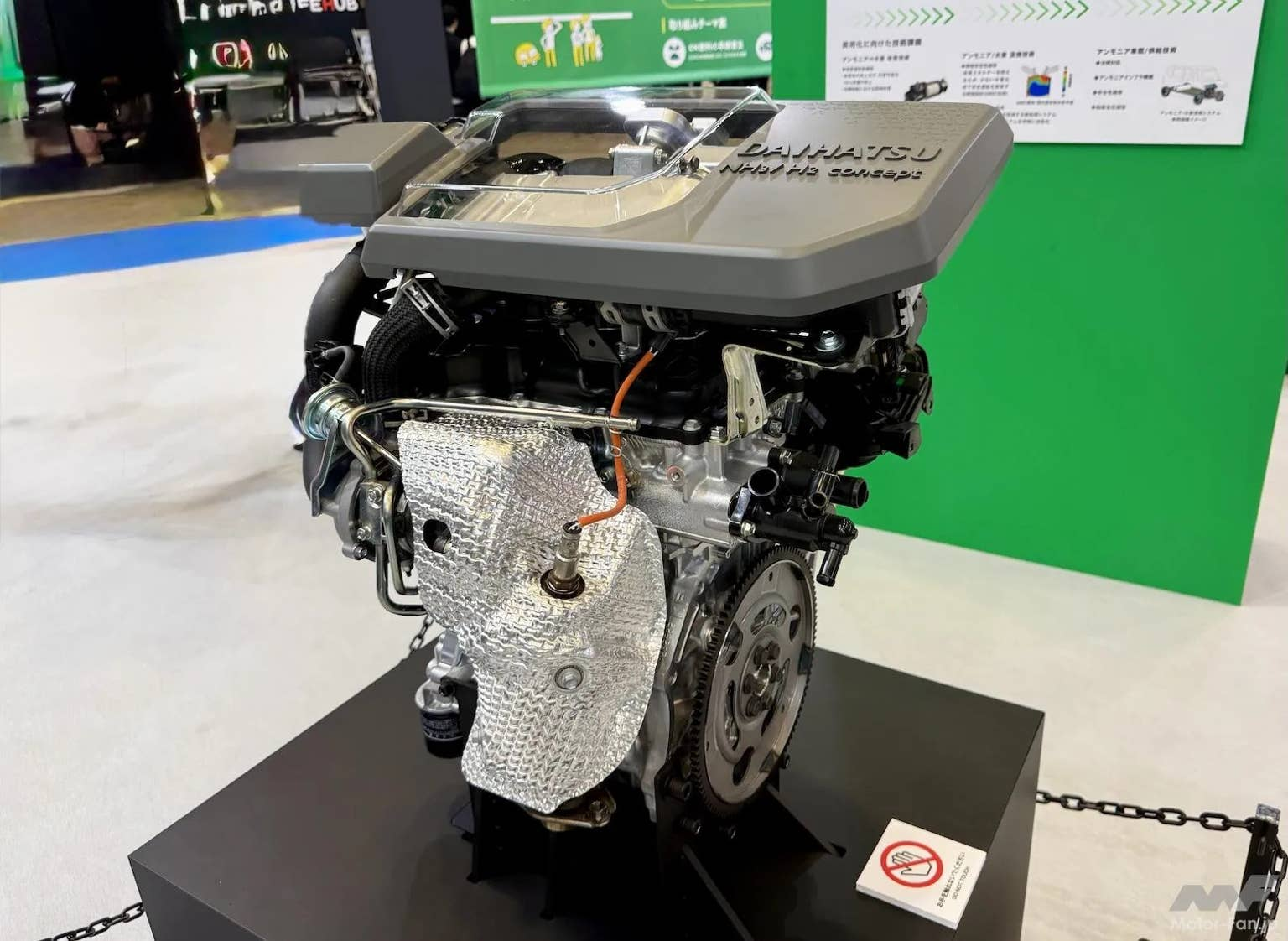
Toyota is exploring another approach to reducing carbon emissions through its multi-pathway strategy, with its subsidiary Daihatsu developing an ammonia- and hydrogen-powered engine designed for kei cars. Unveiled at the Japan Mobility Show 2026 Bizweek, the 658cc three-cylinder engine uses ammonia as its primary fuel while converting part of it into hydrogen to improve combustion.
Toyota’s Multi-Pathway Strategy Expands to Ammonia
Toyota has taken a different position from automakers focused primarily on electric vehicles, arguing that multiple technologies should contribute to the future of mobility. Rather than relying on a single solution, the Japanese automaker has introduced a multi-pathway approach aimed at developing and studying different internal combustion engine technologies.
One of the latest projects under this strategy explores ammonia as both a fuel and a supporting technology for hydrogen combustion. Toyota has assigned the project to Daihatsu, its smaller automaker, which is investigating whether the approach can work in a compact engine intended for kei cars.
How Daihatsu’s Ammonia-Hydrogen Engine Works
Ammonia is widely known for its pungent smell and agricultural applications. According to the source material, approximately 85% to 90% of all industrially produced ammonia worldwide is used to manufacture chemical fertilizers, including urea, ammonium nitrate and ammonium phosphate.
Daihatsu is investigating a different application. Its newly unveiled engine uses ammonia as the primary fuel while converting a portion of it into hydrogen to support combustion. The concept is based on a 658cc inline three-cylinder engine derived from a kei car powertrain.
According to a report by Motor Fan, ammonia is attracting attention as a potential energy carrier for a decarbonized society because it contains hydrogen and is easier to store and transport than hydrogen itself. Ammonia also contains no carbon, meaning its combustion does not directly produce carbon dioxide emissions.
A Built-In System Converts Ammonia Into Hydrogen
The engine’s design incorporates a hydrogen production system that uses part of the ammonia stored in the vehicle’s fuel tank. The system converts that ammonia into hydrogen, which is then used to improve the combustion process.
The hardware includes a small, square plasma reactor and a larger, rectangular catalytic reformer positioned above the engine. Together, these components support hydrogen production under different operating conditions.
The Daihatsu development team explained that electricity is used to produce hydrogen from ammonia during startup and at low temperatures. Once the system reaches a certain temperature, the catalytic reformer takes over and produces a larger flow of hydrogen.
Ammonia Combustion Presents Emissions Challenges
Despite the potential advantages of ammonia as a fuel, the developers acknowledge several challenges that must be addressed. One concern is the formation of nitrogen oxides during ammonia combustion.
Unburned ammonia presents another issue because it can produce nitrous oxide, a potent greenhouse gas. These emissions-related concerns remain important obstacles as the team evaluates the technology.
Engine Size Could Complicate Kei Car Applications
Packaging is another challenge facing the project. Although the test engine is derived from a kei car unit, the complete system, including the equipment needed to convert ammonia into hydrogen, may be too large to fit inside a kei car.
Daihatsu’s developers are continuing their testing to address these issues and determine whether the ammonia-hydrogen engine can become a viable production technology. The project represents another development under Toyota’s multi-pathway strategy, which explores alternatives to relying exclusively on electric vehicles.