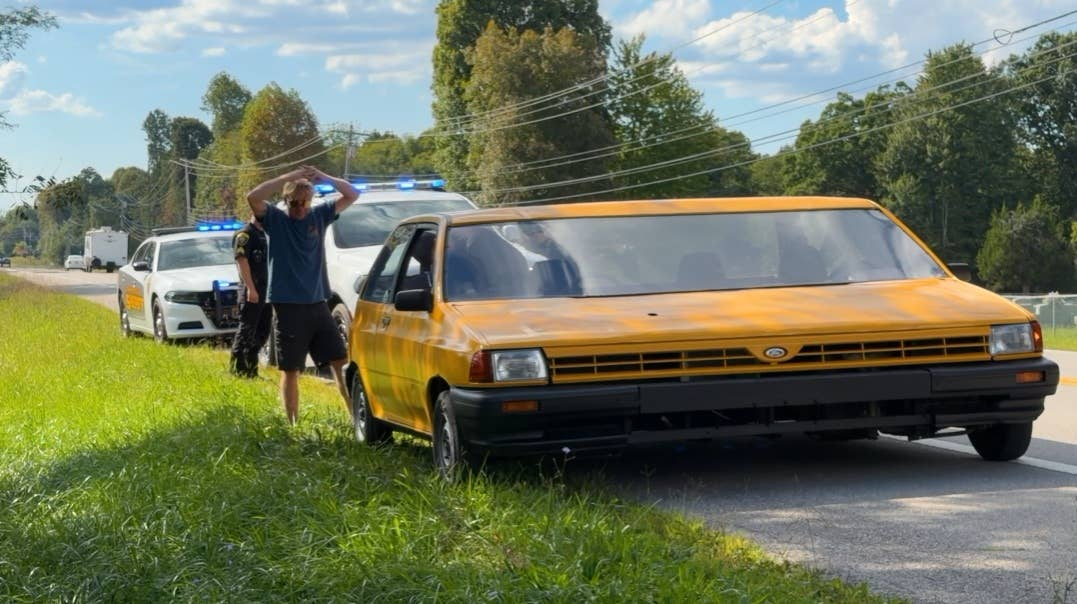
The world’s widest street-legal car is a heavily modified Ford Festiva measuring 120 inches wide. Built by combining three Ford Festivas, the unusual vehicle features extensive fabrication, laser technology, CNC machining and 3D printing. Despite its extraordinary dimensions, the car is registered with the DMV and legal to drive.
The project follows an earlier build of the world’s thinnest car. This time, the goal was to dramatically expand a small car’s width while retaining the ability to drive it on public roads, highways and even off-road terrain.
How the 120-Inch-Wide Ford Festiva Was Built
The builders dismantled three Ford Festivas and combined them to create the oversized vehicle. Using hand tools, CNC machines and 3D printers, they expanded the car from its original width of 63 inches to 120 inches.
The project involved cutting, fabricating and rebuilding the body to accommodate the additional width. The finished vehicle was designed to look cohesive despite its unusual proportions.
The car is registered with the DMV and legal to drive. During testing, police officers stopped the vehicle, but the builders presented their documentation and continued driving.
How Wide Is the World’s Widest Street-Legal Car?
The first-generation Ford Festiva measures approximately 63 inches wide, making the modified version nearly twice as wide as the original car.
At 120 inches, the custom Festiva is more than one-third wider than a Ford F-150 and approximately 14 inches wider than a Ford F-450 when its mirrors are included.
The vehicle approaches the stated legal width limit for ordinary road travel. The maximum is 8.6 feet, while special permits allow vehicles measuring 10 feet wide to travel on public roads.
Any further increase in width would require a pilot car and pre-approved routes.
Driving the Oversized Festiva Requires Two People
The car’s extreme width presents challenges behind the wheel. Steering requires two people, adding another unusual feature to a vehicle that differs significantly from a standard Ford Festiva.
Despite those challenges, the builders took the car onto the highway and drove it off-road. The vehicle also features 14 extra-large cup holders, an addition highlighted alongside its struggling air conditioning.
Lasers, Welding and 3D Printing Made the Build Possible
The construction process began with lasers used to align the car’s centerline before the vehicle was cut in half. The builders then welded and fabricated additional sheet metal to create the expanded structure.
Attention to detail was essential to making the unusual design look intentional. Extending a vehicle’s width is one challenge, but ensuring that the finished body looks cohesive requires carefully designed components.
The project incorporated 3D-printed parts for the dashboard, grille and body panels. These components helped create a consistent appearance, making the vehicle look as though its oversized proportions had been part of the original design.
The builders also used a laser welder instead of conventional gas welding, adding another specialized technique to the construction process.
A Ford Festiva Transformed Into an Oversized Road Car
The finished vehicle combines three Ford Festivas, extensive metal fabrication and modern manufacturing techniques to create a 120-inch-wide car. Despite its unconventional dimensions and two-person steering requirement, it is registered with the DMV and has been driven on public roads, highways and off-road terrain.