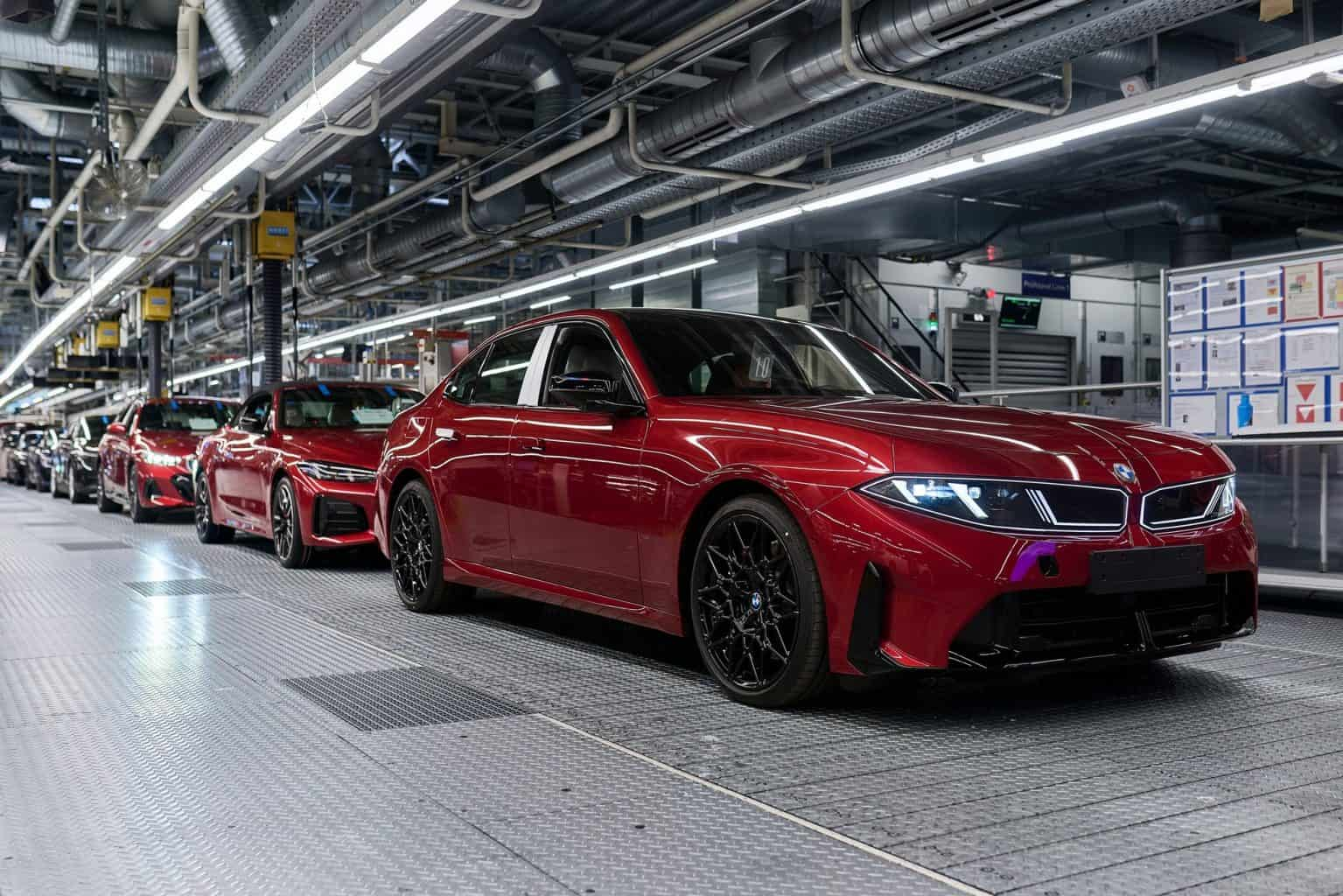
BMW has started production of the eighth-generation 3 Series at its Dingolfing plant in Germany, bringing the iconic sports sedan back to a factory that has helped build the model for nearly half a century. The new generation marks another chapter in the facility’s history, while introducing significant changes to the 3 Series lineup, including the end of diesel-powered models.
BMW 3 Series Production Returns to Dingolfing
The BMW 3 Series has been a familiar presence at the Dingolfing factory in Lower Bavaria since 1980, five years after the original E21 debuted. Over the past 46 years, the plant has assembled approximately 1.15 million examples of the model, although production was interrupted during certain generations.
Dingolfing built some versions of the E30, E36 and E46, as well as the unusual 3 Series Gran Turismo (F34) five-door liftback. Neither the E90 nor the G20 generation was produced at the facility.
In 2026, production returned with the eighth-generation 3 Series at BMW’s largest European manufacturing facility, which employs approximately 18,000 people.
BMW Splits New 3 Series Production Between Two Plants
Dingolfing will not build every version of the new 3 Series. BMW has divided production between two German locations, with combustion-powered models assigned to Dingolfing and the fully electric i3 scheduled for production in Munich.
The new 3 Series joins an extensive lineup at Dingolfing that includes the 4 Series, 5 Series and 7 Series, along with their respective M variants.
The factory also produces the BMW iX, although reports suggest the electric SUV could be discontinued in 2028. BMW has already retired the iX from the U.S. market. Until a few months ago, Dingolfing also assembled the 8 Series.
New BMW 3 Series Engines and the End of Diesel
The new 3 Series initially launches with four-cylinder and six-cylinder gasoline engines. More affordable versions use four-cylinder powertrains, while the range-topping M350 xDrive features a 3.0-liter inline-six.
BMW plans to expand the lineup next year with a plug-in hybrid, but diesel engines will no longer be offered.
For the first time since 1985, BMW will not offer a diesel-powered version of its iconic sports sedan. The G50 becomes only the second 3 Series generation without a diesel engine, following the original E21.
That leaves the outgoing G20 potentially as the last diesel-powered 3 Series generation.
Next-Generation BMW M3 Expected in 2028
The M350 xDrive will not be the only new 3 Series model powered by an inline-six. BMW is developing the next-generation M3, internally designated G84, with an expected arrival in 2028.
Rather than adopting the heavier plug-in hybrid setup used by the M5, the upcoming M3 is reportedly being developed with an updated twin-turbocharged 3.0-liter S58 engine paired with 48-volt mild-hybrid technology.
The electrification is intended to help the six-cylinder engine meet increasingly stringent emissions regulations without adding the considerable weight associated with a larger battery.
BMW 3 Series Touring and M3 Wagon Could Follow
Dingolfing is also expected to produce the more practical G51 3 Series Touring, which should follow the sedan later this decade.
The long-roof model is expected to retain combustion engines, although BMW has so far only committed to building a fully electric i3 Touring in Munich.
If BMW approves the combustion-powered 3 Series wagon, it could also lead to another gasoline-powered M3 Touring, internally known as the G88.
Dingolfing Production Figures
BMW’s Dingolfing plant assembled 279,553 vehicles in 2025, a 6.1% decline from the previous year. The facility ranked as BMW’s fourth-largest production site, behind Spartanburg, Dadong and Regensburg.
The factory produces approximately 1,350 vehicles per day. Alongside its regular model lineup, Dingolfing also assembles the armored 7 Series Protection.
With the eighth-generation 3 Series now entering production, Dingolfing continues its longstanding role in building BMW’s iconic sports sedan, while the next generation of combustion-powered and electrified models takes shape across the company’s German manufacturing network.